Clarinet
Unknown
late 19th century · Wood, brass · Musical Instruments
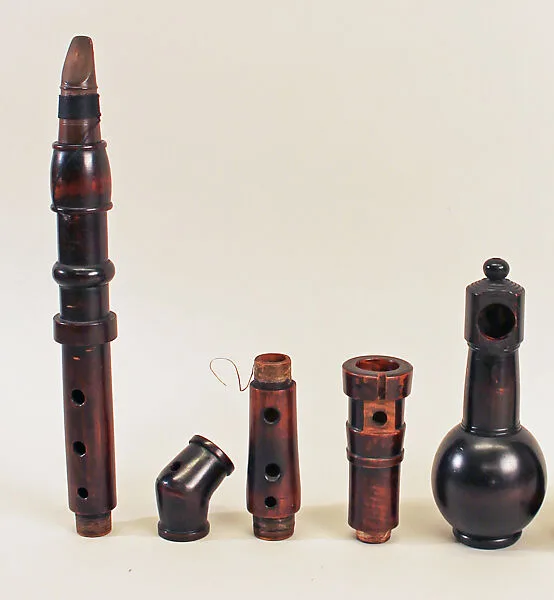
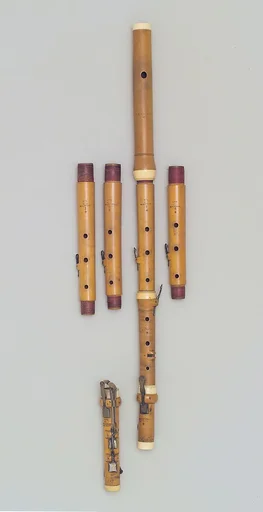
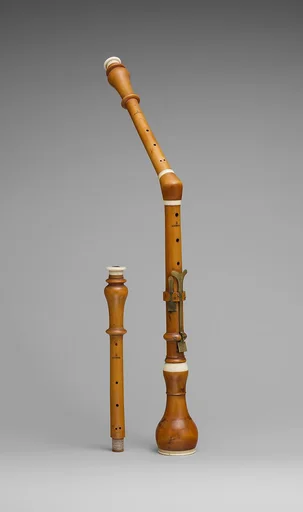
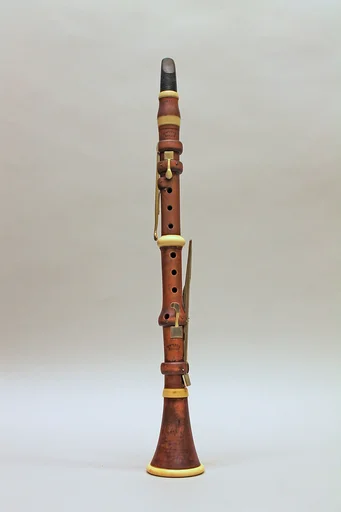
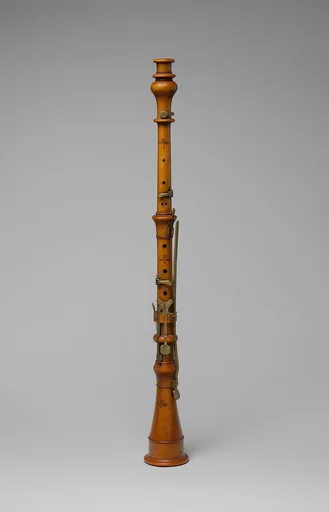
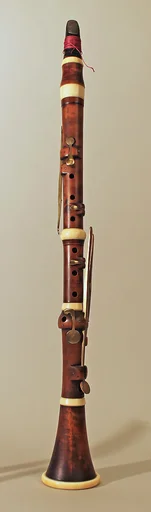
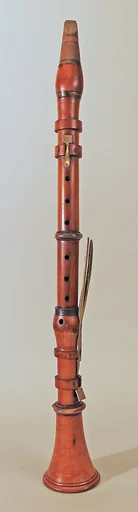
It is impossible to say whether these joints are intended to be assembled to a musical instrument. It may have been an attempt to reconstruct Stadler’s basset clarinet after the description given in ‘Wiener Kunstnachrichten’. Journal des Luxus und der Moden, 16 (October 1801), because it has a knee, a "Querrippe" and a "Liebesfuss". These may be parts of an experimental instrument or just parts which cannot be assembled to an instrument. The "upper section" would miss the key for throat A. The "knee" would miss a key for C♯4/G♯5. The tone-hole on the "knee" has to be on the upper part of this section. There is a middle section for the fingers of the left hand. A section for the basset keys and the tone hole for F3/C♮5 would be missing. It is a piece of decoration rather than a musical instrument. Technical description: Stained boxwood (?) with one brass key. Seven pieces: mouthpiece, barrel, upper section, knee, middle section, lower section, bell (Liebesfuss). Mouthpiece a later addition. Upper section with speaker key. No speaker liner. Knee with a tone hole for C♯4/G♯5. Middle section with the tone holes for L1, L2, and L3. Lower section with one tone hole for a key. (Heike Fricke, 2014)
- Artist
- Unknown
- Date
- late 19th century
- Medium
- Wood, brass
- Culture
- Probably French
- Department
- Musical Instruments
- Credit line
- The Crosby Brown Collection of Musical Instruments, 1889