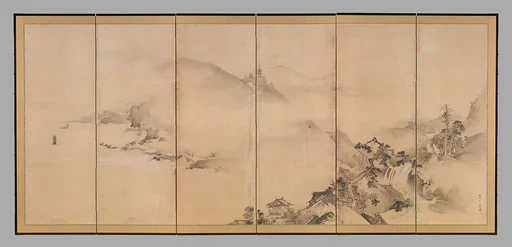
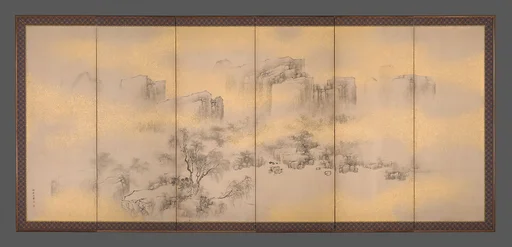
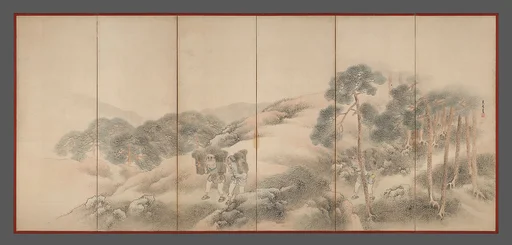
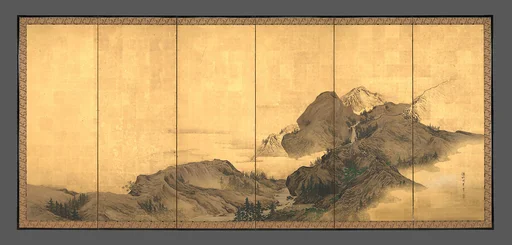
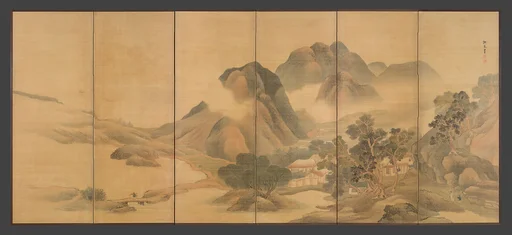
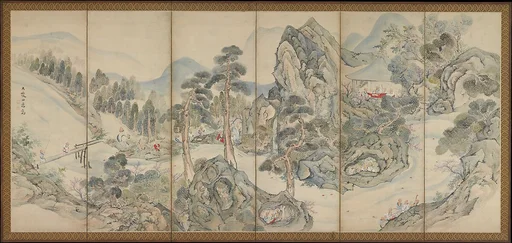
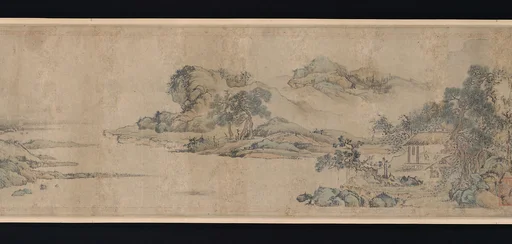
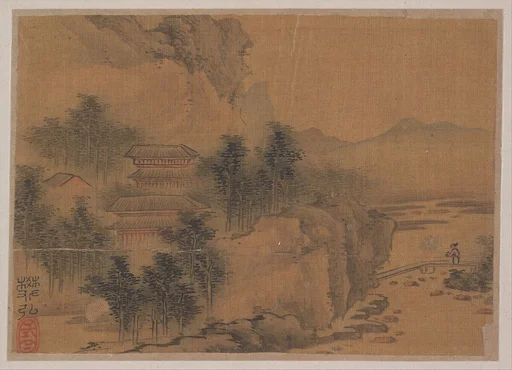
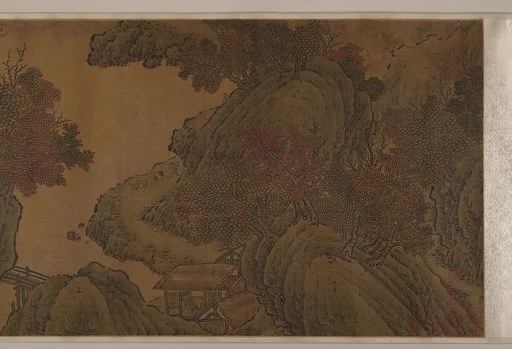
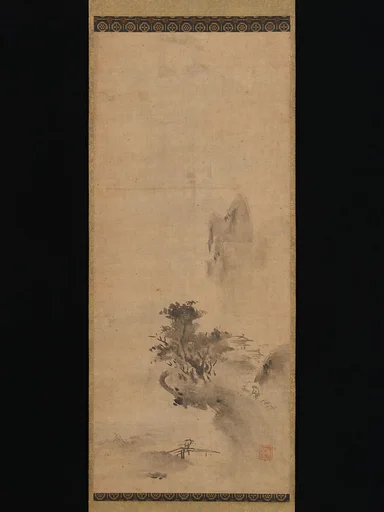
伝天章周文筆 山水図屏風|Mountain Landscape
Tenshō Shūbun
early–mid-15th century · Pair of six-panel folding screens; ink and color on paper · Asian Art
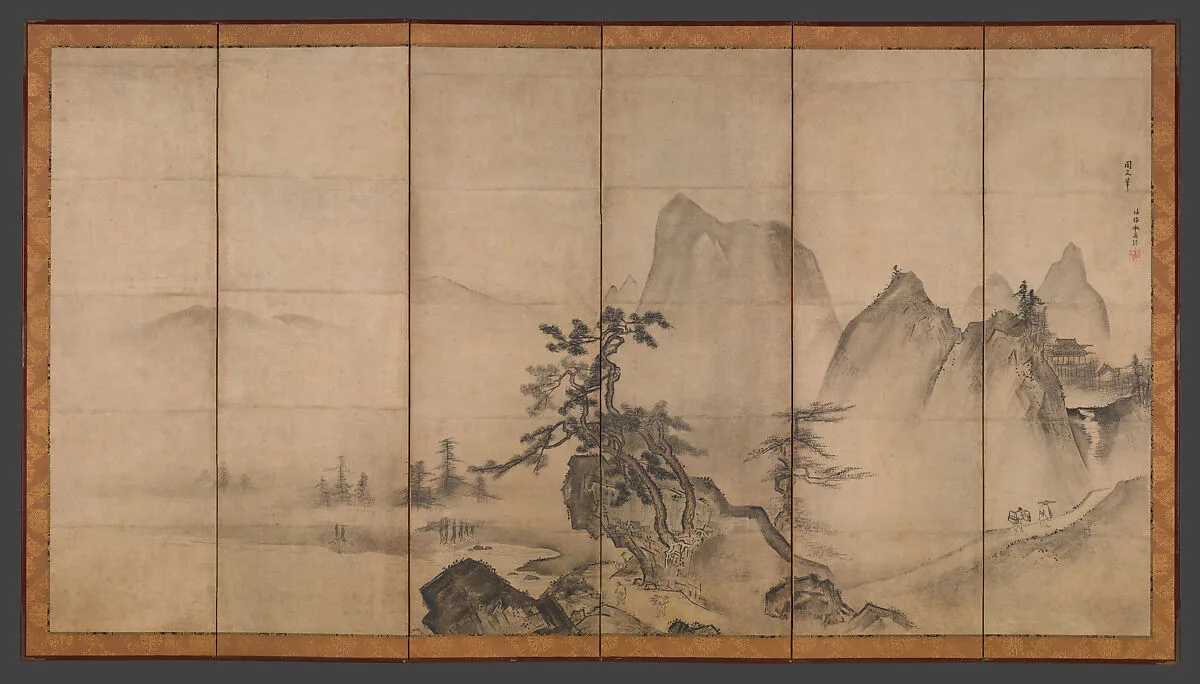
In late medieval Kyoto, cultural elites in the circle of the Ashikaga shoguns were especially interested in Chinese ink paintings. They voraciously collected works by Chinese masters and commissioned Japanese painters to create works in the style of their Chinese forebears. The compositions that make up this pair of screens are inspired by the Southern Song Chinese court painter Xia Gui (active ca. 1195–1230), whose works were highly prized in medieval Japan. Rock forms described with thick contour lines, textured by “axe-cut” brushstrokes and accented with “moss dots,” as well as paired foreground trees were immediately recognizable to the Japanese audience as elements of Xia Gui–style painting. Although later inscriptions by the painter Kano Yasunobu (1614–1685) name the original artist as the Kyoto painter Tenshō Shūbun, the paintings were not actually created as a pair. Rather, they are a later combination of two separate works, both by artists active shortly after Shūbun.
- Artist
- Tenshō Shūbun
- Date
- early–mid-15th century
- Medium
- Pair of six-panel folding screens; ink and color on paper
- Culture
- Japan
- Department
- Asian Art
- Credit line
- Mary Griggs Burke Collection, Gift of the Mary and Jackson Burke Foundation, 2015