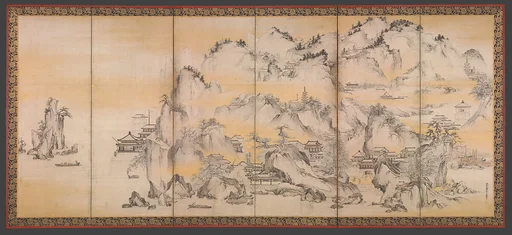
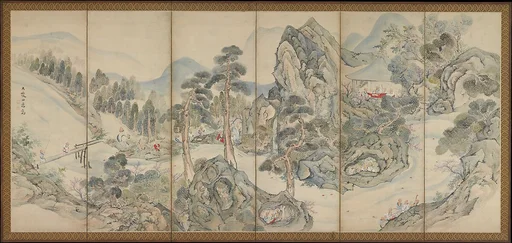
森周峰筆 楼閣山水図屏風|Landscape with Pavilion
Mori Shūhō
early 19th century · Pair of six-panel folding screens; ink, color, gold flecks, and gold leaf on paper · Asian Art
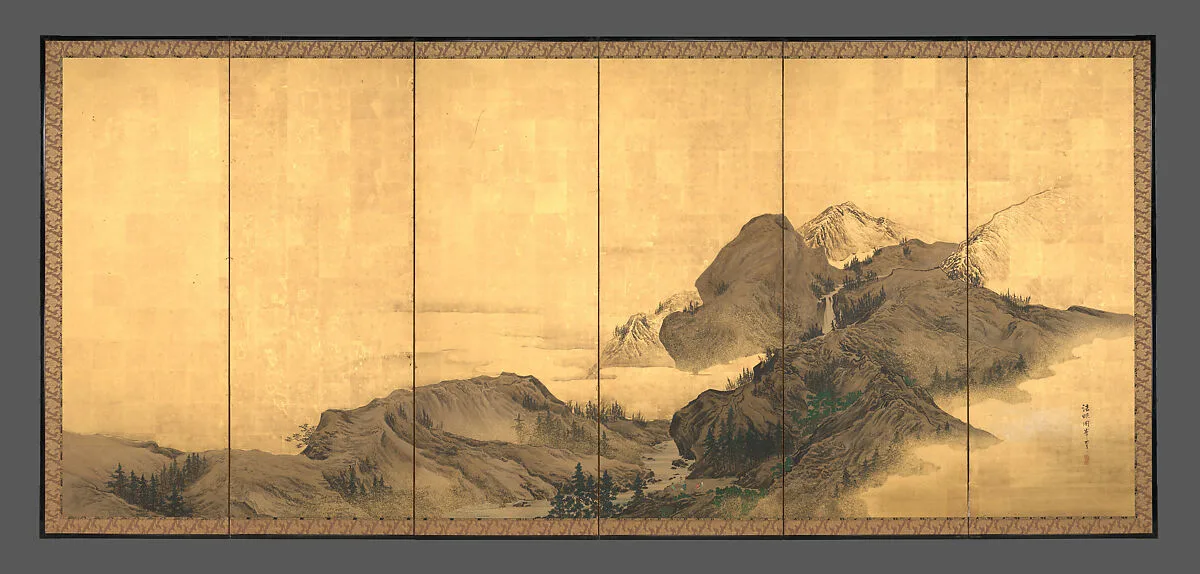
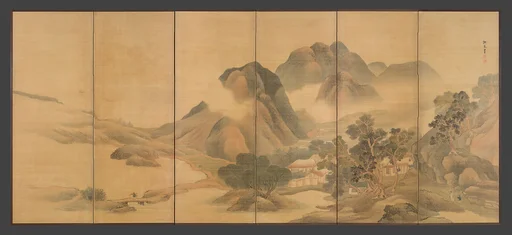
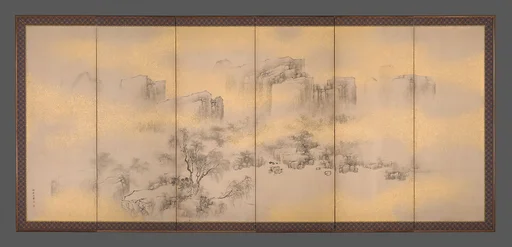
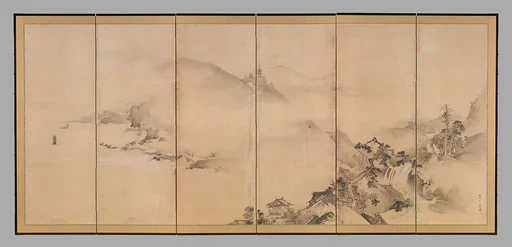
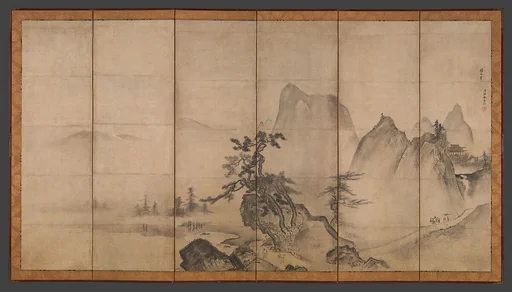
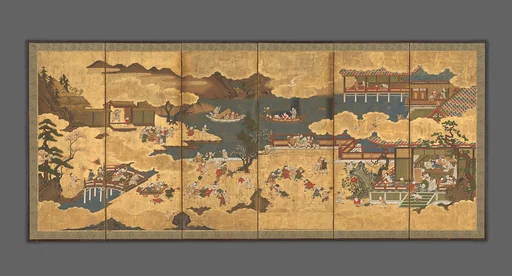
This pair of screens depicts an imaginary scene in China, with a waterfall and lake set among craggy mountains. On the right screen, three Chinese gentlemen-scholars enjoy tea. The left screen features a sumptuous mansion with covered corridors; a pavilion stands atop stone masonry. Scholars sit within the pavilion, while the lady of the house and two maidservants can be seen in other parts of the building. More scholars approach the house on foot and by boat. The artist, Mori Shūhō, was the elder brother of the better-known Mori Sosen (1747–1821), a renowned painter of monkeys. Shūhō incorporated the orthodox Kano style of painting (evident in the linear brush technique) with newly learned Western elements like the low-lying foreground, which creates a strong sense of distance. Such divergent features forecast the complex developments that were to characterize artistic movements of the nineteenth century immediately following Shūhō’s death.
- Artist
- Mori Shūhō
- Date
- early 19th century
- Medium
- Pair of six-panel folding screens; ink, color, gold flecks, and gold leaf on paper
- Culture
- Japan
- Department
- Asian Art
- Credit line
- Gift of Rosemarie and Leighton Longhi, 2001