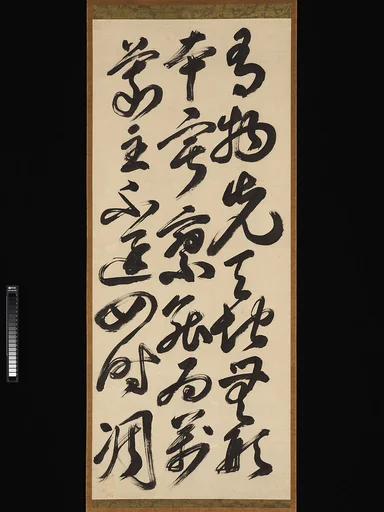
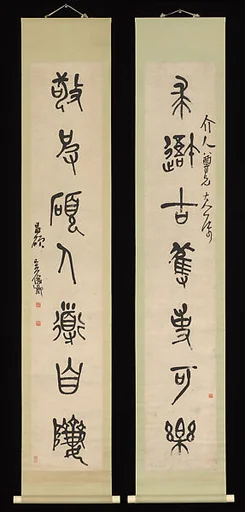
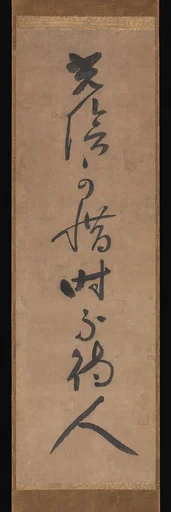
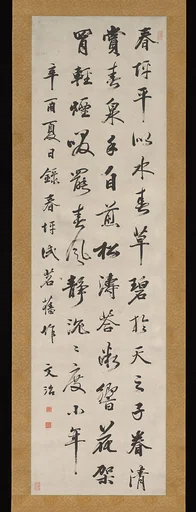
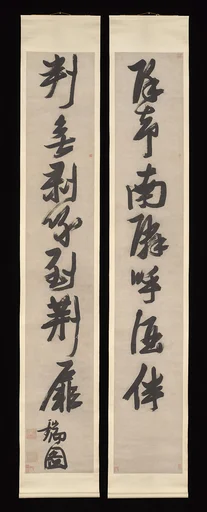
富岡鉄斎書 文天祥衣帯贊|Wen Tianxiang’s Death Poem Inscribed on his Belt
Tomioka Tessai 富岡鉄斎
ca. 1870 · Hanging scroll; ink on paper · Asian Art
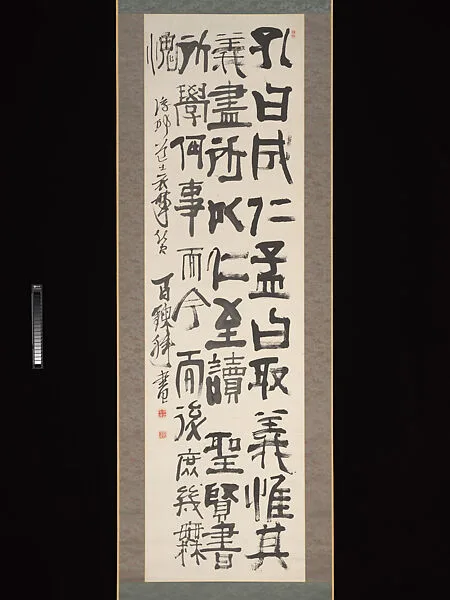
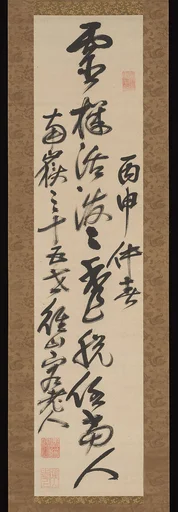
Tomioka Tessai, the great Literati painter and calligrapher of modern Japan, exuberantly brushed three columns of large Chinese characters in archaic clerical script, with thick and straight brushstrokes. But he played with the proportions of each graph and with their spacing to create a novel effect. Clerical script, a formal script used in ancient China for important documents and stone-carved monuments, adds to the solemnity and grandeur of the text. The large size of some of the characters also adds to their impact, commanding the viewer's attention. Overall, the inscription exudes a sense of majesty and dignity. Tessai is transcribing a poem originally composed by Wen Tianxiang (1236–1283), a famous Chinese scholar and official during the late Song and early Yuan dynasties. He is known for his loyalty to the Song dynasty and his resistance against the invading Mongols. He was captured and tortured by the Mongols but refused to surrender and died in prison. The poem was said to have been written on his belt in prison, expressing his devotion to Confucian philosophy as a Song loyalist. It can be transcribed and translated as follows: 孔曰成仁孟曰取義 惟其義盡所以仁至 讀聖賢書所学何事 而今而後庶幾無愧 Confucius said become benevolent, Mencius said practice righteousness. Only by doing things righteously can one acquire benevolence. So what have I gleaned from these sages' writings? From now on I truly hope that I will have no regrets. (Translated by Tim Zhang)
- Artist
- Tomioka Tessai 富岡鉄斎
- Date
- ca. 1870
- Medium
- Hanging scroll; ink on paper
- Culture
- Japan
- Department
- Asian Art
- Credit line
- Mary and Cheney Cowles Collection, Gift of Mary and Cheney Cowles, 2022