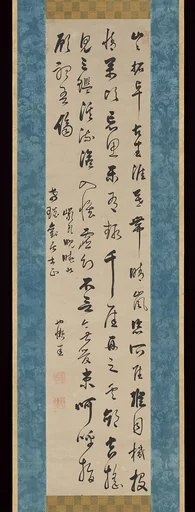
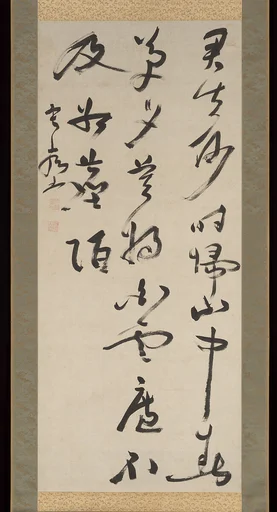
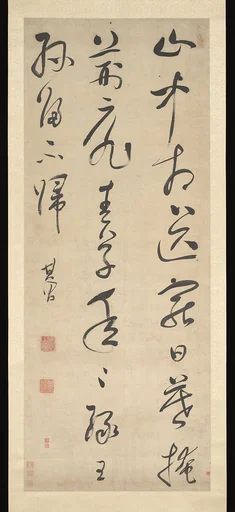
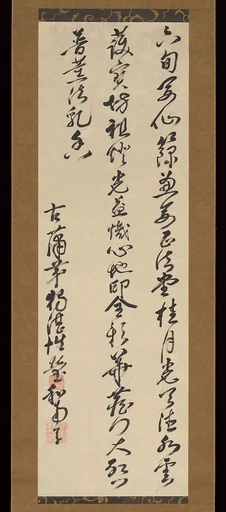
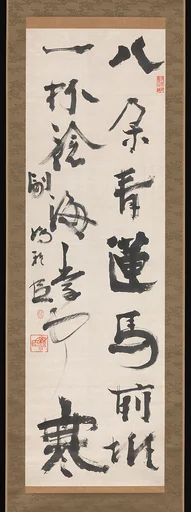
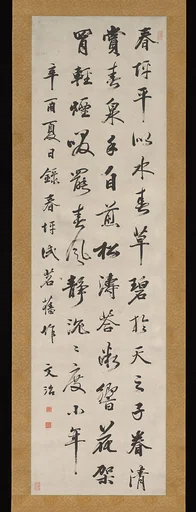
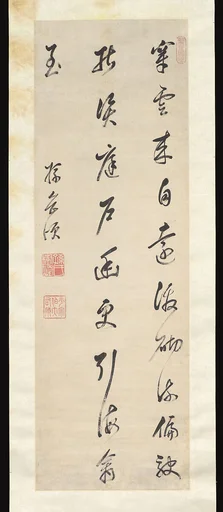
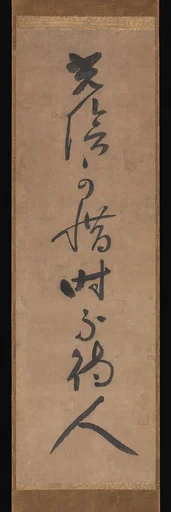
「霊機」 十字一行 (Reiki jūji ichigyō)|Couplet of Chinese Verse on Spiritual Enlightenment
Feiyin Tongrong
1656 · Hanging scroll; ink on paper · Asian Art
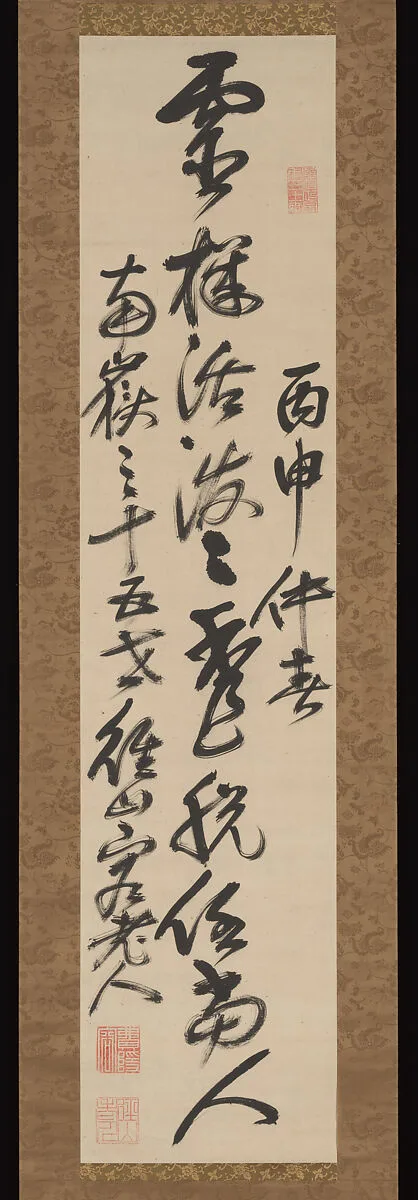
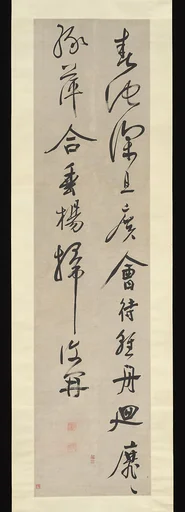
This single-column of dynamic, rapidly and fluidly brushed, faintly angled Chinese characters in cursive script comprises a Buddhist adage, composed in a couplet of five-character verse. It can be deciphered and translated as follows: 霊機活潑〻 透脱任當人 Chinese pronunciation: Lingji huopopo, toutuo rendang ren Parsing in Japanese: 霊機、活スルコト潑潑タリトモ、 透脱ハ當人ニ任サルル. A surge in inspiration with untrammeled vitality— Enlightenment depends on each person’s own efforts. (Translated by Tim Zhang) The term lingji (Japanese: reiki) 霊機 suggests inspired wisdom and in early Daoist texts has the connotation of a supernatural experience. In Chan teaching, enlightenment is something that each person must strive for through their own diligent religious practice including meditation and study with a master. The characters in the right column, unusually written in characters as large as the main text, give the date the work was brushed: mid-spring of the bingshen year (1656). On the left, also in large characters, is the monk Feiyin Tongrong’s lengthy signature, mentioning that he composed this work while at Jingshan monastery in Hangzhou. Feiyin is declaring in this his signature that he belongs to the thirty-fifth generation of the Nanyue sect.
- Artist
- Feiyin Tongrong
- Date
- 1656
- Medium
- Hanging scroll; ink on paper
- Culture
- Japan
- Department
- Asian Art
- Credit line
- Mary and Cheney Cowles Collection, Gift of Mary and Cheney Cowles, 2021