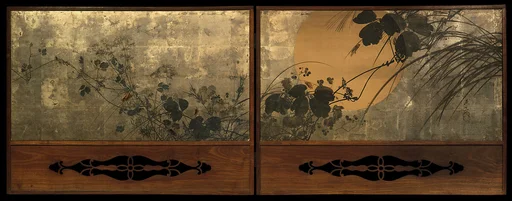
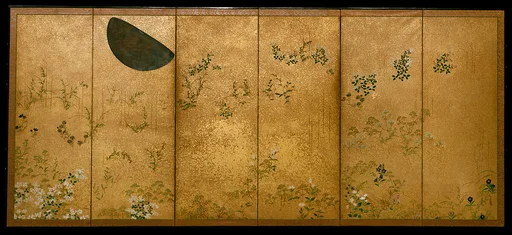
武蔵野図屏風|The Plains of Musashi
Unknown
17th century · Six-panel folding screen; ink, color, gold, silver, and gold leaf on paper · Asian Art
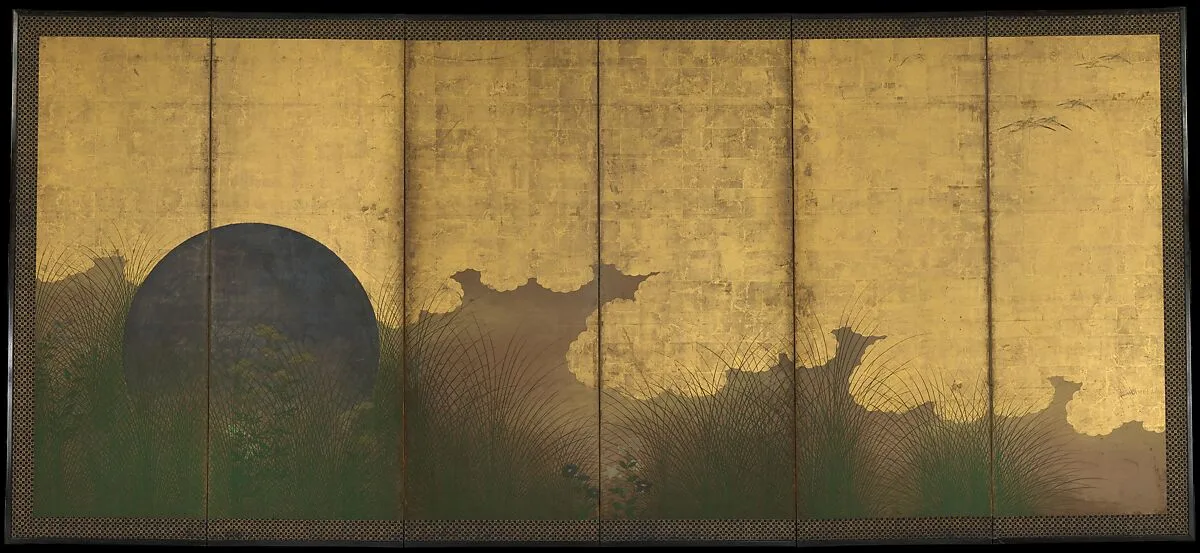
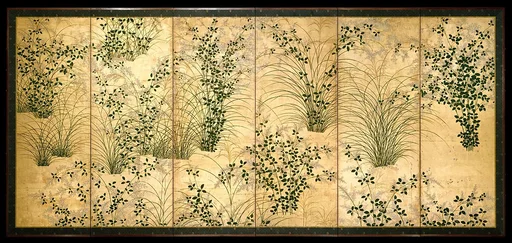
A full moon, once silver but now blackened by age, appears on an unobstructed horizon between a background of golden clouds and a foreground frieze of grasses and autumnal wildflowers: yellow maidenflower, blue and white Chinese bellflower, purple agrimony, and wild chrysanthemum. A queue of descending geese (perhaps a later addition) at upper right conveys the vastness of the grassy plain. These pictorial motifs are associated with the once-wild plain of Musashi, now a densely populated area of North Tokyo. Since the tenth century, Musashi has usually been associated with autumn. The tradition underlying this image began in a poem by Minamoto no Michikata (1189–1238): Musashino wa tsuki no irubeki mine mo nashi obana ga sue ni kakaru shirakumo The plains of Musashi have no mountain peaks into which the moon can slip, as white clouds enshroud spears of plume grasses. —Trans. John T. Carpenter
- Artist
- Unknown
- Date
- 17th century
- Medium
- Six-panel folding screen; ink, color, gold, silver, and gold leaf on paper
- Culture
- Japan
- Department
- Asian Art
- Credit line
- Purchase, Mary Livingston Griggs and Mary Griggs Burke Foundation Gift, 1967