Marsyas
Unknown
19th century, cast after a 15th century composition · Bronze, mounted on an ancient architectural fragment · European Sculpture and Decorative Arts
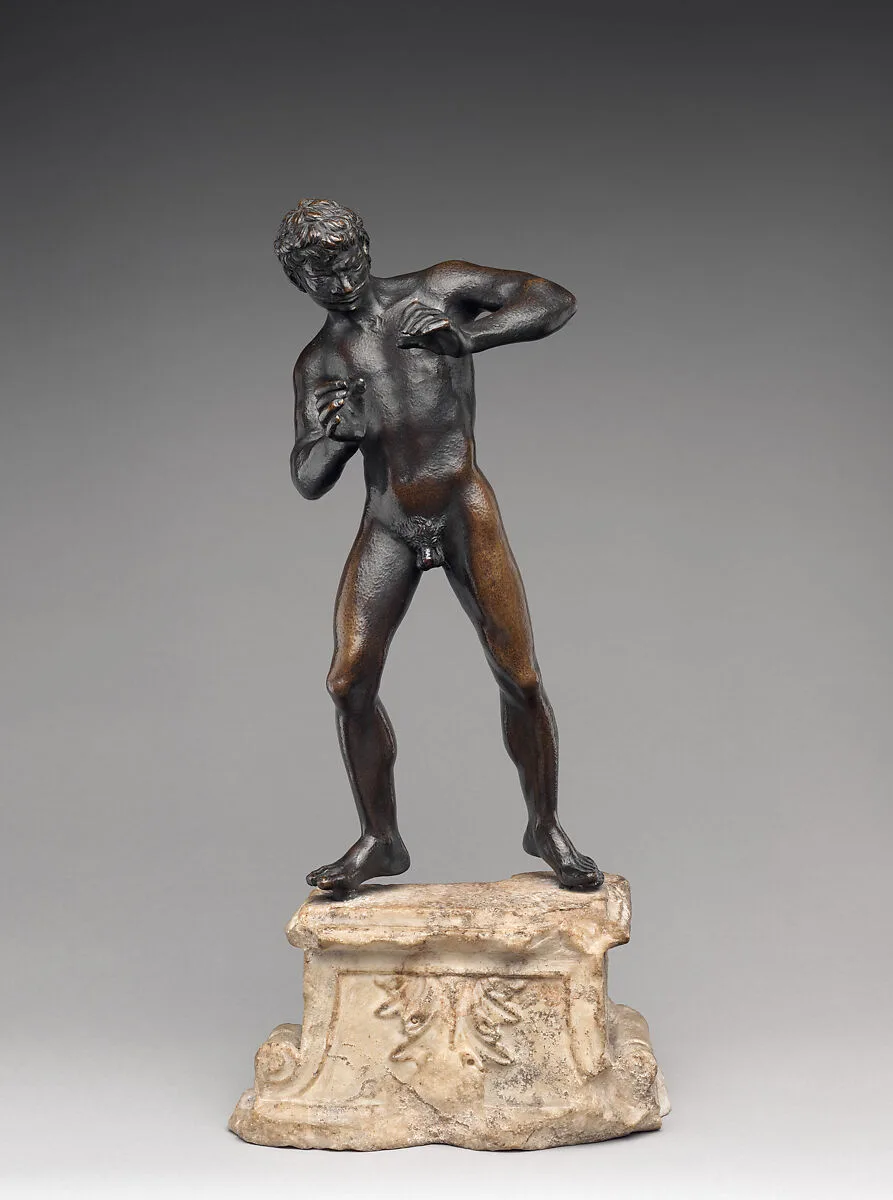
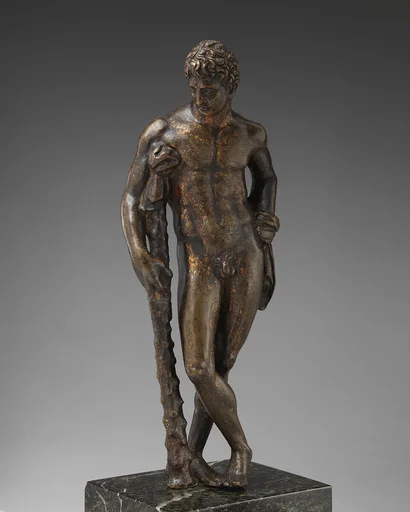
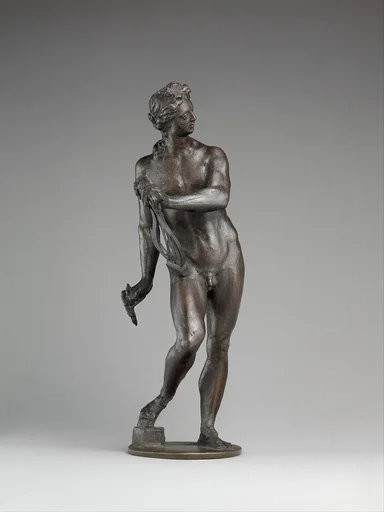
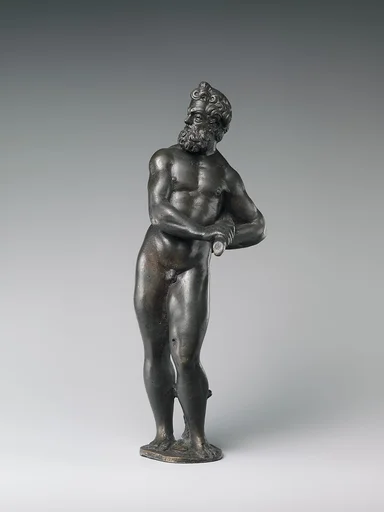
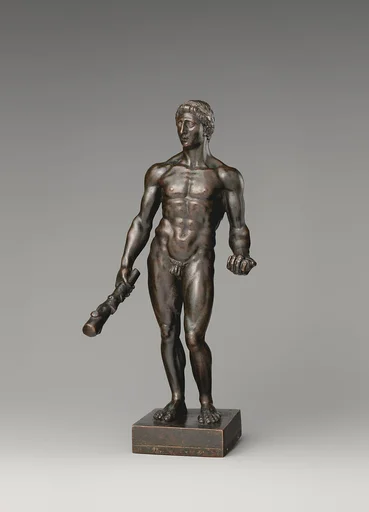
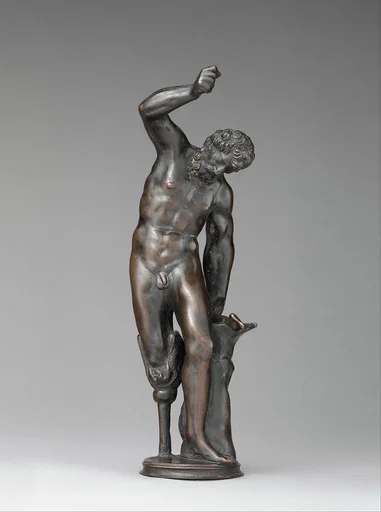
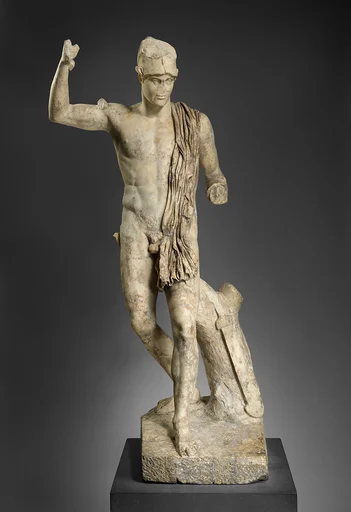
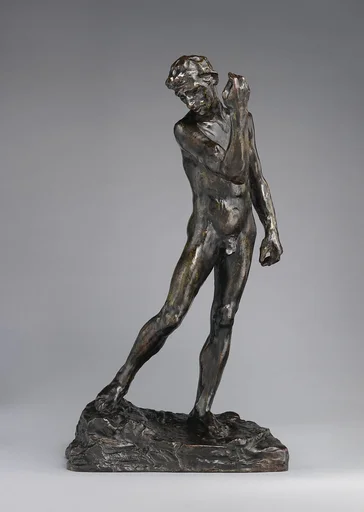
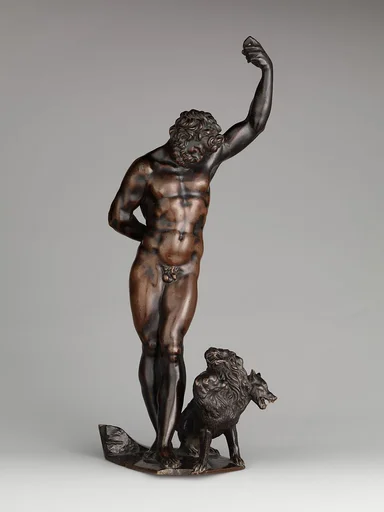
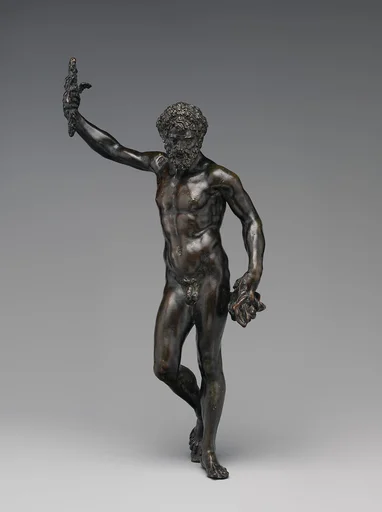
The figure, while not a satyr (no tail), is meant to be Marsyas, Apollo’s foe, playing double panpipes (now lost), which were secured by the leather strap at his mouth. It derives from an ancient composition widely copied since the fifteenth century. The Medici owned bronze examples, one called the “Nude of Fear” (Ignudo della Paura), no doubt seen as a representation of that emotion because it seemed caught in the act of recoiling.[1] There is no consensus on a small host of reproductions that run a wide gamut in composition and facture. Some have prompted ambitious attributions. John Pope-Hennessy ventured to assign the most sculptural piece—a vital, rangy example now in the Bargello—to Donatello himself, and Verrocchio has also been wrongly proposed.[2] The best of a wirier type with fuller hair are in the Bargello and the Galleria Estense, Modena.[3] Our specimen, derived from another model in the Bargello and like it also sometimes labeled Pollaiuolo,4 does not measure up to any of these. While it has figured in prestigious collections and exhibitions, Anthony Radcliffe rightly warned (orally) against quattrocento origins. One saw what he meant as soon as he spoke, and the piece has not been exhibited since. The back muscles are impossibly twisted and grooved, and the whole surface was systematically but inarticulately and monotonously hammered over. No patina has built up. -JDD Footnotes (For key to shortened references see bibliography in Allen, Italian Renaissance and Baroque Bronzes in The Metropolitan Museum of Art. NY: The Metropolitan Museum of Art, 2022.) 1. Müntz 1888, p. 79. 2. Pope-Hennessy 1977; Ciaroni 2007, no. 24. 3. Bode and Draper 1980, pls. XCV, XCVI. For the many pictorial uses to which the model was put, see Middeldorf 1958. 4. See Ragghianti Collobi 1949, p. 52, cat. 15, and letters of expertise from Leo Planiscig in 1950 supporting the Pollaiuolo attribution (ESDA/OF).
- Artist
- Unknown
- Date
- 19th century, cast after a 15th century composition
- Medium
- Bronze, mounted on an ancient architectural fragment
- Culture
- probably Italian
- Department
- European Sculpture and Decorative Arts
- Credit line
- Gift of C. Ruxton Love Jr., 1963