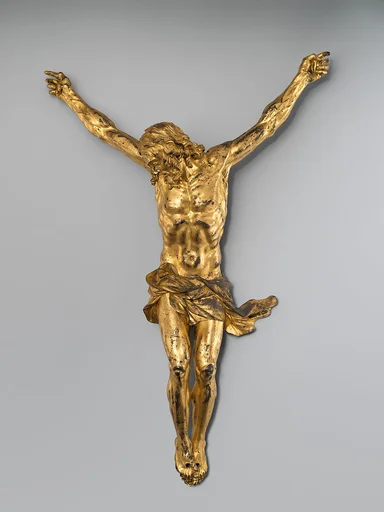
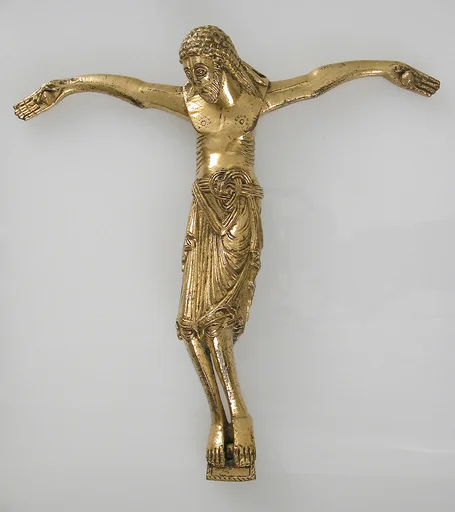
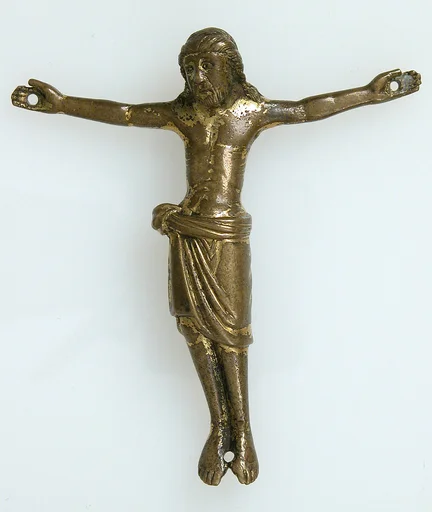
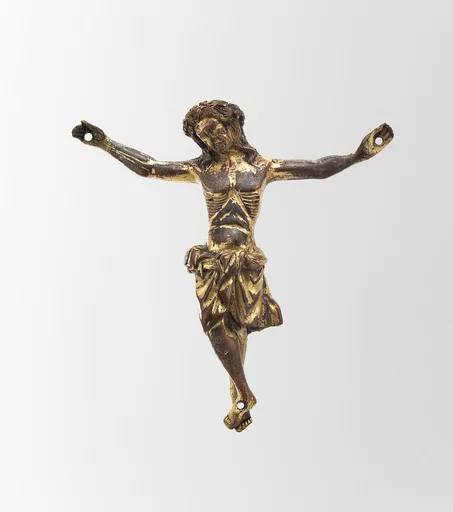
Corpus from a crucifix
Unknown
18th century · Bronze, fire-gilt; silver · European Sculpture and Decorative Arts
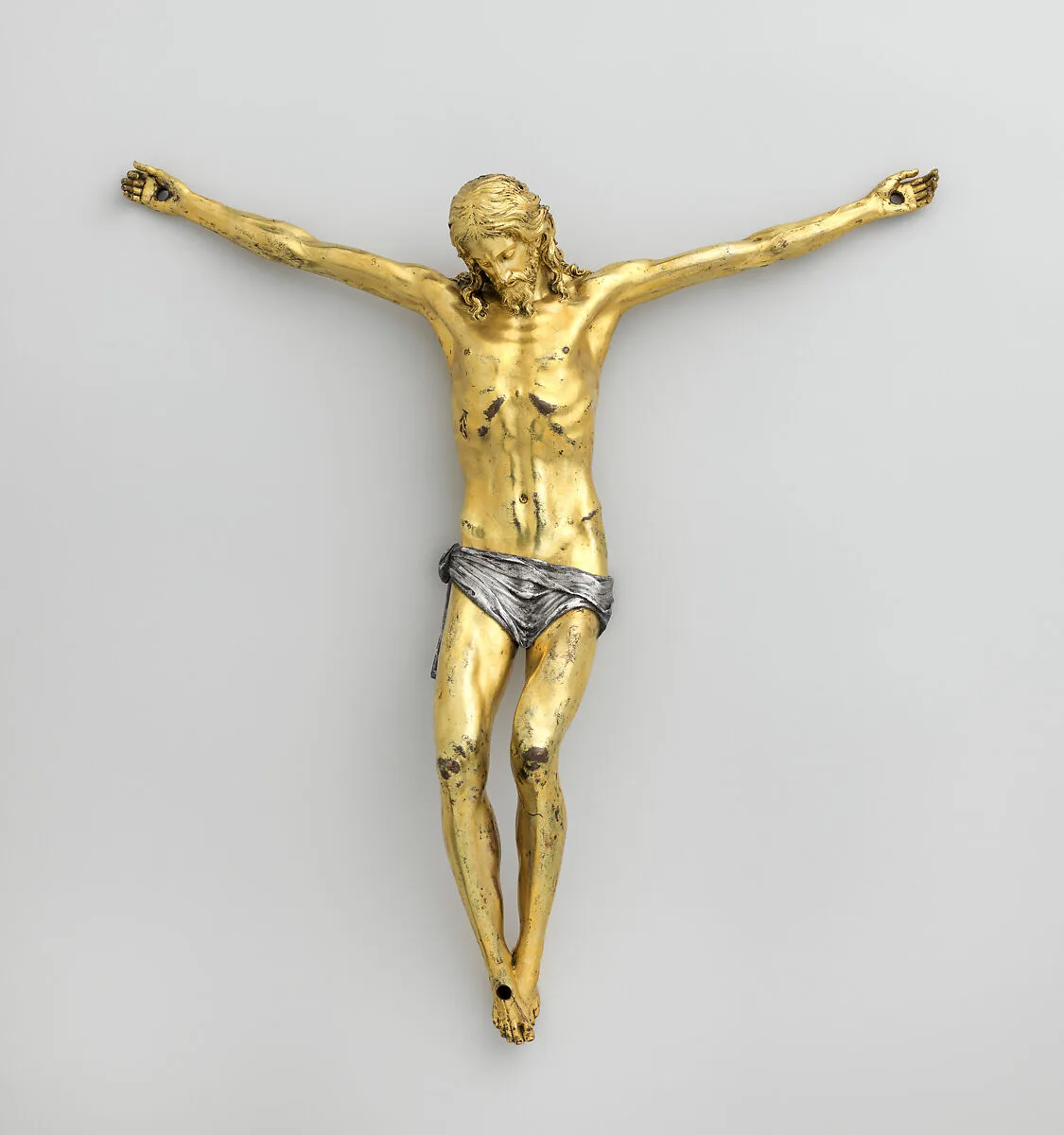
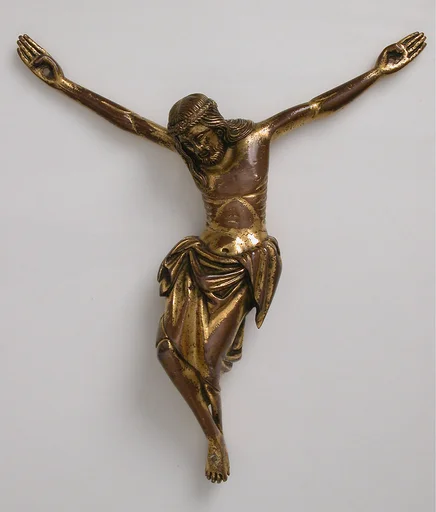
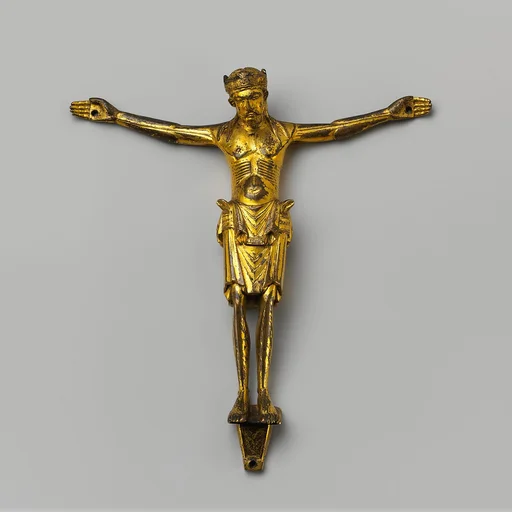
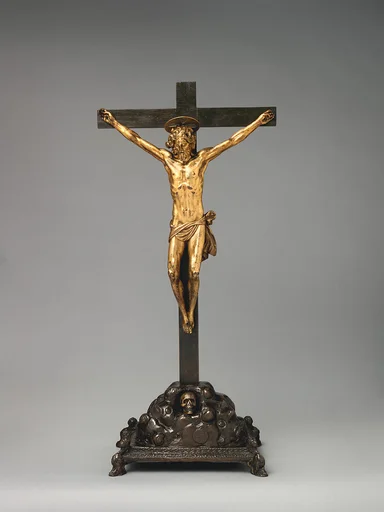
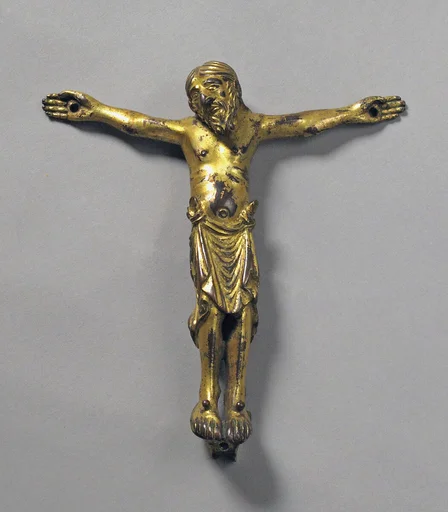
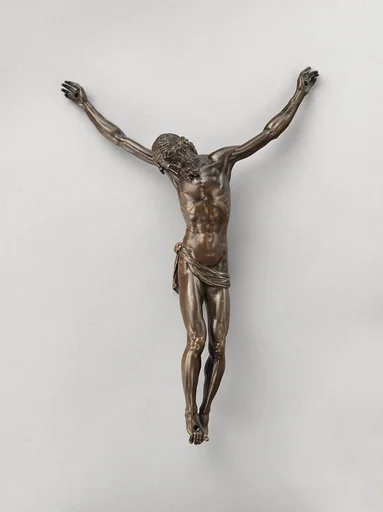
This exquisite corpus is fitted with a separate silver loincloth that attaches neatly to the body. The exceptionally fine cast is well finished on both sides and in very good condition (only a fracture on the left leg to be noted). The figure is very light (the walls are less than a millimeter thick), there are no traces of chasing, and it was probably cast in one piece. The artist lavished attention on the beautiful head and its individualized locks of hair. The precise execution suggests that the bronze was cast after a prototype. Usually identified as early seventeenth-century Italian, the corpus has also been considered a German product of about 1600.[1] However, it looks much more like an eighteenth-century cast, and may not even be Italian but French. The impeccable cast, sophisticated treatment of the hair, shape of the forehead, and straight nose strongly suggest the later chronology, reinforced by the elegant font of the initials “L.G.” incised on the sole of the left foot.[2] Though the initials are logically assumed to be those of the sculptor or founder, it has not yet been possible to link them to a specific name. -FL Footnotes (For key to shortened references see bibliography in Allen, Italian Renaissance and Baroque Bronzes in The Metropolitan Museum of Art. NY: The Metropolitan Museum of Art, 2022.) 1. See Olga Raggio, 1966, ESDA/OF, who compares it to Hans Reichle’s work, in particular a bronze Crucifixion at the Szépművészeti Múzeum, Budapest. The latter was attributed to Reichle by Balogh 1964 but recently ascribed to Guglielmo della Porta; see Szőcs 2013. 2. Michael Riddick has published our corpus on his website with an unlikely attribution to Bastiano Torrigiani (https://renbronze.com/2020/03/16/a-possible-corpus-saint-and-siren-by-sebastiano-torrigiani/).
- Artist
- Unknown
- Date
- 18th century
- Medium
- Bronze, fire-gilt; silver
- Culture
- Possibly Italian or French
- Department
- European Sculpture and Decorative Arts
- Credit line
- Gift of Susan Dwight Bliss, 1944