Untitled
Unidentified artist
early 20th century (ca. 1920–40) · Framed painting; ink and color on cotton · Asian Art
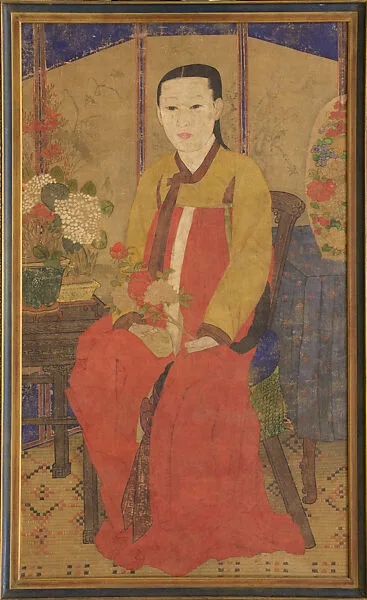
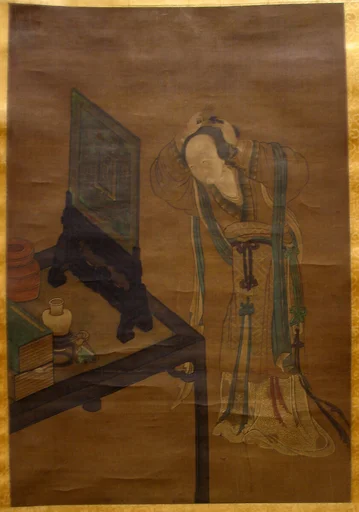
Neo-Confucian patriarchy led to a scarcity of female portraits. The rise of pungsokhwa (everyday-life genre paintings) in the late seventeenth century resulted in more depictions of women, mainly gisaeng (female entertainers), commoners, and shamans. Despite literary praise for women’s roles as matriarchs, wives, and daughters, visual representation of them only emerged in the late nineteenth century, often in the form of dual ancestral portraits with their husbands. This sitter is in an interior akin to early twentieth-century photography studios, featuring a folding screen, tables, potted flowers, a vase, and a patterned mat. The woman’s unblemished, porcelain-like face adheres to contemporary beauty ideals. This treatment, paired with the braid that marks her unmarried status, links the piece to the Joseon miindo genre (painting of a beauty), depictions of colonial Korean women, and soft-hued nihonga (literally “Japanese painting”).
- Artist
- Unidentified artist
- Date
- early 20th century (ca. 1920–40)
- Medium
- Framed painting; ink and color on cotton
- Culture
- Korea
- Department
- Asian Art
- Credit line
- Rogers Fund, 1943