수월관음도 고려|水月觀音圖 高麗|Water-moon Avalokiteshvara
Unidentified artist
first half of the 14th century · Hanging scroll; ink and color on silk · Asian Art
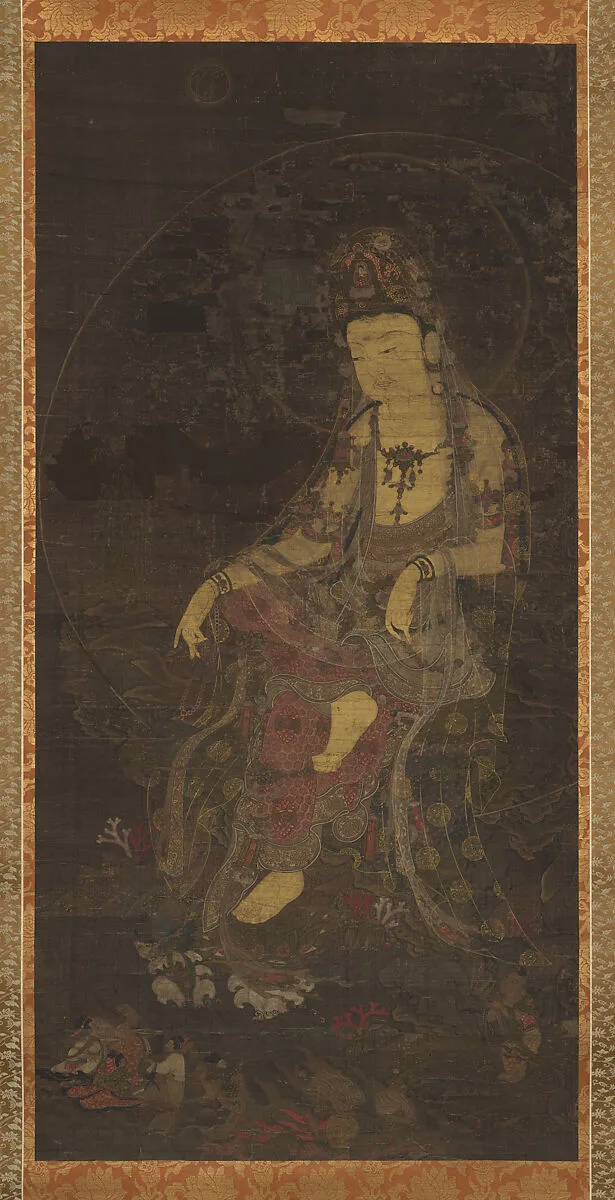
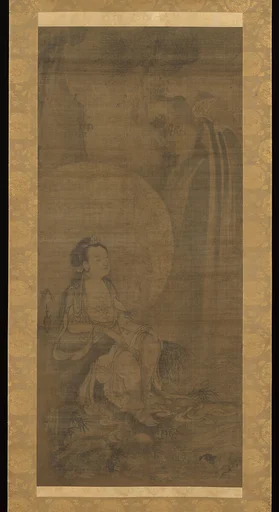
The Water-moon Avalokiteshvara (Korean: Suwol gwaneum) is an iconographic type that was popular in Korea during the Goryeo period. She was worshipped for her ability to prevent calamities and diseases and to safeguard travelers on their journey. This painting shows the resplendently attired bodhisattva in three-quarter view, seated on a rocky outcropping above the waves. At the top is a diminutive moon, in which a hare pounds the elixir of immortality. At the bodhisattva’s feet, the dragon king leads a group of elegantly dressed miniature figures; behind them follow sea monsters bearing precious gifts. The boy pilgrim Sudhana (Korean: Seonjae dongja) stands at the lower right; his encounter with this deity, as recounted in the Avatamsaka (Flower Adornment) Sutra, provides the textual source for the scroll. The delicate and splendid gold-painted design on the robes of the deities is a noteworthy trademark of Goryeo Buddhist painting. Another is that the pigments were applied to both the back and front of the semitransparent silk, intensifying their hues and luminosity, though some have faded over time due to light exposure.
- Artist
- Unidentified artist
- Date
- first half of the 14th century
- Medium
- Hanging scroll; ink and color on silk
- Culture
- Korea
- Department
- Asian Art
- Credit line
- Charles Stewart Smith Collection, Gift of Mrs. Charles Stewart Smith, Charles Stewart Smith Jr., and Howard Caswell Smith, in memory of Charles Stewart Smith, 1914