慈航妃図 (Jikōhi zu)|Goddess of Compassion
Munakata Shikō 棟方志功
1960s · Hanging scroll; ink and color on paper · Asian Art
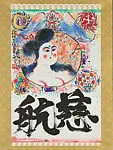
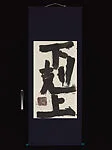
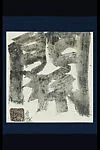
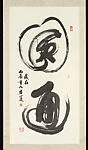
Partially framed by a halo-like roundel is a voluptuous goddess of compassion, as imagined in this vibrantly colored painting by Munakata Shikō, who carved similar compositions in the medium of woodblock prints. The goddess is at the center of a mandala that includes a Fuji-like triple-peaked sacred mountain in the background and a quartet of orbs representing the dynamic energy of nature—the sun framing a crow; the moon enclosing a hare beating out the elixir of immortality; a dipper-like constellation; and a fourth emblem yet to be deciphered. Munakata, equally renowned as a calligrapher, brushed the characters for Jikō 慈航, or Compassion, with an intensity that recalls the calligraphies of Zen monks of medieval times. Munakata Shikō is recognized as one of the most highly acclaimed Japanese painters and woodblock print artists of the twentieth century. Munakata’s reputation was established when he was recognized the mid-1930s by the prominent art critic Yanagi Sōetsu (1889–1961). Yanagi was a fervent advocate of Mingei, or “folk art,” which he saw as embodying two quintessential aspects of Japanese art: a deep respect for the materiality of the medium and a bold, direct, unselfconscious mode of expression. Munakata’s Mingei approach was further enhanced by his immersion in Zen Buddhist philosophy as well as by his fascination with European experiments in Post-Impressionist art—van Gogh, whom he idolized, as well as the German Expressionists—which enabled him to create an entirely new style of Japanese woodcut and painting that propelled him to international fame.
- Artist
- Munakata Shikō 棟方志功
- Date
- 1960s
- Medium
- Hanging scroll; ink and color on paper
- Culture
- Japan
- Department
- Asian Art
- Credit line
- Mary and Cheney Cowles Collection, Gift of Mary and Cheney Cowles, 2021