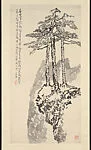
野長瀬晩筆 「溪流乃図」|Mountain Stream
Nonagase Banka 野長瀬晩花
1920s · Hanging scroll; ink, color, and gold paint on silk · Asian Art
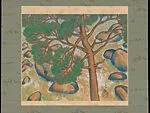
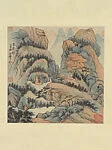
In this boldly cropped composition, the upper portion of a foreground pine tree is viewed against the backdrop of a broad mountain stream. The scene is presented from a high vantage point that has flattened out the perspective into a nearly abstract pattern. Both the composition and bold palette of yellow, orange, and green, with the shadows of the rocks rendered in dark blue, shows the influence of Post-Impressionist paintings that the artist would have seen while he was living and studying in Paris from 1921 to 1923. From his mid-teens, Banka studied traditional styles of Shijō School and Nihonga painting in Osaka under Nakagawa Rōgetsu (1859–1924) He then moved to Kyoto to continue his studies, but clearly he was frustrated with toeing the orthodox line. In 1918, with a group of other students he established the Society for the Creation of National Painting (Kokuga Sōsaku Kyōkai) that advocated “a fusion of Western and Asian art to create a new [style of] Japanese painting.” Along with Banka, the organization included other prominent Nihonga artists, most notably, Irie Shikō, Tsuchida Bakusen, and Murakami Kagaku, all of whom had rebelled against the status quo of the government-sponsored Bunten exhibitions. The exhibitions held by the organization were colloquially referred to as “Kokuten.” Banka thereafter became closely associated with the radicalism of the Kokuten, and he was labeled an “eccentric” (fūgawari na otoko), a designation he wore as a badge of honor.
- Artist
- Nonagase Banka 野長瀬晩花
- Date
- 1920s
- Medium
- Hanging scroll; ink, color, and gold paint on silk
- Culture
- Japan
- Department
- Asian Art
- Credit line
- Mary and Cheney Cowles Collection, Gift of Mary and Cheney Cowles, 2022