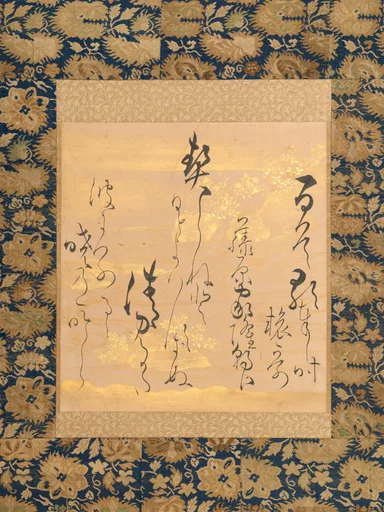
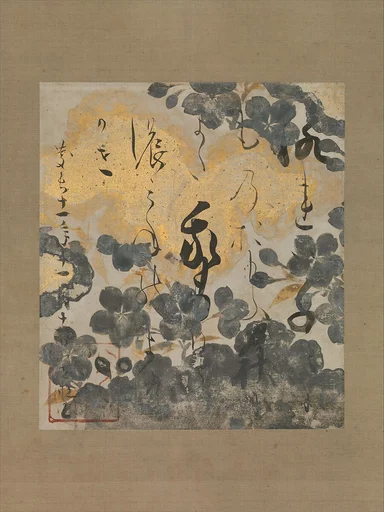
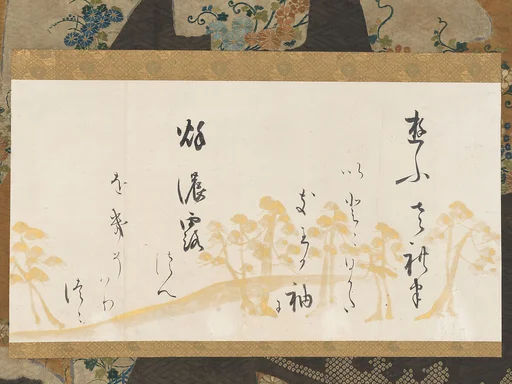
「曙や」和歌色紙|“Akebonoya” waka poem
Hon'ami Kōetsu
early 17th century · Hanging scroll; ink on gold-decorated paper · Asian Art
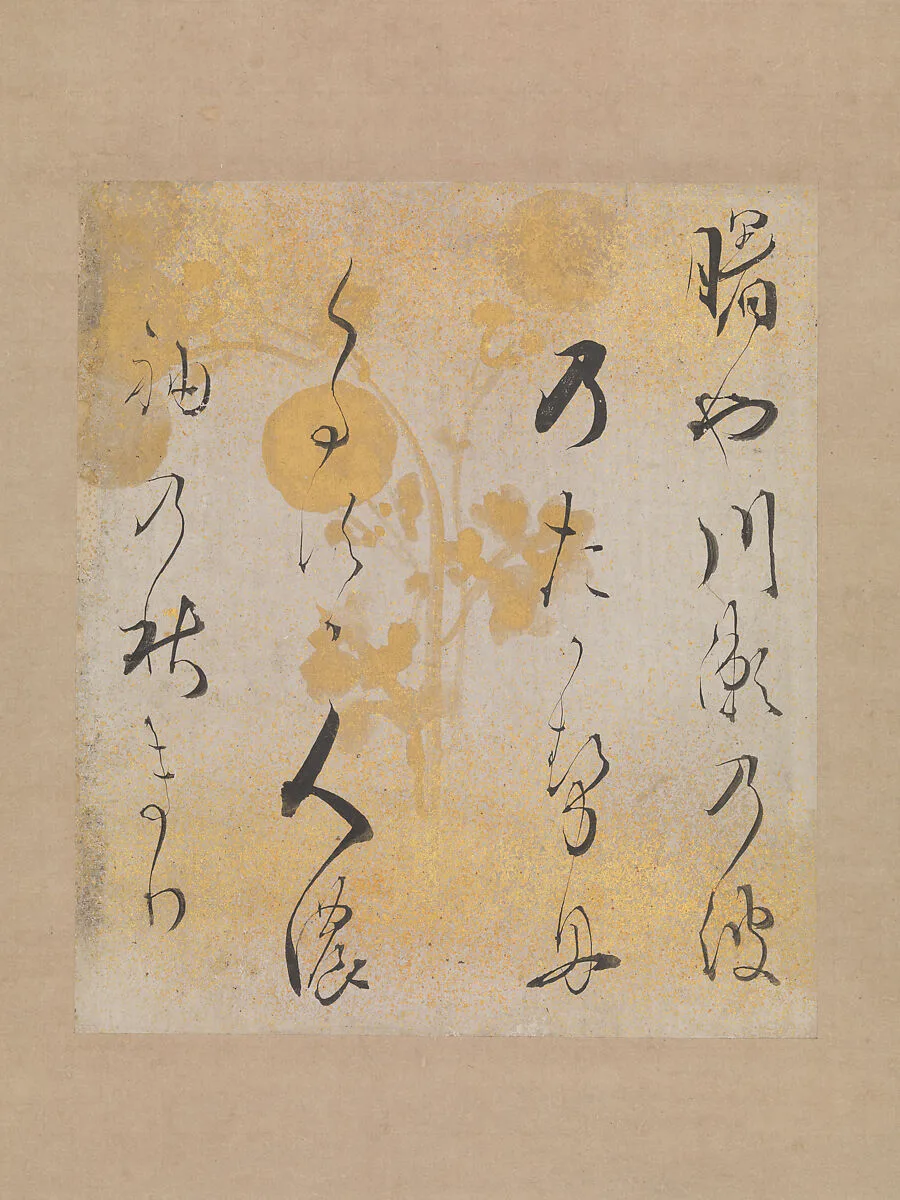
Against an extravagant design of chrysanthemums and mist rendered in gold flakes and gold dust, the most famous calligrapher of his age, Hon’ami Kōetsu, has inscribed a single waka (31-syllable court verse) by Minamoto no Michiteru (Koga Michiteru, 1187-1248), a high-ranked courtier-poet of ancient times, whose poems, including the one cited here, were included in distinguished imperially sponsored anthologies such as the New Collection of Japanese Poems Ancient and Modern (Shin kokin wakashu). Evoking the autumn season in the capital, the verse here reads: 曙や川瀬の波のたかせ舟 くだすか人の袖の秋きり Akebono ya kawase no nami no takasebune kudasu ka hito no sode no akikiri At the break of dawn a skiff rides the rapids of the river, as the boatman’s sleeves drift in the autumn mist. (Trans. John T. Carpenter) This example of a waka on a gorgeously decorated shikishi (poem card) serves as a textbook example of Kōetsu’s distinctive hand. While manifesting the calligrapher’s brilliant sense of spacing, it shows off his alacrity at creating ligatures between clusters of two of three characters—that injects a new rhythm of reading to the poem. Characteristic of Kōetsu’s handwriting, extremely simple characters such as the possessive particle no 乃or hito 人( [boat]man) are inscribed boldly to make them stand out. At the same time, to create a sense of variation, the calligrapher employs an exceedingly complex variant form of the particle no濃 at the bottom of the third column—the way he inscribes this character became one of his trademark idiosyncracies.
- Artist
- Hon'ami Kōetsu
- Date
- early 17th century
- Medium
- Hanging scroll; ink on gold-decorated paper
- Culture
- Japan
- Department
- Asian Art
- Credit line
- Mary and Cheney Cowles Collection, Gift of Mary and Cheney Cowles, 2018