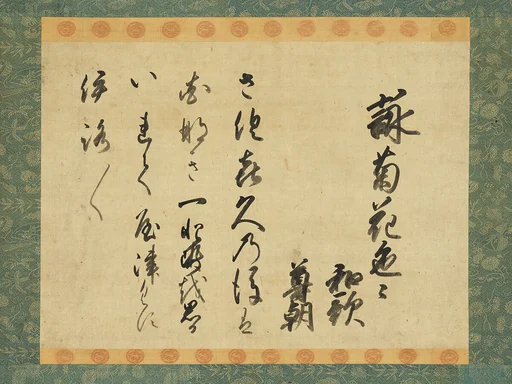
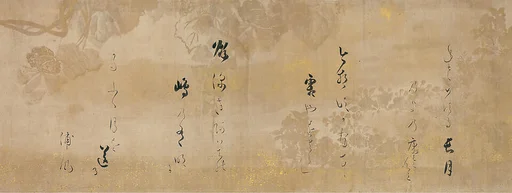
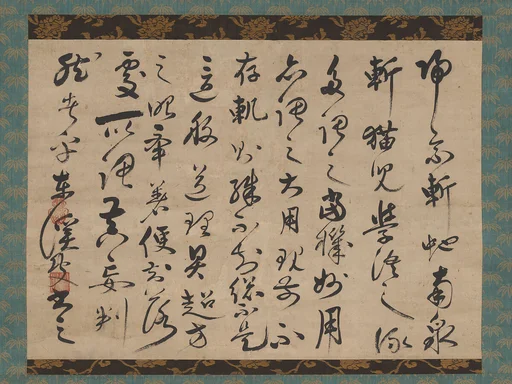
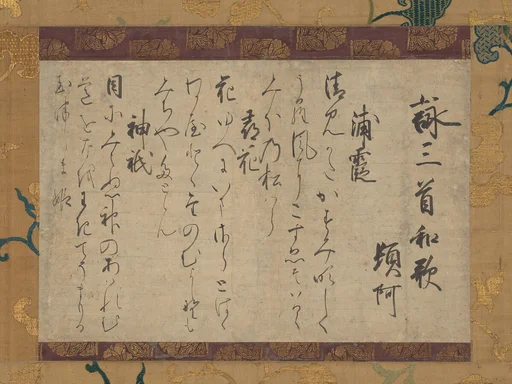
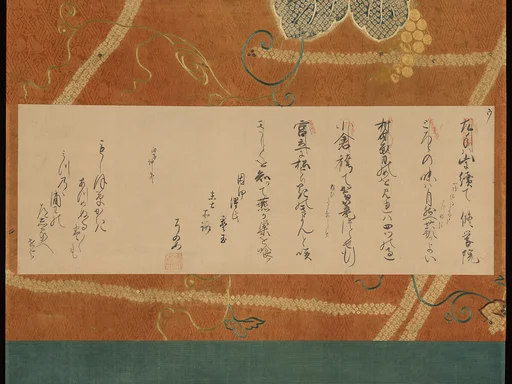
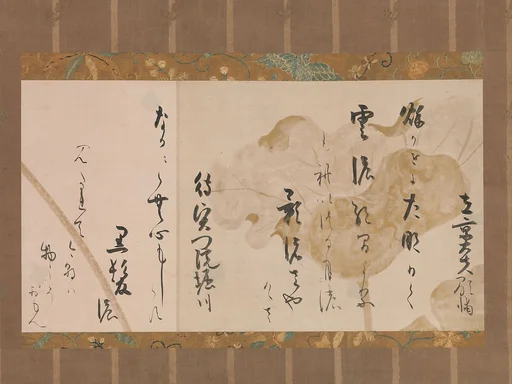
近衛前久筆 『和漢朗詠集』より白居易詩及び 藤原敏行和歌 (部分)|Chinese Couplet by Bai Juyi and Waka by Fujiwara no Toshiyuki (partial) from “Japanese and Chinese Poems to Sing” (Wakan rōeishū)
Konoe Sakihisa 近衛前久
late 16th–early 17th century · Handscroll section mounted as hanging scroll; ink on dyed and decorated paper · Asian Art
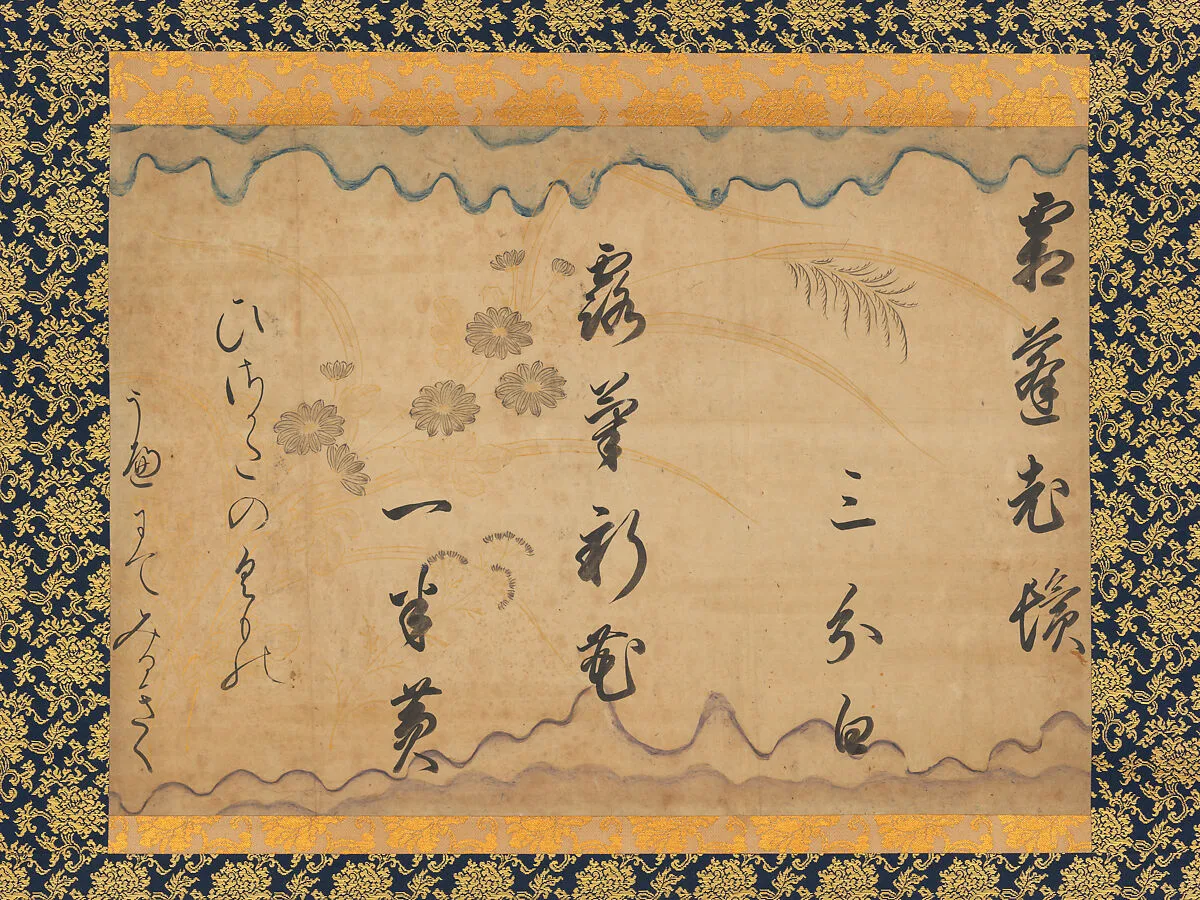
This handscroll section brilliantly encapsulates the elegance of Momoyama court calligraphy, here inscribed on sumptuously decorated paper with chrysanthemums and pampas grasses in gold and silver. The “cloud-patterned paper” (kumogami), featuring blue- and purple-dyed undulating cloud motifs, evokes the aesthetic sensibilities of the ancient Heian court. The calligrapher, Konoe Sakihisa, a courtier-poet of high rank, was recognized as one of the most talented calligraphers of his day. Both texts refer to chrysanthemums and are included in the autumn section of Japanese and Chinese Poems to Sing, the influential anthology compiled by courtier-poet Fujiwara no Kintō about 1014. The Chinese couplet by Bai Juyi (772–846) is written in kanji staggered in four columns; at left are two columns of elegant kana representing the first half of a waka by Fujiwara no Toshiyuki (died ca. 907).
- Artist
- Konoe Sakihisa 近衛前久
- Date
- late 16th–early 17th century
- Medium
- Handscroll section mounted as hanging scroll; ink on dyed and decorated paper
- Culture
- Japan
- Department
- Asian Art
- Credit line
- Mary and Cheney Cowles Collection, Gift of Mary and Cheney Cowles, 2020