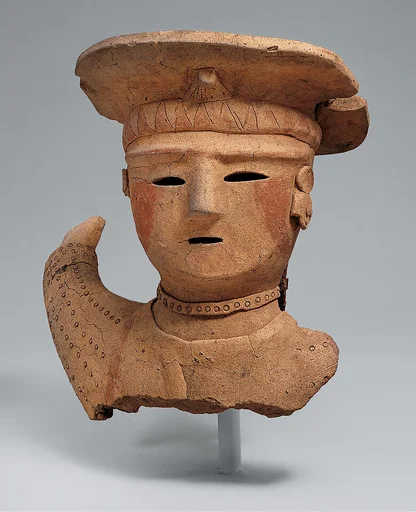
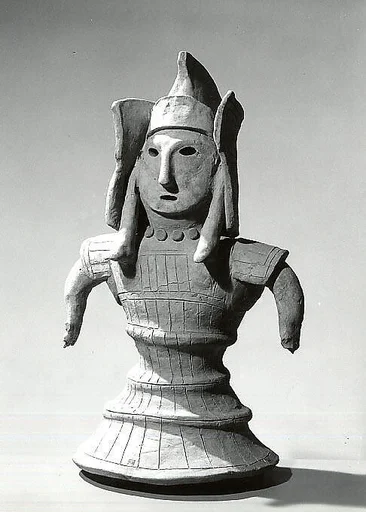
埴輪武装男子像|Haniwa (Hollow Clay Sculpture) of a Warrior
Unknown
5th–early 6th century · Earthenware with painted, incised, and applied decoration (Kanto region) · Asian Art
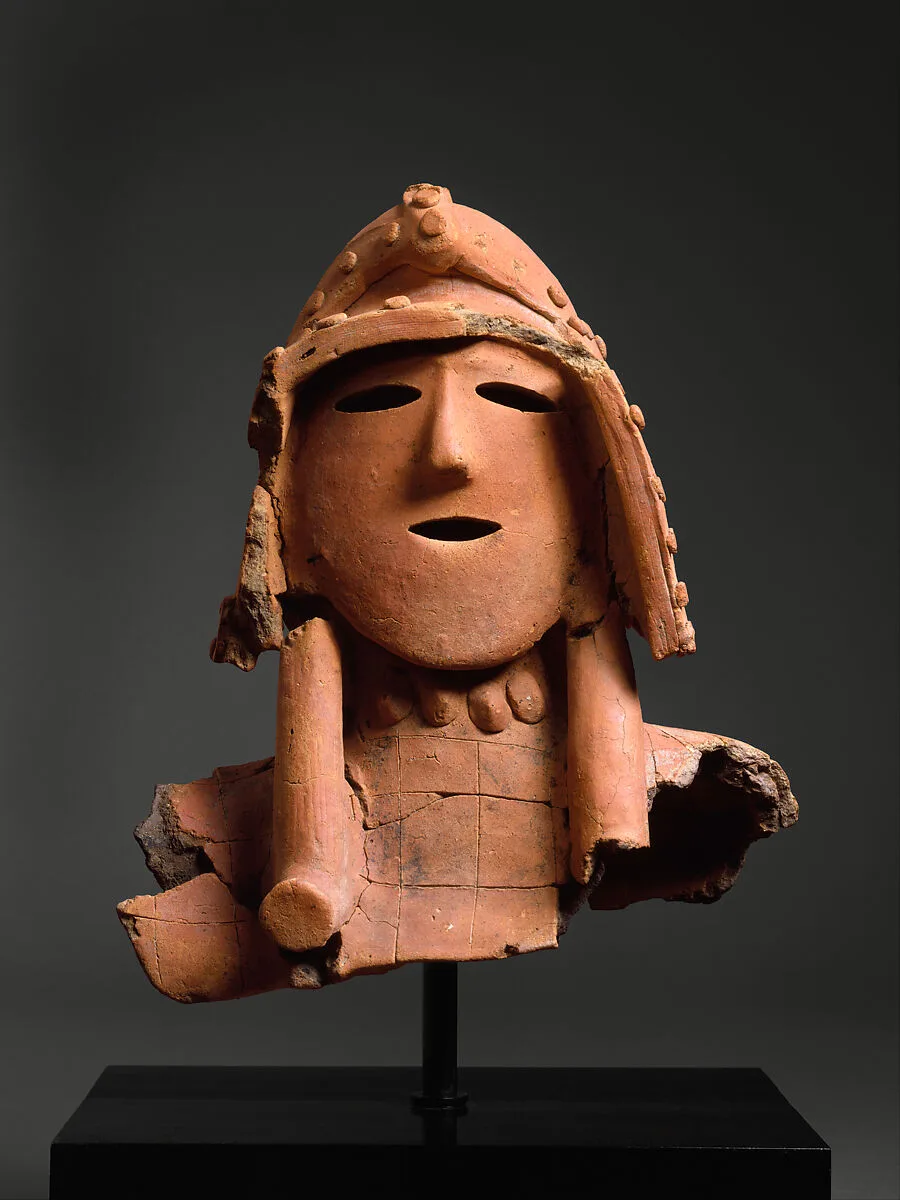
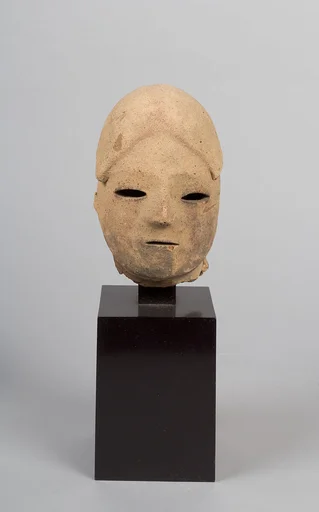
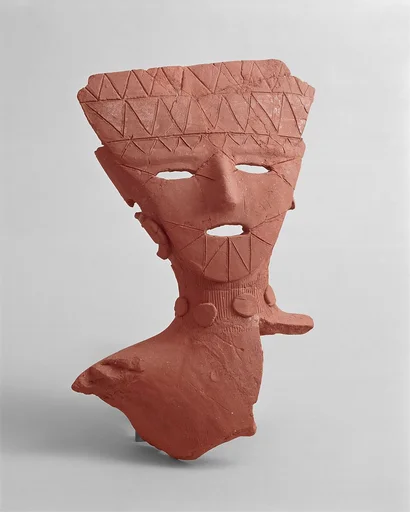
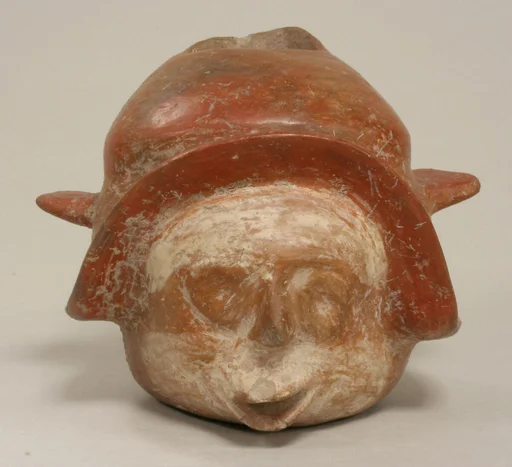
Formally attired in a breastplate and studded metal helmet, this haniwa (circle of clay) bust of a warrior vividly attests to the world of early Japan. Boldly potted from fragile earthenware, his broad face, triangular nose, and the oval perforations for his eyes and mouth evoke an impassive resolve. The earliest haniwa, dating to the late third century A.D., were simple clay cylinders. Houses and animals as well as ceremonial and other objects appeared in the late fourth century, while figural haniwa were created in the fifth, sixth, and seventh centuries. The traces of red paint found on this figure indicate that it was made in the Kanto region (around Tokyo). Haniwa were placed at the top of the burial mound, in the center, along the edges, and at the entrance of the burial chamber of enormous tombs constructed for the ruling elite during the Tumulus, or Kofun (ca. 200–600), period. These tombs were generally covered with large mounds of earth and were often shaped like keyholes and surrounded by moats. Keyhole-shaped tombs spread throughout Japan from the Kansai (Osaka-Nara-Kyoto) region. Their diffusion is often understood to reflect a parallel spread of political power as Japan, which had been divided into a series of loosely related domains, was gradually organized into a unified state with a central government. The arrival of immigrants from Korea, and possibly others parts of mainland East Asia, provided one impetus for changes in political organization and related burial practices.
- Artist
- Unknown
- Date
- 5th–early 6th century
- Medium
- Earthenware with painted, incised, and applied decoration (Kanto region)
- Culture
- Japan
- Department
- Asian Art
- Credit line
- The Harry G. C. Packard Collection of Asian Art, Gift of Harry G. C. Packard, and Purchase, Fletcher, Rogers, Harris Brisbane Dick, and Louis V. Bell Funds, Joseph Pulitzer Bequest, and The Annenberg Fund Inc. Gift, 1975