Untitled
Soga Shōhaku
late18th–early 19th century · Two-panel folding screen; ink and gold on paper · Asian Art
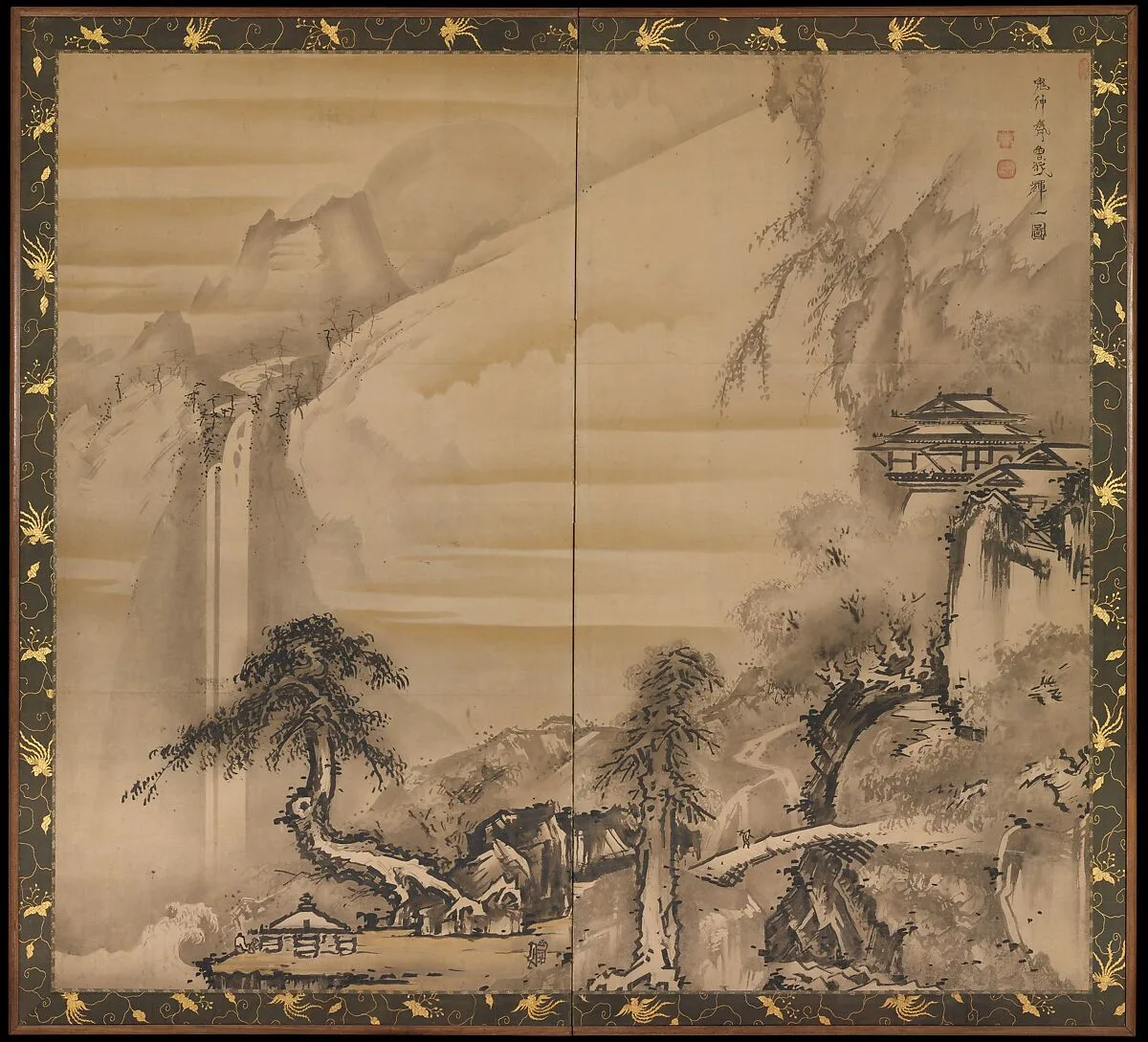
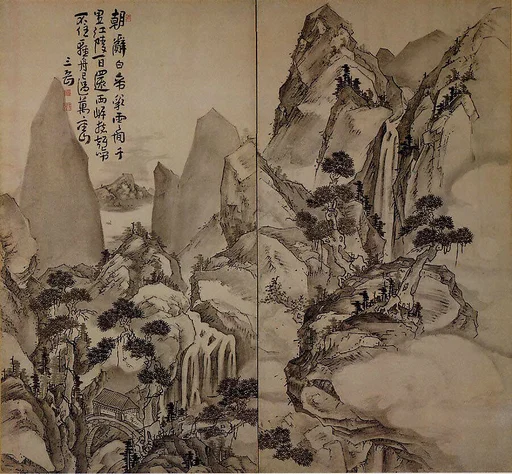
This mountain landscape, in which the human presence is but a minor aspect of the vastness of nature, draws on an archetypal motif in East Asian art first formulated by Song-dynasty painters in the tenth century. Yet here the vision of nature is more foreboding than grand, and the minute humans seem more in peril than in harmony with their strangely animated environment. At the edge of a precipice in the left foreground a gentleman sits contemplating a distant waterfall, unaware of the improbably huge splash that arches up over him like a dragon. To the right a single traveler crosses a mountain ravine on a precarious bridge. He seems to be making his way toward the temple at far right, but the path disappears in light-filled mist. In the distance skeletal trees on barren mountaintops accentuate the forbidding nature of the vast landscape. Soga Shōhaku was notorious for his eccentric treatment of conventional themes, and he and his followers created a number of similar compositions. He was one of a growing group of painters who worked in styles that challenged the orthodox manner of the dominant Kano school, which enjoyed the sponsorship of the Tokugawa shogunate. Because of the overall stiffness of the composition and the strained eccentricity of the signature style, it is safe to assume that this work was created by a follower rather than the master himself.
- Artist
- Soga Shōhaku
- Date
- late18th–early 19th century
- Medium
- Two-panel folding screen; ink and gold on paper
- Culture
- Japan
- Department
- Asian Art
- Credit line
- Purchase, Barbara and William Karatz Gift and Rogers Fund, 1996