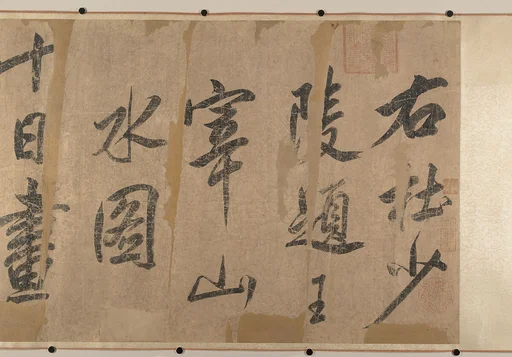
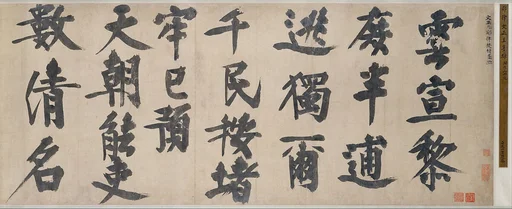
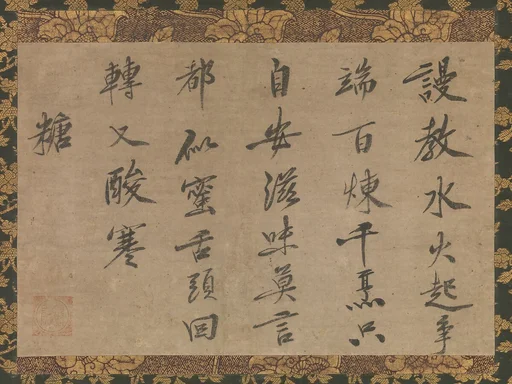
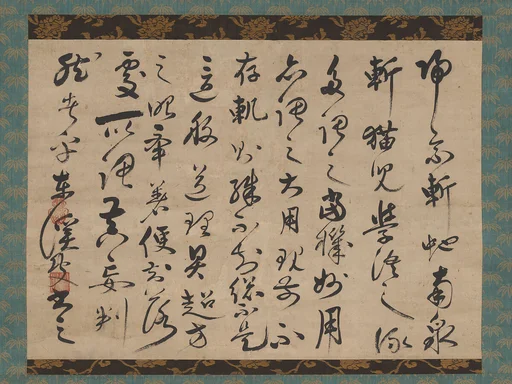
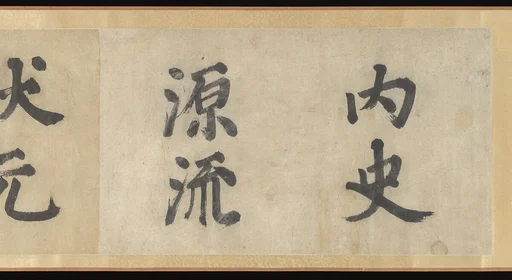
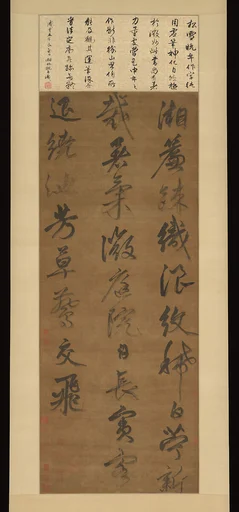
南宋 張即之 行書杜甫樂遊原詩殘卷 軸|Excerpt from “Song of Leyou Park”
Zhang Jizhi
Date unknown · Section of a handscroll mounted as a hanging scroll; ink on paper · Asian Art
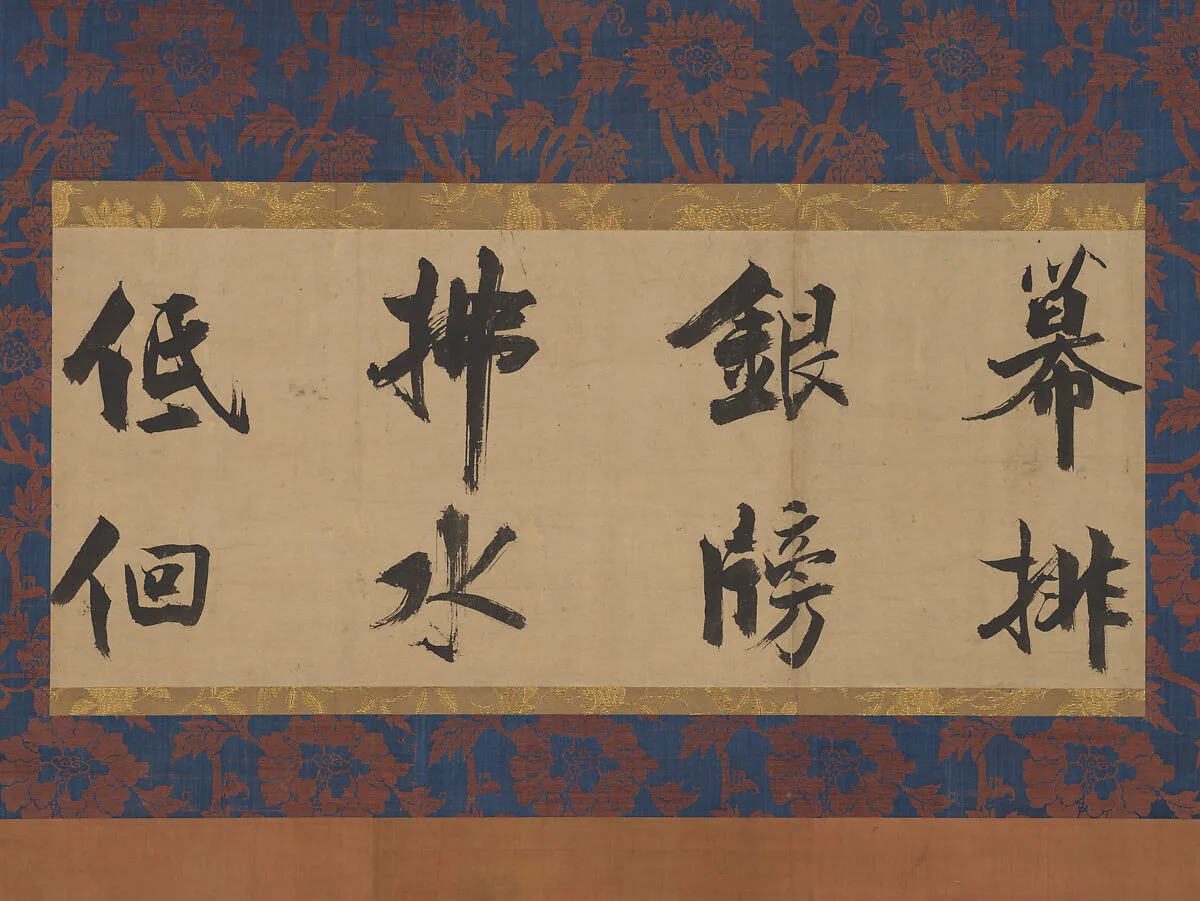
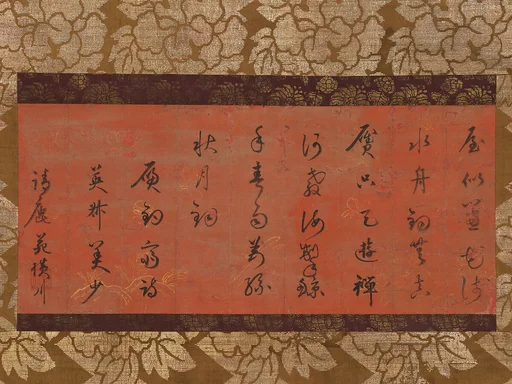
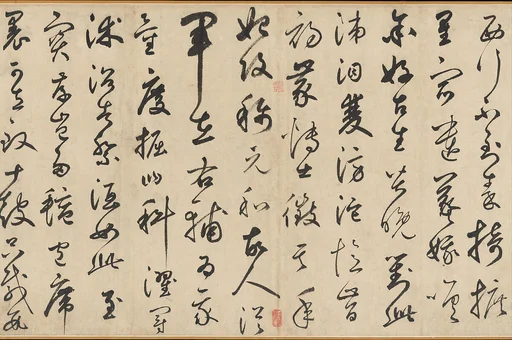
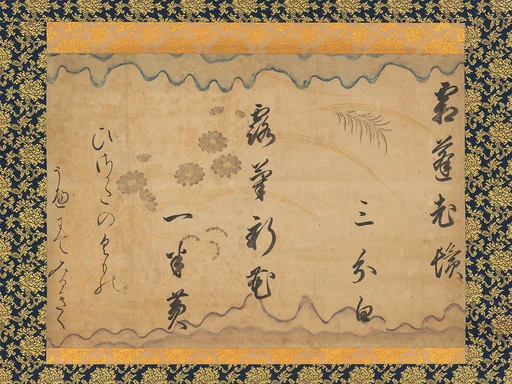
Zhang Jizhi, the last important calligrapher of the Song period, was a devout Buddhist who often transcribed religious texts as an act of devotion. He obtained his jinshi degree, the highest rank in the civil service examination, but never rose to high office. As a calligrapher, however, his fame spread beyond the borders of the Song to the Jin empire in northern China as well as to Japan, where his handwriting was particularly prized by Zen monks. Zhang was noted for his forceful large-character standard script, with its boldly contrasting blunt and sinuous brushstrokes. This piece, remounted centuries ago in Japan for display in a tokonoma, was cut from a long handscroll transcribing a poem by Du Fu (712–770) in such a manner that the poetic phrasing of the original is completely fragmented. The original two couplets may be translated as follows (the text of this scroll is on the fourth and fifth lines): Heavenly gates open in clear skies, ripples vastly trembling; By the Serpentine, kingfisher curtains hang arrayed with silver plaques. Brushing the water, hovering, dancing sleeves flutter; Climbing to the clouds, crisp and clear, the sounds of songs arise. (Translated by Jonathan Chaves)
- Artist
- Zhang Jizhi
- Date
- Date unknown
- Medium
- Section of a handscroll mounted as a hanging scroll; ink on paper
- Culture
- China
- Department
- Asian Art
- Credit line
- Gift of Sylvan Barnet and William Burto, in honor of Tajima Mitsuru, 2000