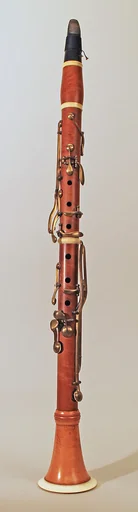
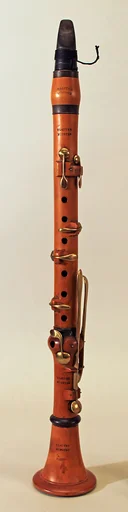
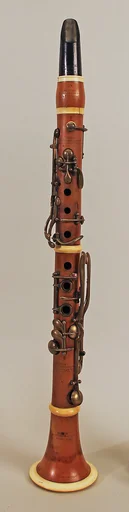
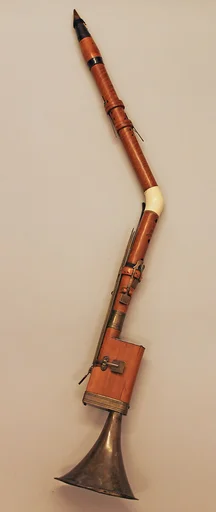
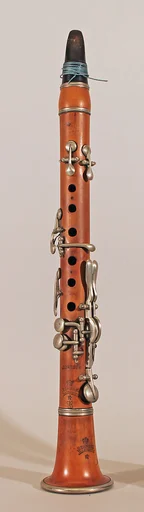
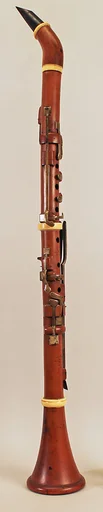
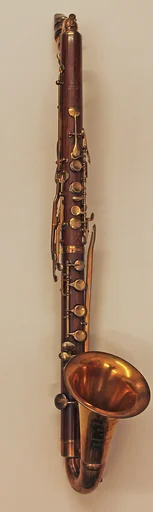
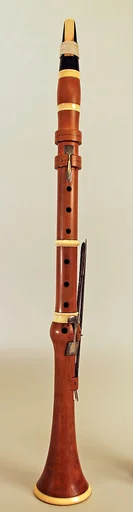
Alto Clarinet in E-flat
Johann Friedrich Wilhelm Wernicke
1858–64 · Boxwood, brass · Musical Instruments
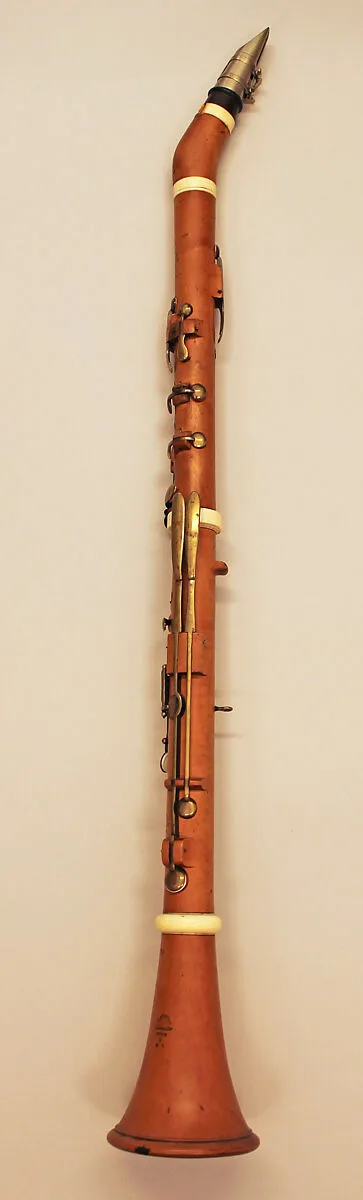
Johann Friedrich Wilhelm Wernicke was appointed as court instrument maker in 1863. The Prussian eagle in his stamp hints to that privilege. His customers included musicians in court and theater orchestras, in Saint Petersburg, Sweden, and Berlin. Overall size: 890 Bore: 17.0 Technical description: This instrument is a 14 key Müller system alto clarinet. Boxwood with ivory ferrules and brass keywork. Five pieces: mouthpiece, barrel, upper section, lower section, bell. Very interesting mouthpiece of ebony covered with German silver. Bent barrel. Brass tube in thumb hole. Speaker liner projects ca. 4 mm into the bore. All keys mounted in blocks, except for G♯3/E♭5, which is mounted on a rod-axle and F3/C5, which is mounted between pillars. Wood recessed under some touch pieces. Integral wooden thumb rest. Silng ring below thumb rest. Wooden rim on bell. Wooden guidance for F♯3/C♯5 lever. L0: T; speaker. L1: T; throat A♮; throat A♭. L2: T; cross F4/ C6. L3: T; E♭4/B♭5. L4: C♯4/G♯5; E3/B♮4; F♯3/C♯5. R1: T; side F4/ C6; side trill key for throat A-B♮ and B♭-C. R2: T. R3: T; B♭3/F♮5; side B♮3/F♯5. R4: F3/C5; G♯3/E♭5. Keyhead type: shallow cups. Keymount type: wooden blocks. Inscribed on barell and upper section "HOLZINSTRUMENTENMACHER" / Prussian Eagle / "Wernicke / BERLIN / 2" / two stars"; on lower section with Prussian Eagle / "Wernicke / BERLIN" / one star; below that with Prussian Eagle / "Wernicke / BERLIN / 2" / two stars; and on bell with Prussian Eagle / "Wernicke / BERLIN / 2" / two stars. Playing accessories: a German silver ligature. (Heike Fricke, 2014)
- Artist
- Johann Friedrich Wilhelm Wernicke
- Date
- 1858–64
- Medium
- Boxwood, brass
- Culture
- German
- Department
- Musical Instruments
- Credit line
- The Crosby Brown Collection of Musical Instruments, 1889