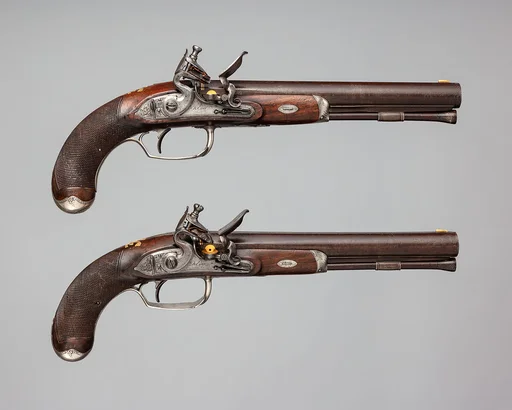
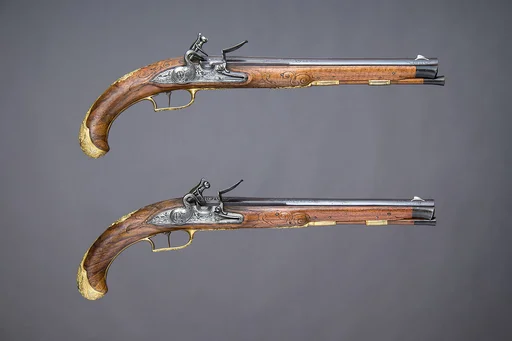
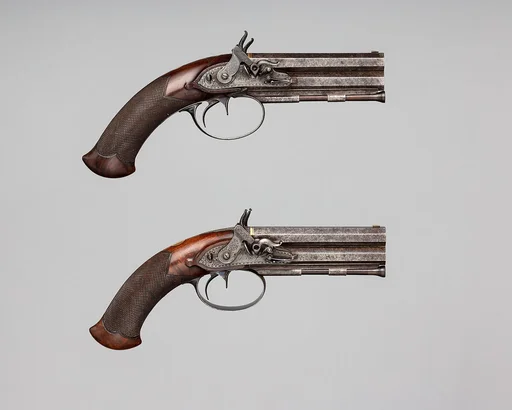
Pair of Pellet-Lock Pistols with Case with Accessories
Charles Moore
ca. 1825 · pistols: steel, wood (walnut), platinum, brass; case: wood (mahogany), textile, brass, bone, paper; powder flask: brass; bullet mold: steel; nipple wrench: wood (mahogany?), brass, steel; ramrod: wood (mahogany?), bronze, steel; spare nipples: steel; spare firing pins: steel · Arms and Armor
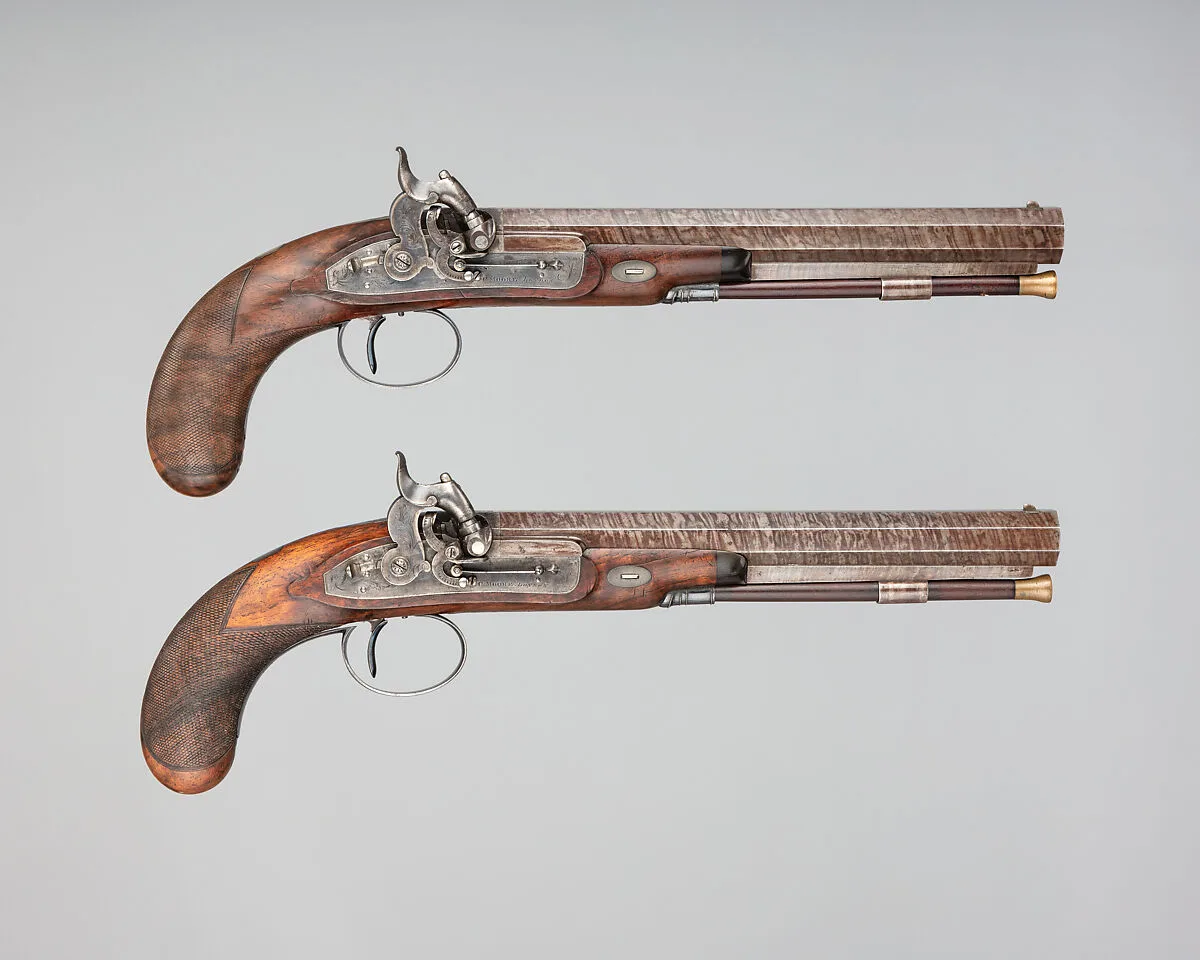
English percussion mechanisms of the early nineteenth century utilized fulminate, a highly combustible chemical compound that burned faster than gunpowder and ignited when struck with force, as their means of ignition. Like gunpowder, it could be used in loose, powdered form or contained within different types of caps. These finely made pistols by Charles Moore used spherical pellets made of mercury fulminate coated with iron oxide (rouge), each about 2mm in diameter and weighing about 20 mg, which were considerably safer and more manageable than the loose powder. A pellet dispenser tool included with the pistol set would have facilitated the user in placing pellets precisely in the lock’s pellet cup under the cock. When the cock fell, the pellet cover (mounted under the cock) would automatically flip out of the way. Moore’s lock adapted a design previously patented by gunmaker Westley Richards (1788–1865) in 1821.
- Artist
- Charles Moore
- Date
- ca. 1825
- Medium
- pistols: steel, wood (walnut), platinum, brass; case: wood (mahogany), textile, brass, bone, paper; powder flask: brass; bullet mold: steel; nipple wrench: wood (mahogany?), brass, steel; ramrod: wood (mahogany?), bronze, steel; spare nipples: steel; spare firing pins: steel
- Culture
- British, London
- Department
- Arms and Armor
- Credit line
- Gift of Charles M. Schott Jr., 1917