Shield
Unknown
19th–20th century · Leather, wood, pigment, fur · Arts of Africa, Oceania, and the Americas
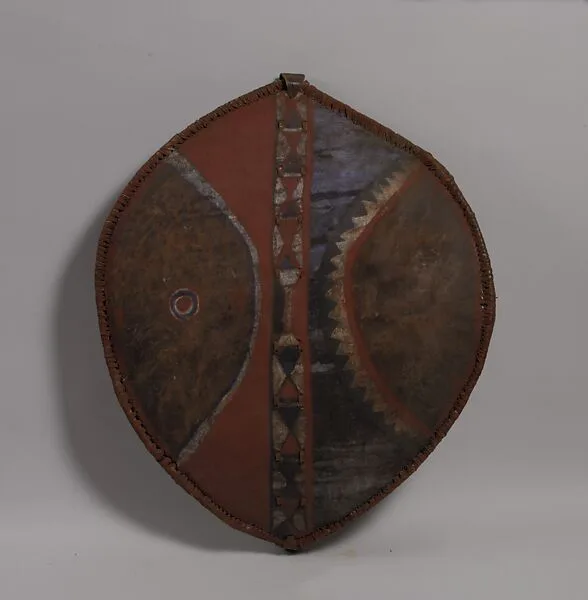
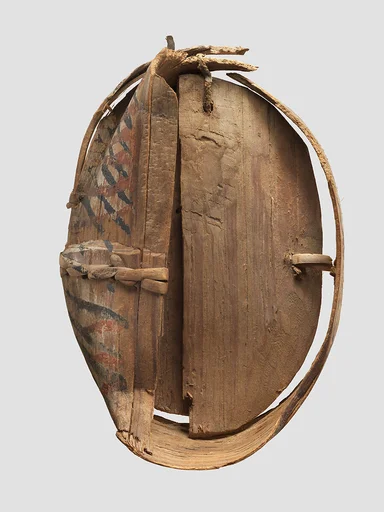
Pastoralist Maasai from the grasslands of southern Kenya and northern Tanzania used such shields in warfare, hunting, and rites of passage. A buffalo hide sewn onto a wooden frame is the convex elliptical canvas onto which an artist traced rich polychrome geometric patterns: two large crescents symmetrically positioned on either side of a central vertical band composed of alternating triangles. The motifs identified the owner's position within a complex lineage system. Called sirata, many of these symbolic motifs have fallen into disuse and are poorly understood by contemporary Maasai. Several elements relate this shield to a proven warrior herder. The red and blue dyes, traditionally obtained by mixing different types of clays and ashes, were the prerogative of accomplished individuals. The red patch on the proper right side of this shield can be identified as a sirata el langarbwali, a badge that signifies great bravery in battle. This prestigious sign is conferred only with the permission of a high-ranking chief.
- Artist
- Unknown
- Date
- 19th–20th century
- Medium
- Leather, wood, pigment, fur
- Culture
- Maasai peoples
- Department
- Arts of Africa, Oceania, and the Americas
- Credit line
- The Michael C. Rockefeller Memorial Collection, Gift of Joseph J. Shapiro, 1972