Door panel from the "Cabinet Turc" of Comte d'Artois at Versailles
Jules-Hugues Rousseau|Jean -Siméon Rousseau de la Rottière
1781 · Oil on oak · European Sculpture and Decorative Arts
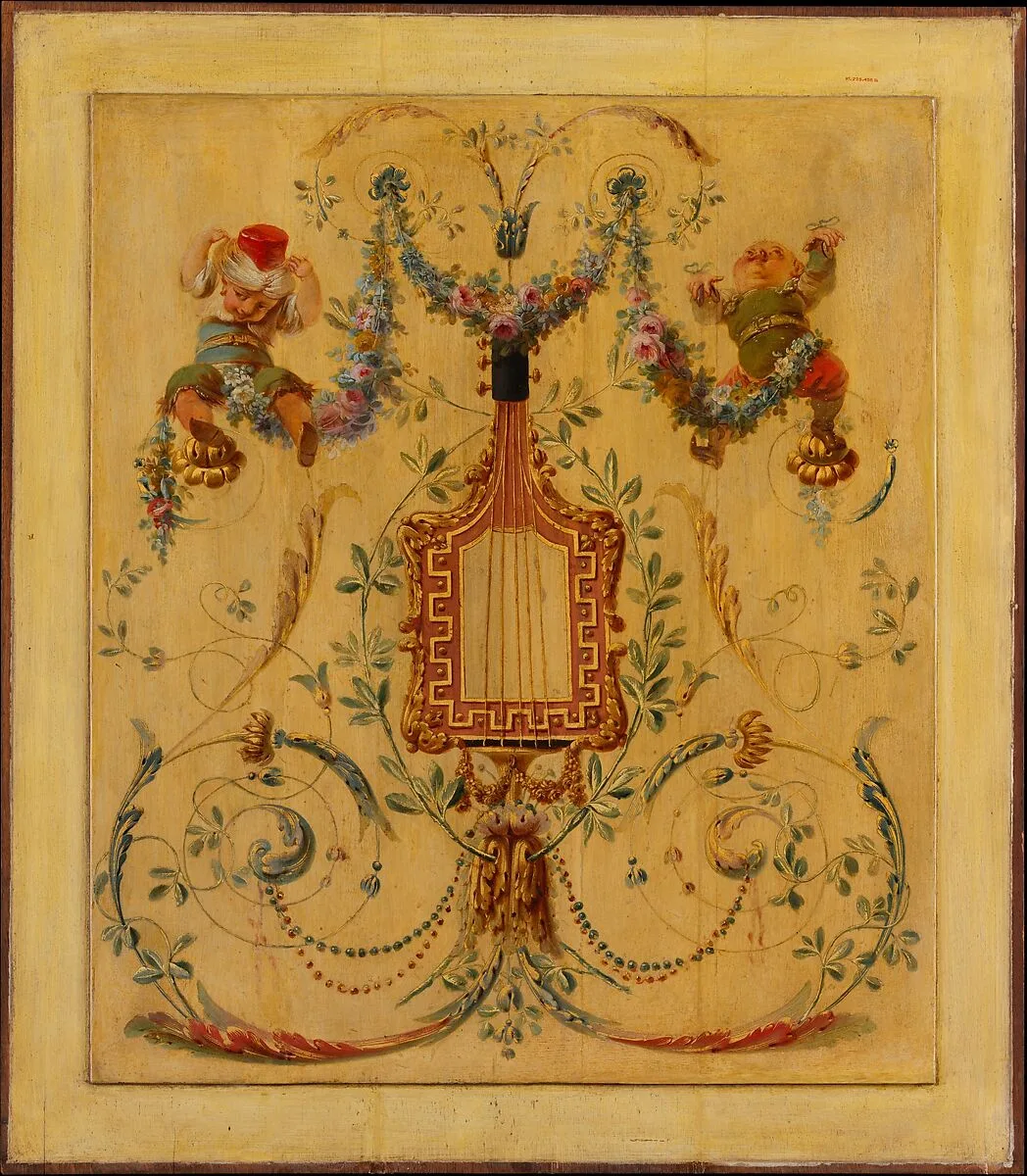
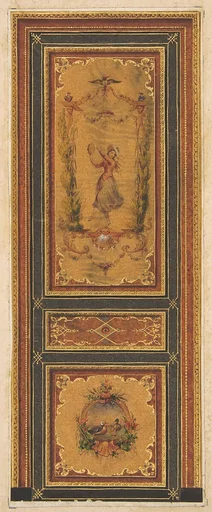
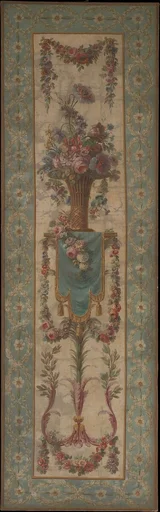
The visit of the second Turkish delegation to Paris in 1742 stimulated the French elite's taste for exotic interior decoration known as turquerie. The comte d'Artois, for instance, was clearly fond of such fantasy décors, for he had two rooms in his apartment in the south wing of Versailles furnished in the "Turkish" manner. The second of these rooms, an intimate cabinet that doubled as a library, was created between April and November of 1781. It had pilasters painted with arabesques and was elaborately draped with costly fabrics. The eminent chair maker Georges Jacob (1739–1814) provided matching seat furniture in the Turkish style. Jean-Siméon Rousseau de la Rottière (1747–1820) and his brother Jules-Hugues Rousseau (1743–1806), who worked in a number of French royal palaces, most likely painted the lighthearted arabesques, fanciful turbaned figures, naiads with entwined fish tails, floral garlands, and strings of pearls on the room's four doors. Two panels that came to the Museum as part of the 1906 Pierpont Morgan gift (see also 07.225.458a) have only recently been identified as pieces of those particular doors, though they had long been thought to have come from Versailles. A cameolike medallion is painted in monochrome against a blue marbleized fond and framed by simulated gilt molding on the larger of the two panels, which originally formed the upper half of one of the doors in the comte d'Artois's Turkish Cabinet. In the medallion a sultan or pasha sits on a throne surmounted by a crescent moon while two odalisques offer him a long-stemmed pipe.
- Artist
- Jules-Hugues Rousseau|Jean -Siméon Rousseau de la Rottière
- Date
- 1781
- Medium
- Oil on oak
- Culture
- French
- Department
- European Sculpture and Decorative Arts
- Credit line
- Gift of J. Pierpont Morgan, 1906