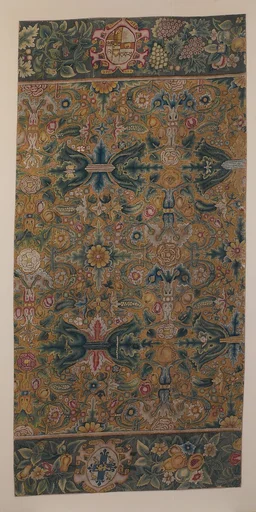
Back of a chasuble
Unknown
1525–50 · Wool, silk, silver and silver-gilt thread (19-20 warps per inch, 8-9 per cm.) · European Sculpture and Decorative Arts
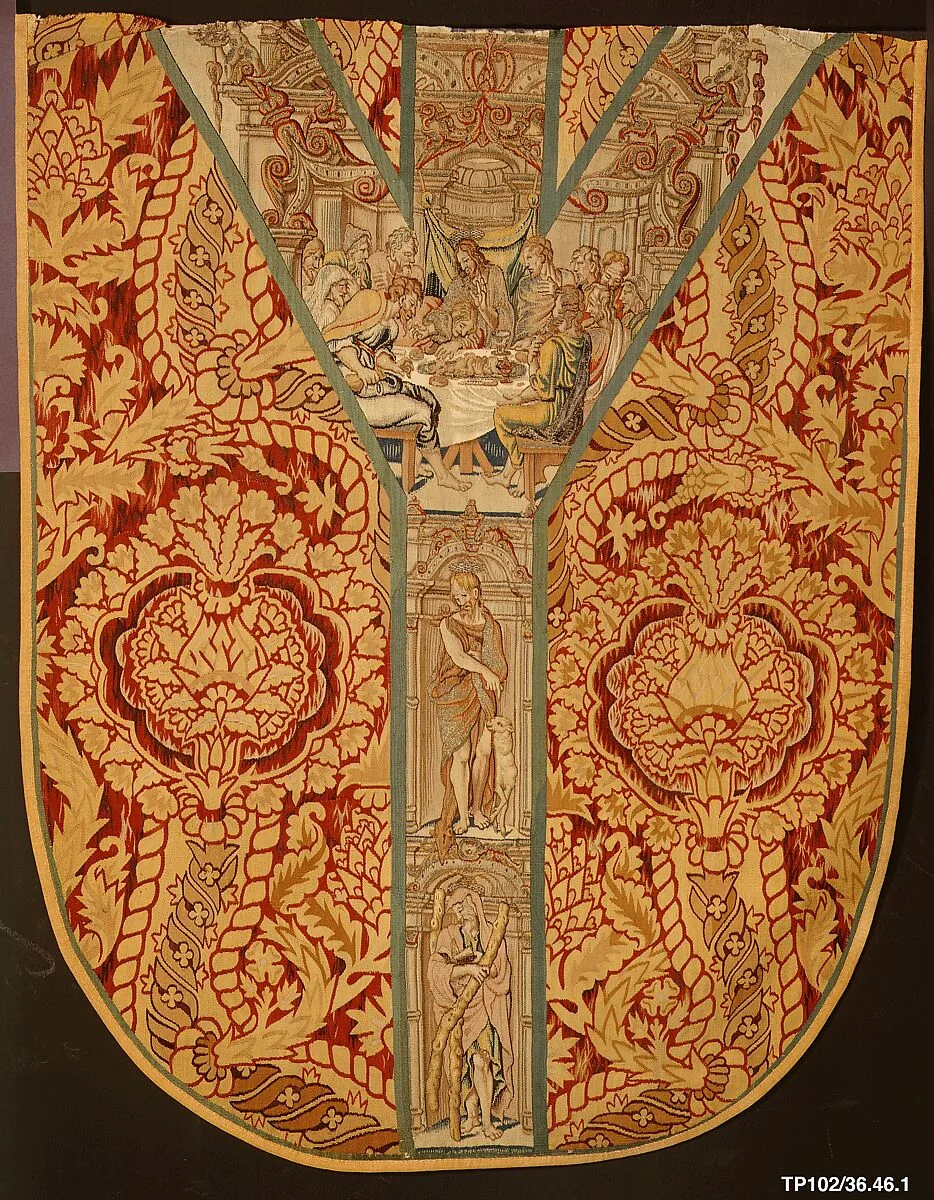
Entirely woven in one piece, using tapestry technique, at first glance, this appears to be a sixteenth-century tapestry-woven priestly vestment, similar to the well-documented examples associated with Gouda in The Met's collection (54.176.1 and .2). Like those, this seems to imitate the effect of more conventional velvet cloth of gold vestments ornamented with needlework orphreys (for example, The Met's 14.134.4a, .4b). However, the weaving, though regular, is unusually flat and lifeless for sixteenth-century Netherlandish work. Oddities in design include the unnervingly gauche and bold faux velvet design, which is quite unlike other imitation velvet and damask tapestries (like 67.55.97). The palette of the figurative scenes is strangely pastel and quite different from sixteenth-century pictorial tapestries, and the saints in the "orphrey" shaft are unusually outlined in brown and black. Above all, the dimensions of this ostensible fragment of the reverse of a chasuble are uncommonly expansive; had this actually originally been part of a complete chasuble, it would have been of gigantic size, swamping any priest wearing it. As such, it becomes apparent that this is probably a nineteenth-century pastiche, either woven in creative emulation of early modern work, or made to trick the enthusiastic and spendthrift antique tapestry market.
- Artist
- Unknown
- Date
- 1525–50
- Medium
- Wool, silk, silver and silver-gilt thread (19-20 warps per inch, 8-9 per cm.)
- Culture
- Netherlandish, possibly Brussels
- Department
- European Sculpture and Decorative Arts
- Credit line
- Purchase, Joseph Pulitzer Bequest, 1936