Saint Jerome in the Wilderness
Antonio Rossellino
ca. 1470 · Marble · European Sculpture and Decorative Arts
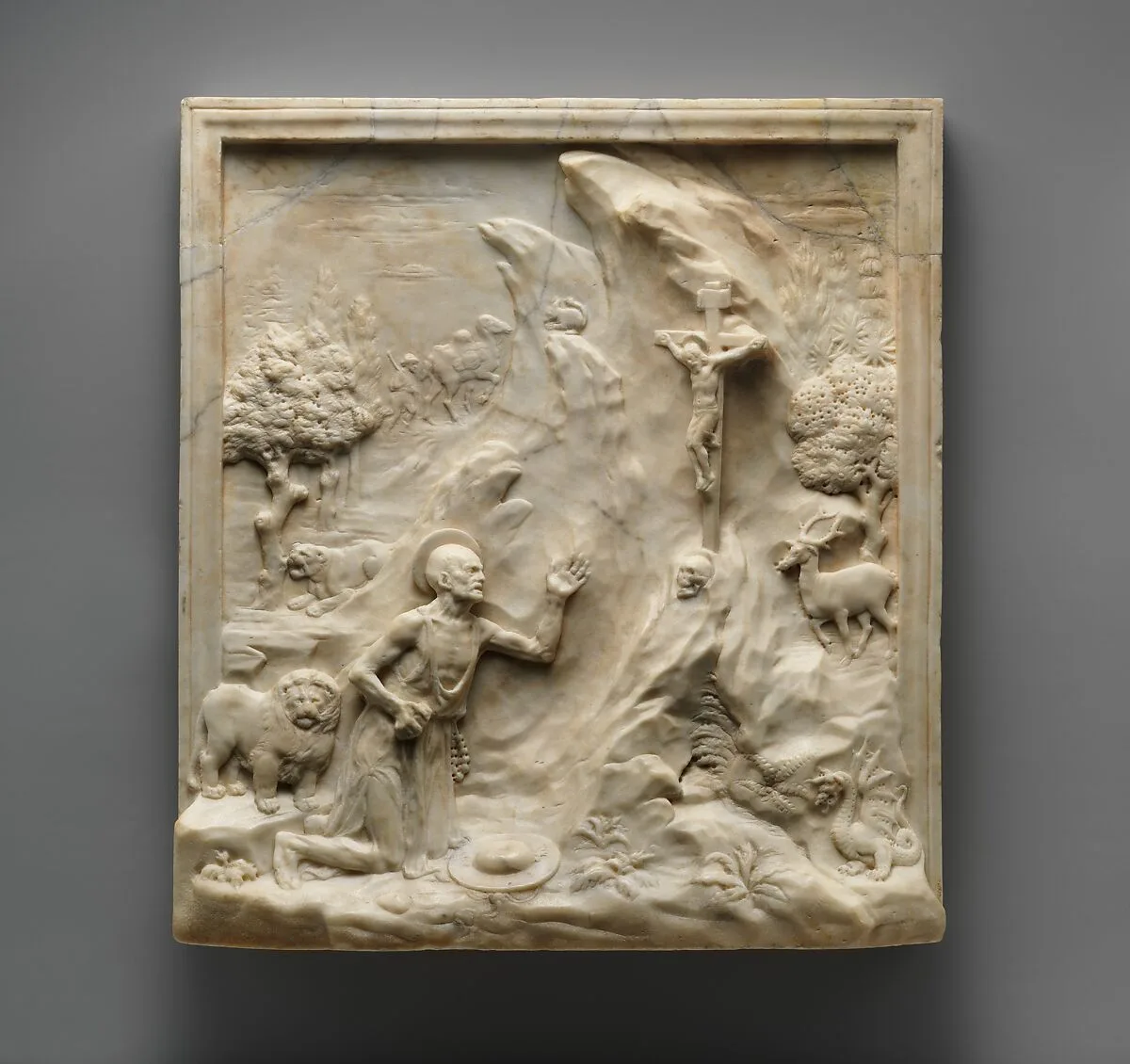
The hermit-scholar Saint Jerome was particularly venerated in humanist Florence. Here, he kneels before a cruficifx, his cardinal's hat at his feet. A stream, the water of life, flows from beneath the crucifix in a landscape inhabited by various symbolic creatures. The stage signifies thirst for salvation (Psalm 42). The squirrel stand for endurace or the search for divinity. The lion, whose paw Saint Jerome healed, is followed by a lioness; they may symbolize constancy and also the dangers that the saint faced - certainly the meaning of the wyvern at bottom right. The camel alludes to Jerome's only glimpse of humanity in the wilds, the occasional camel driver. The traditional attribution to Antonio Rossellino has to be revised. The naive but felicitous plants and animals, the drill work, and the atmospheric staging find perfect counterparts in the earliest works believed to be by Benedetto: marble reliefs (1468–71) for the shrine of Saint Savinus in Faenza Cathedral, particularly a scene of his vision, the starting point of our Jerome. In both, Benedetto abandoned the linear perspective that had preoccupied his peers in favor of an arier continuum. The foreground spilling over the bottom edge derives from the reliefs of Lorenzo Ghiberti's "Gates of Paradise" for the Florence Baptistry.
- Artist
- Antonio Rossellino
- Date
- ca. 1470
- Medium
- Marble
- Culture
- Italian, Florence
- Department
- European Sculpture and Decorative Arts
- Credit line
- Purchase, Rogers Fund and Lila Acheson Wallace Gift, 2001