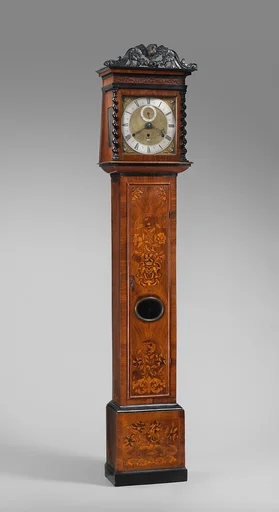
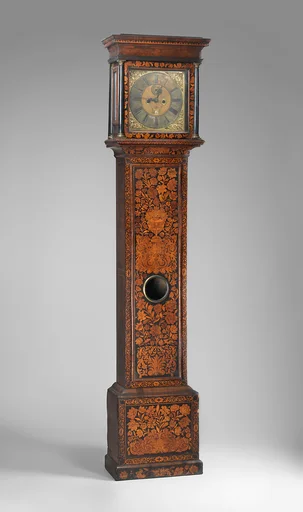
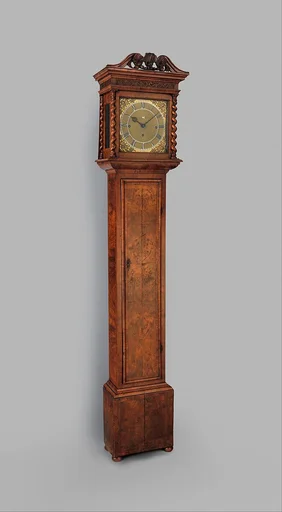
Longcase clock with calendrical, lunar, and tidal indications, also known as the Graves Tompion
Thomas Tompion|Jasper Braem
ca. 1677–80 · Case: oak veneered with walnut, panels of oystershell-cut olive wood; marquetry panels of green-stained bone, ivory, various woods; mounts: gilded brass; dial: gilded and silvered brass; movement: brass, steel · European Sculpture and Decorative Arts
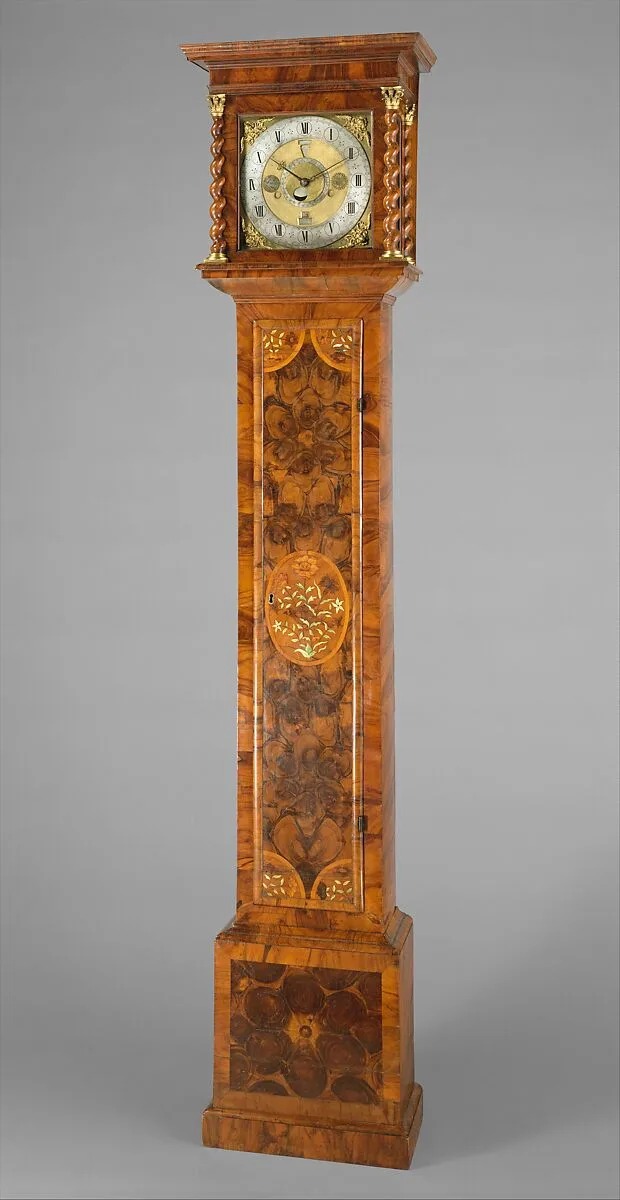
Tompion combined the technical advances made by English clockmakers with his own superb workmanship and ingenious designs to produce timepieces that contributed vastly to the fame of English clock making in the second half of the seventeenth century. One of Tompion's earliest surviving longcase clocks, this example was made before he began systematically numbering his works sometime after 1685. The dial indicates hours and minutes, subdivided into ten-second intervals (on the silvered chapter ring), calendrical information (in various apertures), and the phases, aspects, and ages of the moon in its monthly cycle, as well as times of high tide at London Bridge (on the central revolving disk). The eight-day, weight-driven movement, with anchor escapement and long pendulum, strikes in an unusually complicated way: full and half hours are struck respectively on large and small vertically mounted bells, and the first and fourth quarters, once and twice respectively, as double blows on small horizontally mounted bells. The beautifully proportioned case, with panels of floral marquetry and oystershell-cut veneer and applied Baroque columns supporting crisply detailed Corinthian capitals framing the dial, is also an unusually fine product of the late 1670s.
- Artist
- Thomas Tompion|Jasper Braem
- Date
- ca. 1677–80
- Medium
- Case: oak veneered with walnut, panels of oystershell-cut olive wood; marquetry panels of green-stained bone, ivory, various woods; mounts: gilded brass; dial: gilded and silvered brass; movement: brass, steel
- Culture
- British, London
- Department
- European Sculpture and Decorative Arts
- Credit line
- Bequest of Marilyn Preston Graves, 1999