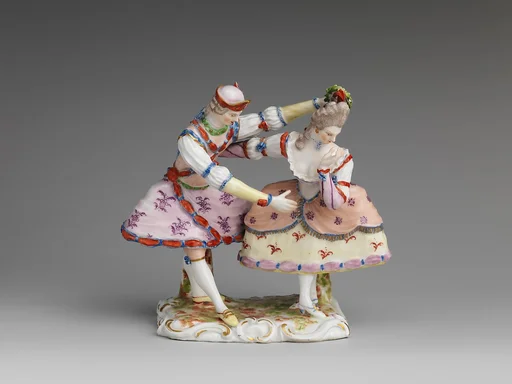
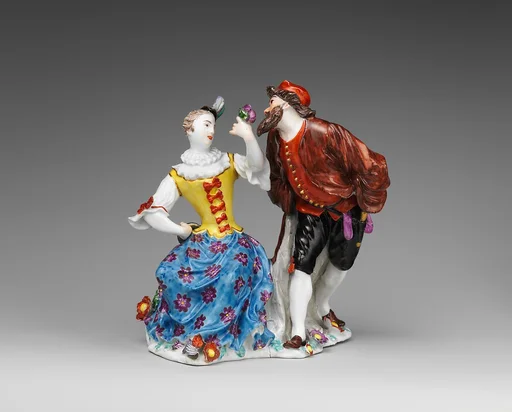
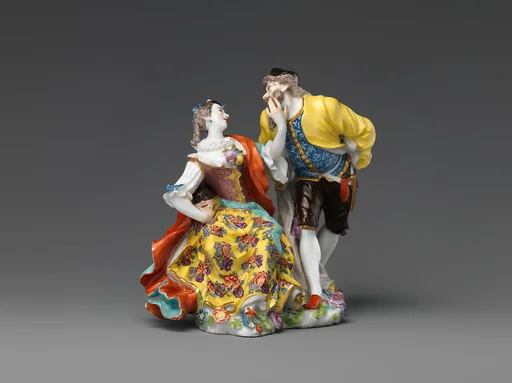
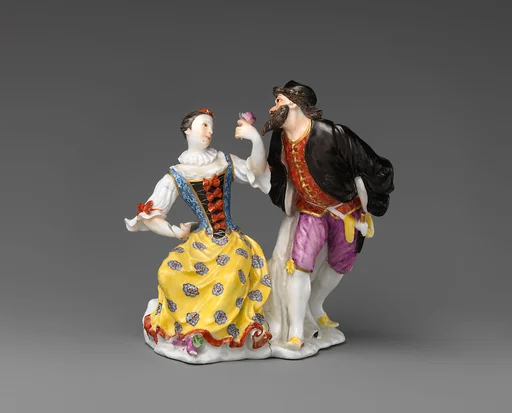
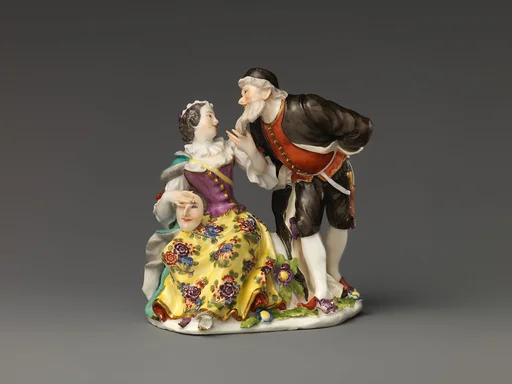
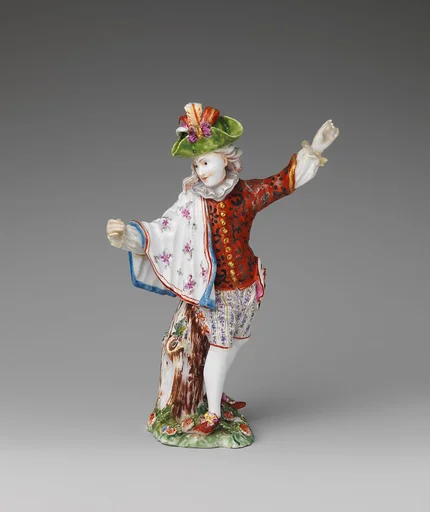
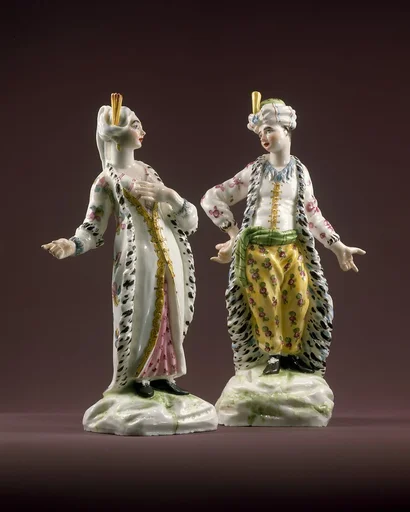
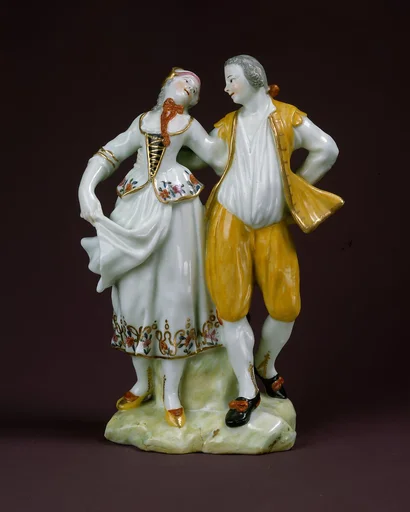
Two Opera Singers
Johann Joachim Kändler|Meissen Manufactory|Charles Nicolas Cochin II
1749–50 · Hard-paste porcelain · European Sculpture and Decorative Arts
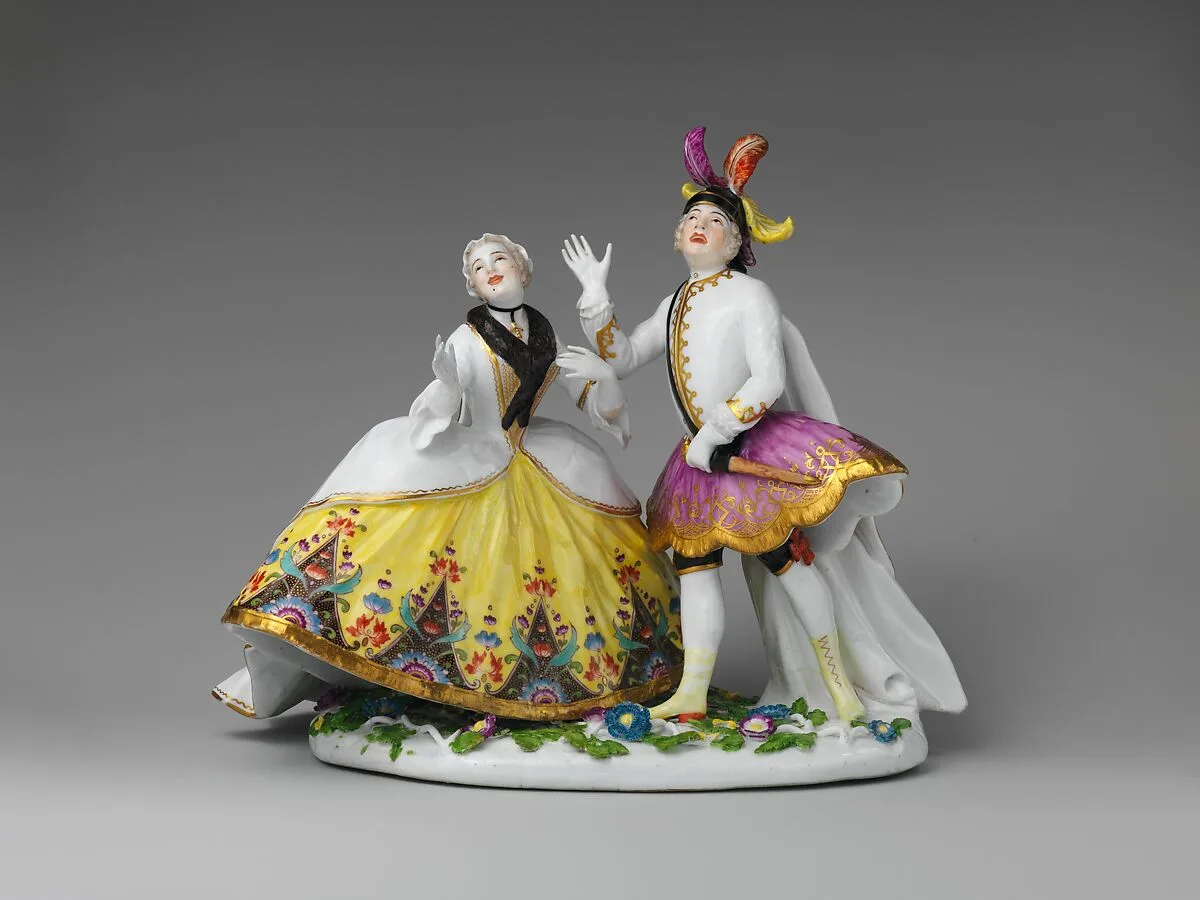
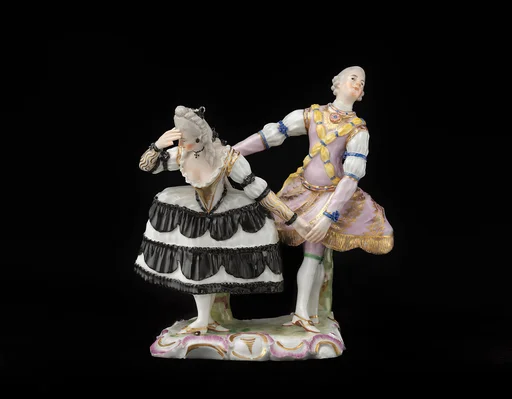
This figure group represents two opera singers engaged in a duet. Their identities as singers are reflected as much by their theatrical gestures as by their elaborate costumes. The group has been interpreted as depicting a duet from Acis and Galatea as performed by Madame de Pompadour and the prince de Rohan, an event known to have taken place in the theater of Versailles in 1749.[1] However, subsequent identification of a group corresponding to this model in the workbook of the Meissen modeler Kändler dating from March 1744 – five years earlier – indicates the impossibility of this interpretation.[2] Kändler's entry refers to the male singer's Roman outfit (Römischen Habit), and it is clear that his costume and plumed helmet were intended to identify him as a classical and hence heroic figure. His wide scalloped skirt was known as a tonnelet and was frequently worn by male singers and ballet dancers. The popularity of porcelain figures depicting singers reflects high status of opera at the Dresden court. A new opera house designed by the court architext Matthäus Daniel Pöppelmann had been built next to the Zwinger Palace in 1718–19, during the reign of Augustus the Strong, and its interior was remodeled in 1738 and again in 1747. The choice of opera singers – either specific or generic, as in this group – for representing in the relatively new and highly valued medium of porcelain[3] indicates the importance ascribed to this aspect of Dresden court culture. [1] Yvonne Hackenbroch, Meissen and Other Continental Porcelain, Faience and Enamel in the Irwin Untermyer Collection (Cambridge, mass., 1956), p. 35 [2] Ingelore Menzhausen, In Porzellan verzaubert" Die Figuren Johann Joachim Kändlers in Meissen aus der Sammlung Pauls0Eisenbeiss Basel (Basel, 1993), p. 117. [3] The formula for true or hard-paste porcelain was discovered in Europe in Dresden in 1708, which led to the founding of the Meissen factory in 1710.
- Artist
- Johann Joachim Kändler|Meissen Manufactory|Charles Nicolas Cochin II
- Date
- 1749–50
- Medium
- Hard-paste porcelain
- Culture
- German, Meissen
- Department
- European Sculpture and Decorative Arts
- Credit line
- Gift of Irwin Untermyer, 1964