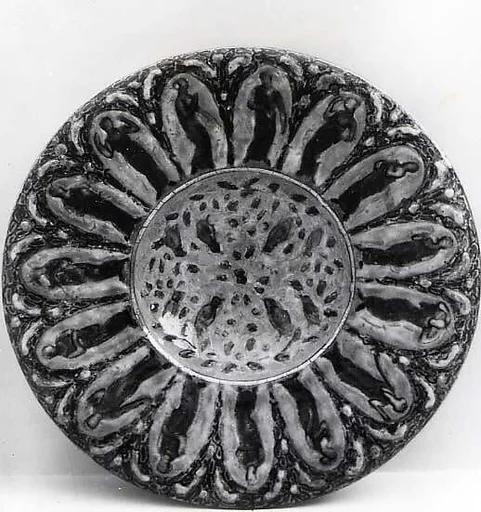
Dish
Bernard Palissy
19th century · Lead-glazed earthenware · European Sculpture and Decorative Arts
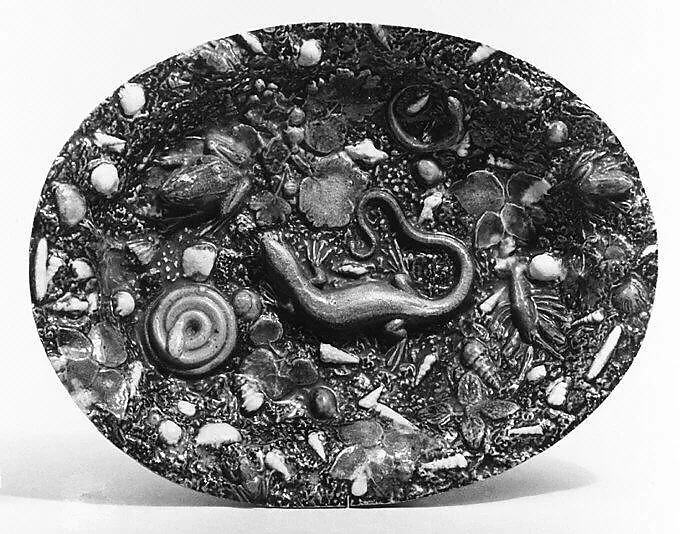
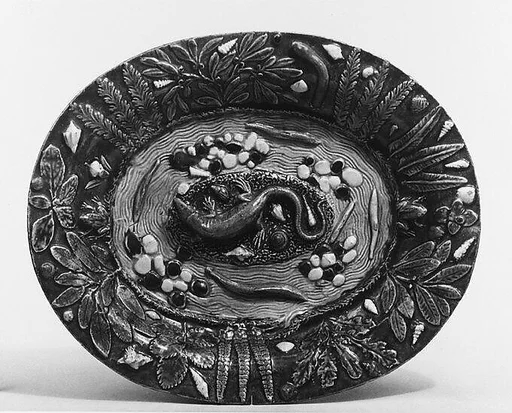
The sixteenth century was marked by a scientific interest in natural phenomena. New worlds had been discovered, occupied by animals and human beings never before seen in Europe. Museums of curiosities abounded, and self-styled naturalists, such as Cosimo de' Medici, gilded armadillos from the Americas and placed them on pillars in their palaces. Native Indians of the Americas toured the courts of Europe, and the taste for the exotic flourished. It was in this atmosphere that the talented French potter Bernard Palissy began practicing his trade. An enthusiastic natural scientist, Palissy used local fish, plants and reptiles—he made casts of actual specimens for use in his modeling—fashioned in a range of colored glazes, to develop what he called "pastoral pottery." Although he is recorded as having produced his rustic ware in abundance, the only documented work by his hand was the grotto (now destroyed) in the garden of the Tuileries. This oval dish, in the manner of Palissy, is in the shape of a pond surrounded by plant life. Perched on the plate are fish, frogs, a twisting snake, a lizard, a water beetle, crayfish, and a variety of occupied shells.
- Artist
- Bernard Palissy
- Date
- 19th century
- Medium
- Lead-glazed earthenware
- Culture
- French
- Department
- European Sculpture and Decorative Arts
- Credit line
- Gift of Julia A. Berwind, 1953
![[Tabby Shell Construction Detail, St. Mary's, Georgia]](https://d2pvxr3eb77vb4.cloudfront.net/assets/v1/db/db860d5d04ccaa001e8dd995404c9479bd15c393f19650fd5aa4241f29c39ca5/graph.webp)