Rolltop desk
David Roentgen|Januarius Zick|Thomas Chippendale
ca. 1776–79 · Oak, cherry, pine, mahogany, veneered with maple, burl woods, holly, hornbeam (all partially stained), tulipwood, mahogany, and other woods; mother-of-pearl; partially gilded and tooled leather; gilt bronze, iron, steel, brass, partially gold-lacquered brass · European Sculpture and Decorative Arts
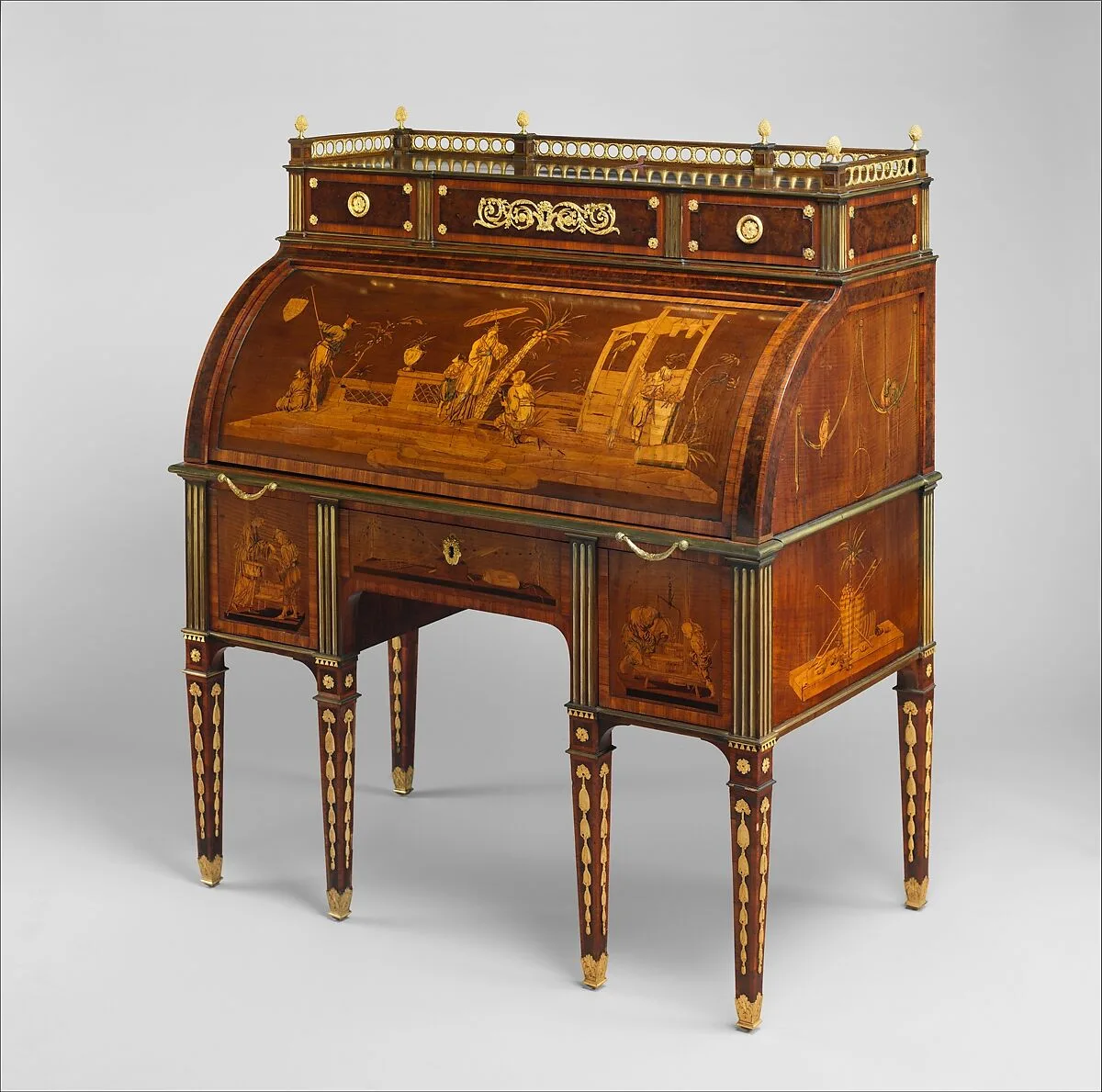
This rolltop desk demonstrates the inventive talent of its maker, distinguished by six legs instead of the usual four. The chinoiserie marquetry scenes have a painterly effect that Roentgen alone attained, using minute pieces of naturally colored exotic woods. His mechanical ingenuity is exemplified by the workings of the lower section of the desk: when the key of the lower drawer is turned to the right, the side drawers spring open; if a button is pressed on the underside of these drawers, each swings aside to reveal three other drawers. The monogram DR, inlaid on the drawer below the keyhole, indicates the cabinetmaker's satisfaction, as his work is rarely signed. The turn of the key commands which side opens. The interior is decorated in the restrained French Neoclassical style with mahogany and gilded mounts. The outside was once colorful, as the Chinoiserie marquetry is set into maple panels, perhaps stained gray, evoking a silky fabric popular in the late 1770s. Like a theater scrim, it would have set off the scenes of Chinese life. Although Roentgen maintained his workshop at Neuwied, Germany, where this desk was made between 1776 and 1778, his French clientele became so important that he opened an outlet in Paris and joined the Parisian guild in 1780.
- Artist
- David Roentgen|Januarius Zick|Thomas Chippendale
- Date
- ca. 1776–79
- Medium
- Oak, cherry, pine, mahogany, veneered with maple, burl woods, holly, hornbeam (all partially stained), tulipwood, mahogany, and other woods; mother-of-pearl; partially gilded and tooled leather; gilt bronze, iron, steel, brass, partially gold-lacquered brass
- Culture
- German, Neuwied am Rhein
- Department
- European Sculpture and Decorative Arts
- Credit line
- Rogers Fund, 1941