Greenery
John Henry Dearle|Merton Abbey Tapestry Works|John Martin|Morris & Company
designed 1892; woven 1915 · Wool, silk (11 warps per inch, 4 per cm.) · European Sculpture and Decorative Arts
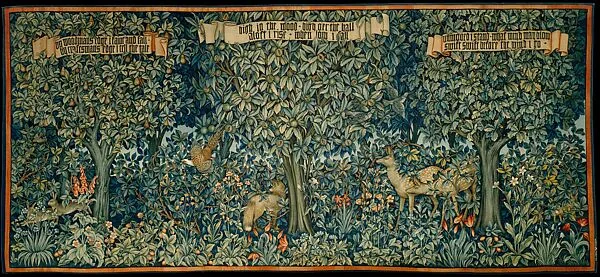
This tapestry was woven at the Merton Abbey Tapestry Works. William Morris had founded the workshop at Merton, in Surrey, near London, in 1881 as part of his vision to use the integrity of medieval craftsmanship to revitalize the art and design of postindustrial Britain. Although only woven in 1915, the design for this tapestry was made by John Henry Dearle in 1892, imitating William Morris's style in the trees and that of Philip Webb in the animals. The three riddles, composed by William Morris, give voice to the trees, alluding to the purpose the timber from each would serve after felling: the first, pear-wood, was commonly used for decorative carving; the second, chestnut, was traditionally made into roof rafters; the third, oak, tended to be the lumber of choice for building sailing ships. Greenery unites Victorian sentimentality with the loftier ideals of the Arts and Crafts Movement: Morris founded the Merton Abbey Tapestry Works in 1881 as part of his vision to use the integrity of medieval craftsmanship to revitalize the art and design of postindustrial Britain.
- Artist
- John Henry Dearle|Merton Abbey Tapestry Works|John Martin|Morris & Company
- Date
- designed 1892; woven 1915
- Medium
- Wool, silk (11 warps per inch, 4 per cm.)
- Culture
- British, Merton Abbey
- Department
- European Sculpture and Decorative Arts
- Credit line
- Purchase, Edward C. Moore Jr. Gift, 1923