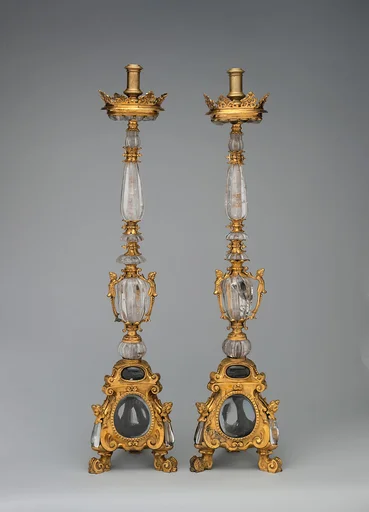
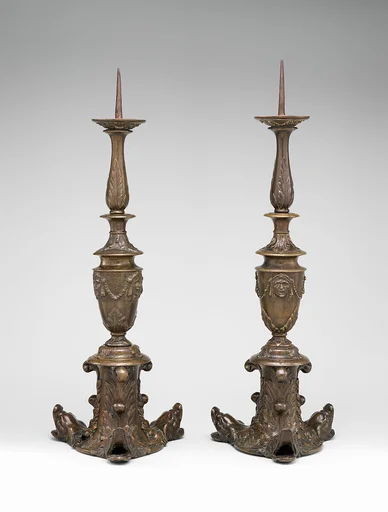
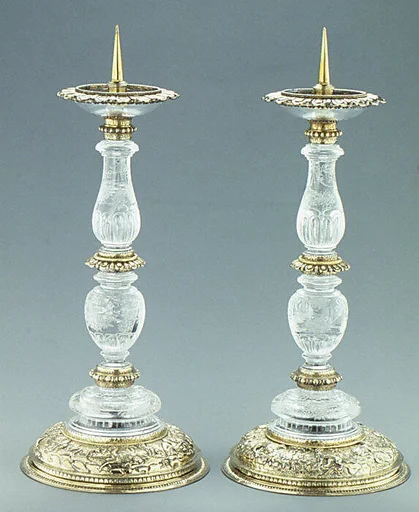
Altar candlestick (one of a pair)
Unknown
1610–20 · Bronze, fire-gilt; rock crystal · European Sculpture and Decorative Arts
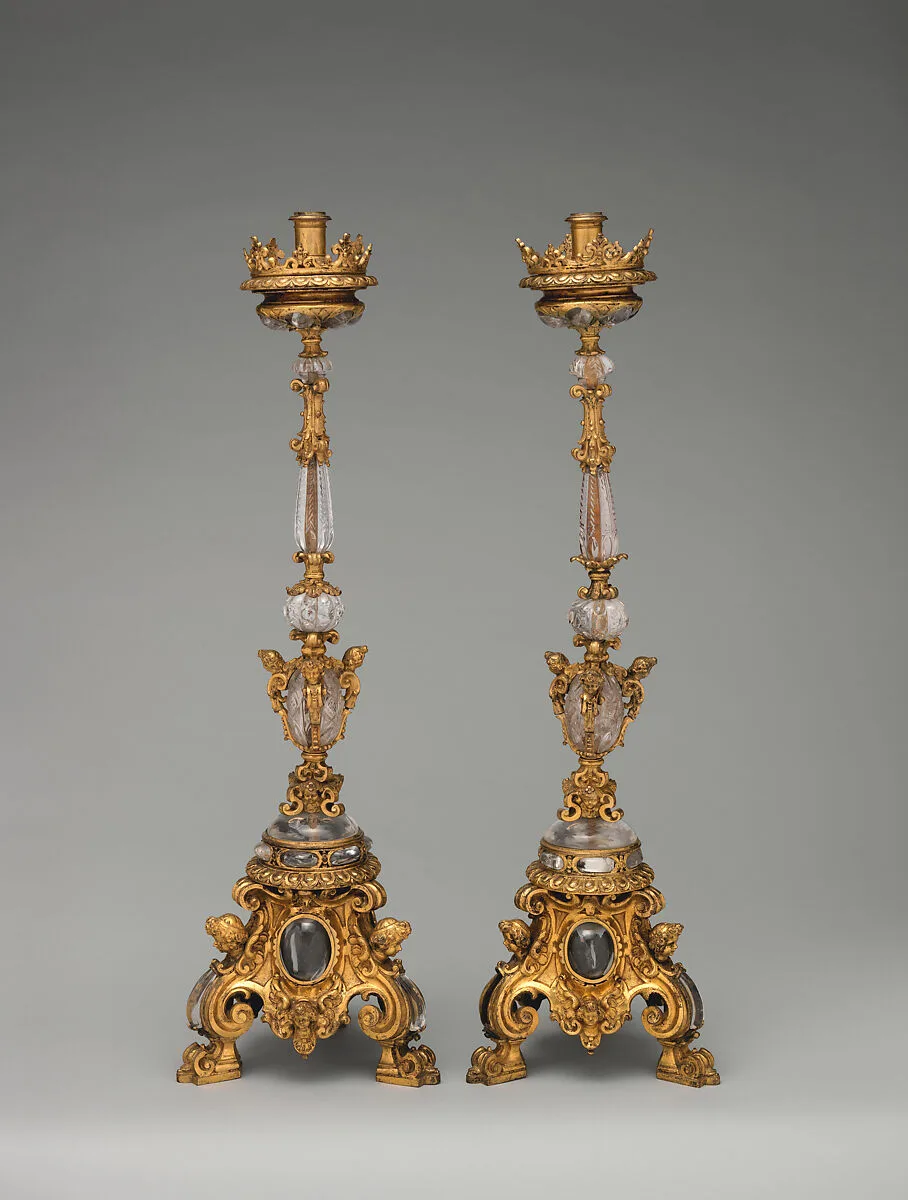
These candlesticks were probably made for a church altar. The pair entered The Met with the donation of J. Pierpont Morgan in 1917 but seem never to have been on view. They were previously dated to the eighteenth century, however the style and materials point to an earlier date, possibly the second decade of the seventeenth century. The combination of rock crystal and gilt bronze was common in Italian production of metal religious objects in the early seicento. Here, the ornate rock crystal and the cherubs, their hair adorned with small flowers, recall the decorative output of Stefano Maderno and his workshop. Maderno was a prominent sculptor and gifted metalworker in Rome at the beginning of the seventeenth century.[1] The candlesticks could have been designed and then cast in one of the numerous goldsmiths’ shops active around the 1610s, after the completion of the monumental ciborium in the Sistine Chapel in the Basilica of Santa Maria Maggiore and the high altar of Santa Cecilia in Trastevere, where many sculptors and goldsmiths jointly produced lavish decorations under Maderno’s supervision. -PD’A Footnotes (For key to shortened references see bibliography in Allen, Italian Renaissance and Baroque Bronzes in The Metropolitan Museum of Art. NY: The Metropolitan Museum of Art, 2022.) 1. For Stefano Maderno, see Dickerson 2008 and Arnaboldi 2008.
- Artist
- Unknown
- Date
- 1610–20
- Medium
- Bronze, fire-gilt; rock crystal
- Culture
- Italian, possibly Rome
- Department
- European Sculpture and Decorative Arts
- Credit line
- Gift of J. Pierpont Morgan, 1917