Alexander the Great (?)
Unknown
ring: mid-16th century; cameo: early Hellenistic 4th century BCE · Turquoise, enamel, gold · European Sculpture and Decorative Arts
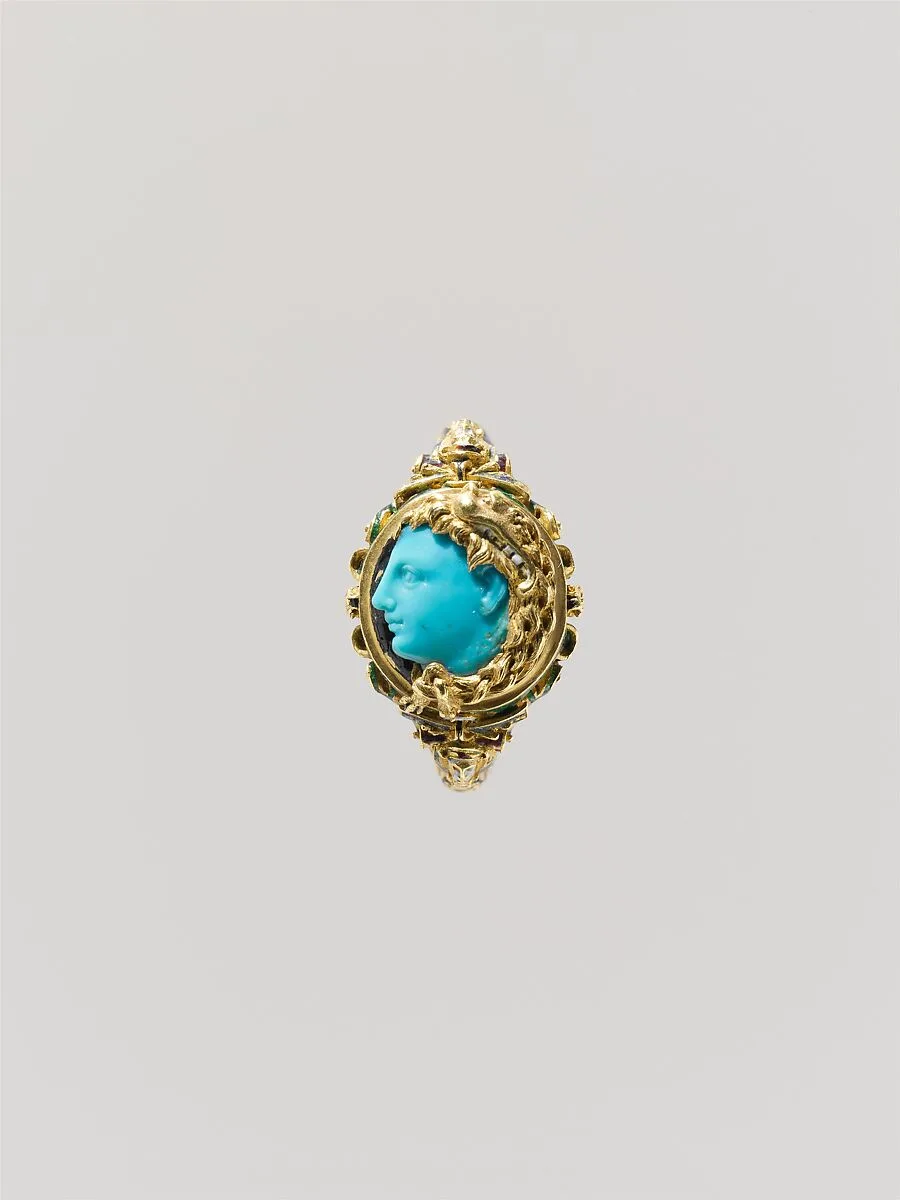
This vibrant carving has previously been described as made of glass and as a product of the French Renaissance, but it is in turquoise, a rarity in cameos of any period. That it is reputed to have been in the Este collections may make an Italian origin likelier. It is not to be ruled out even that the stone is Hellenistic, from as early as the fourth century B.C., but the heroic type of Alexander the Great’s profile was adopted by various Hellenistic successors. In any case, the person who caused it to be set surely thought of it as ancient and as representing Alexander. It is probably a fragment whose broken edges the goldsmith has deftly concealed by forming the bezel as a lion skin, a motif that Alexander borrowed from Hercules.
- Artist
- Unknown
- Date
- ring: mid-16th century; cameo: early Hellenistic 4th century BCE
- Medium
- Turquoise, enamel, gold
- Culture
- probably Italian
- Department
- European Sculpture and Decorative Arts
- Credit line
- Rogers Fund, 1910