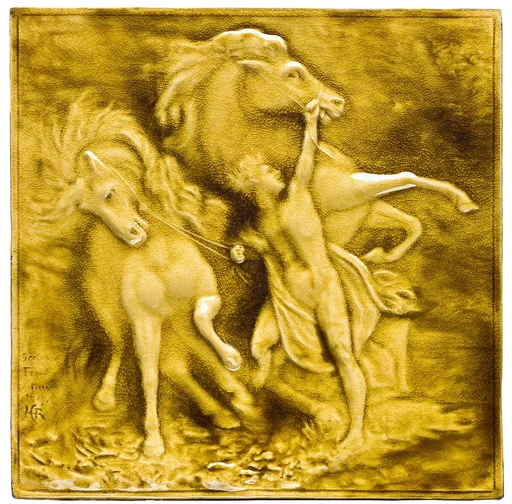
The Horses of Anahita or The Flight of Night
William Morris Hunt
ca. 1848–50, cast by 1880 · Plaster, tinted · The American Wing
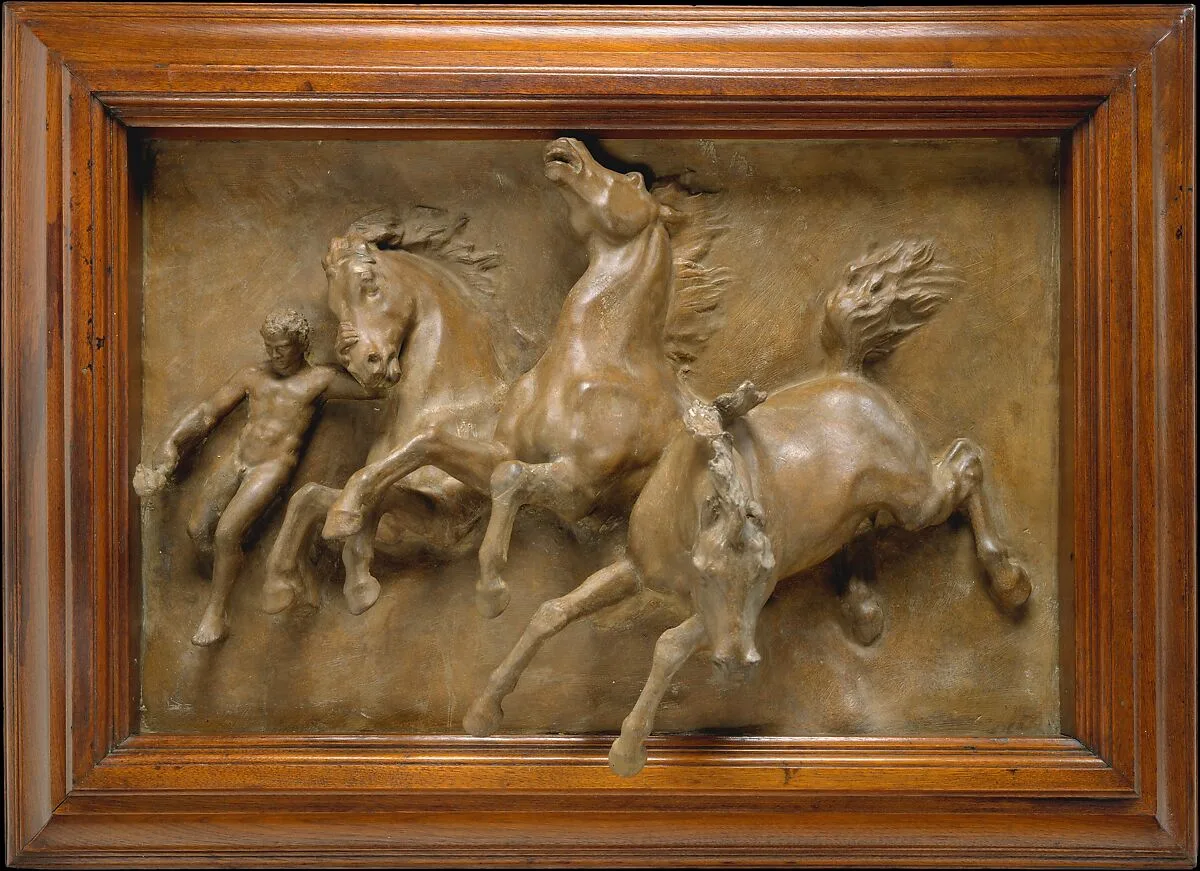
The theme of Anahita, Persian goddess of the moon and the night, and the forces of darkness yielding to the coming of light occupied Hunt intermittently throughout his career. Hunt's earliest extant Anahita work may be a pencil sketch, probably from 1847 (American Institute of Architects Foundation, Washington, D.C.), which includes three frenzied horses and an unresolved form of an attendant. In 1848 Hunt began to model the three horses into a high-relief sculpture, perhaps because he was having difficulty working out the plunging horses in two dimensions and much of his training thus far was in sculpture. The illusionistic plaster is a tour de force of alto-relievo sculpture. The charging horses-one restrained by a man holding a torch-burst forth from the background, creating a lively animated surface and a dramatic play of light and shadow. The three-dimensional composition was later incorporated, with slight variation, into Hunt's design for one of the two murals he painted in lunettes in the Assembly Chamber of the New York State Capitol in Albany.
- Artist
- William Morris Hunt
- Date
- ca. 1848–50, cast by 1880
- Medium
- Plaster, tinted
- Culture
- American
- Department
- The American Wing
- Credit line
- Gift of Richard Morris Hunt, 1880