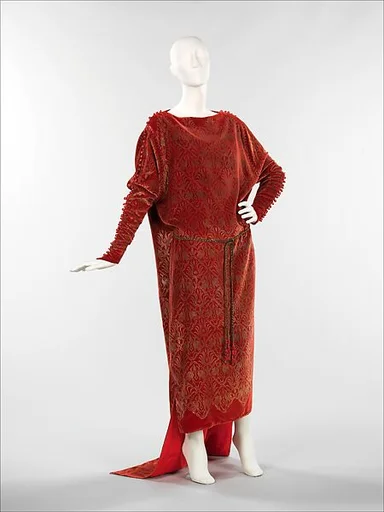
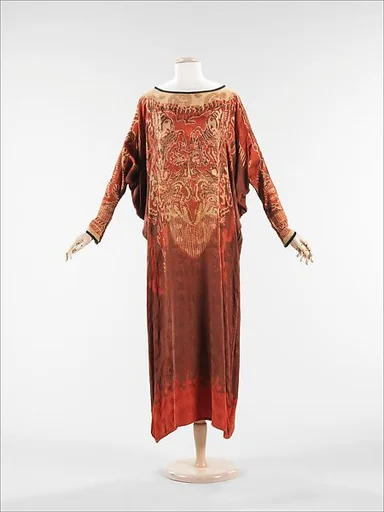
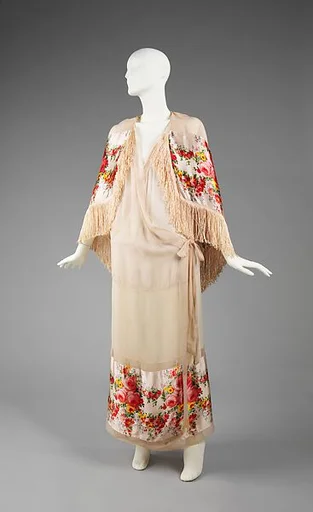
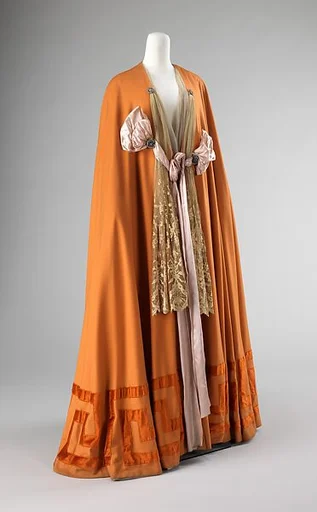
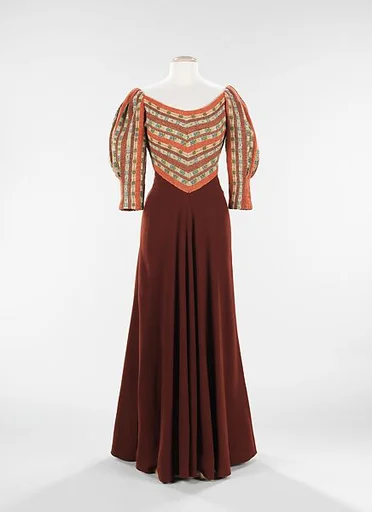
"Robe Sabat"
Paul Poiret
1921 · silk, metal · Costume Institute
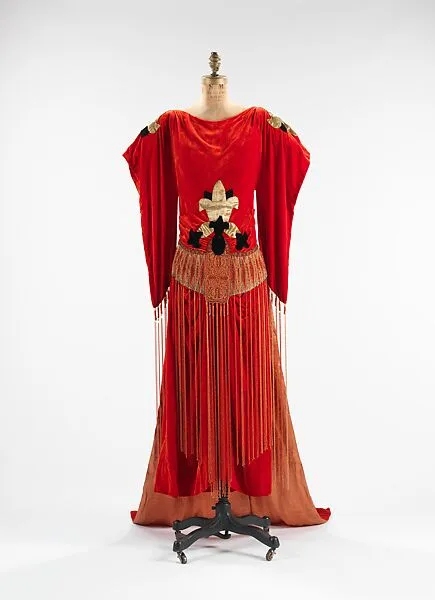
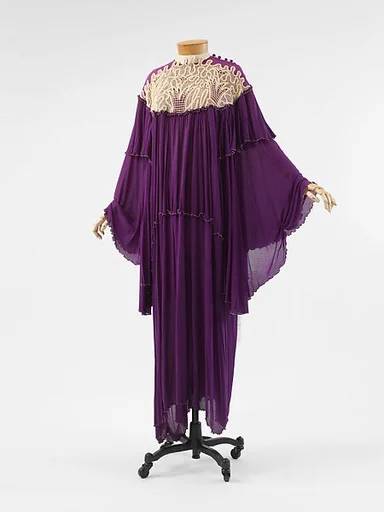
Poiret's cultural fascination can be seen in this dress, which is named for the historical Middle Eastern kingdom, Sheba. The beadwork belt and fringe assist in evoking the exotic feel while the fleur-de-lis puts the gown in a national context. Paul Poiret was the son of a textile distributor with the ambition and creativity to become a fashion designer. Brief employment for Jacques Doucet (1853-1929) and the House of Worth (1858-1956) led him to open his own dressmaking shop near the Place de l'Opèra in 1903 at the age of 24. His first two design albums, "Les Robes de Paul Poiret" drawn by Paul Iribe (1883-1935) in 1908 and "Les Choses de Paul Poiret" created by Georges Lepape (1887-1971) in 1911, not only changed the concept of fashion marketing and illustration, they prophesied the pivotal transition women made from the corseted silhouette of the Victorian age into the natural and sleek un-corseted form of the modern era. The tubular shape and folkloric trimmings he presented were continuously part of the Poiret vocabulary as well as draping, which proved ingenious in the time of tailoring and drafting.
- Artist
- Paul Poiret
- Date
- 1921
- Medium
- silk, metal
- Culture
- French
- Department
- Costume Institute
- Credit line
- Brooklyn Museum Costume Collection at The Metropolitan Museum of Art, Gift of the Brooklyn Museum, 2009; Augustus Graham School of Design Fund, 1973