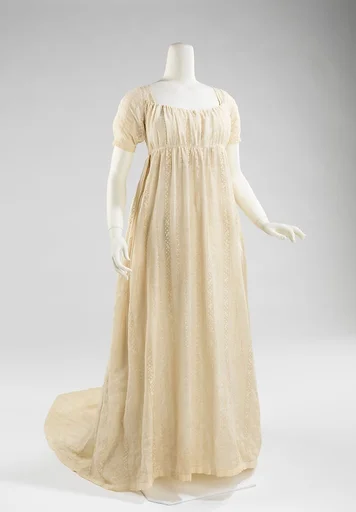
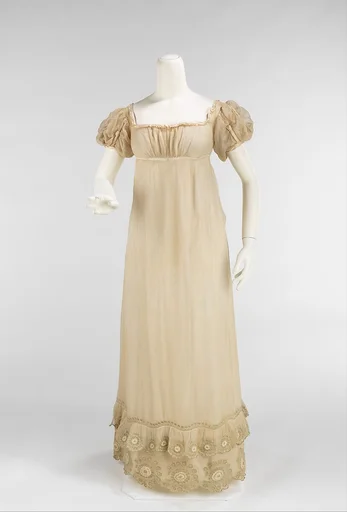
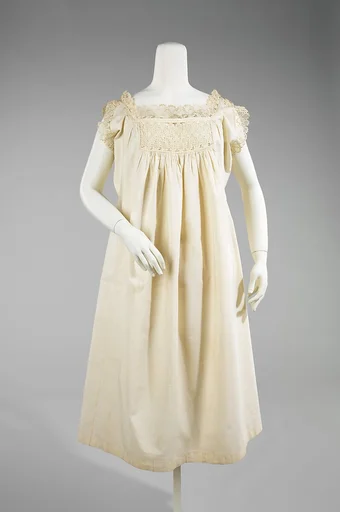
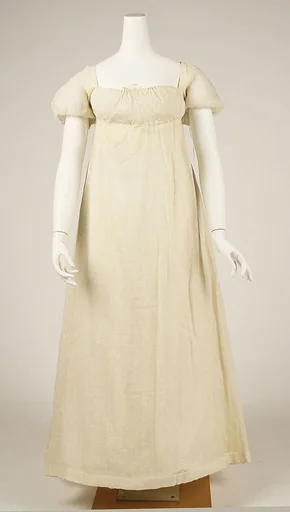
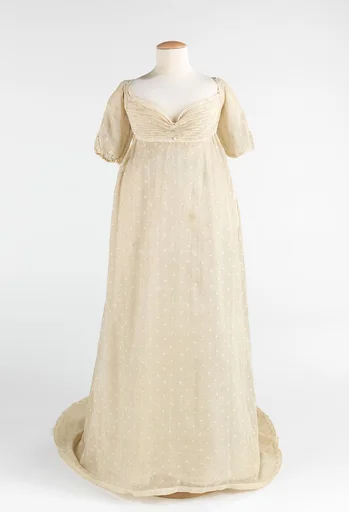
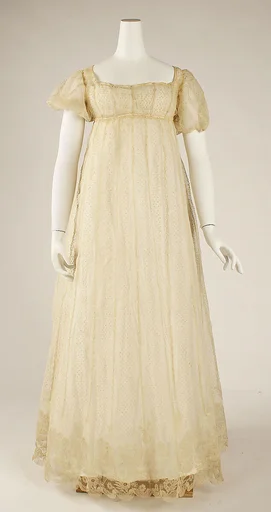
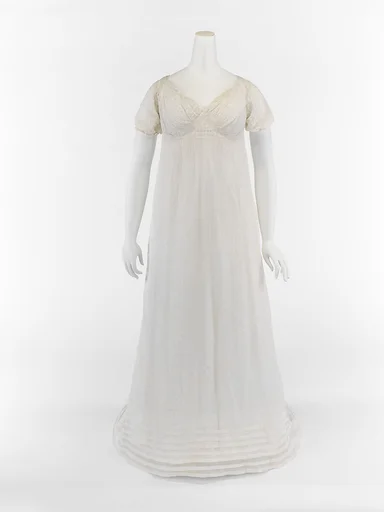
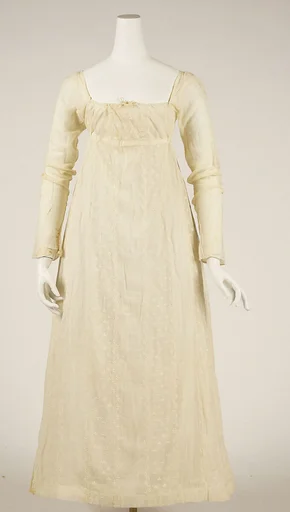
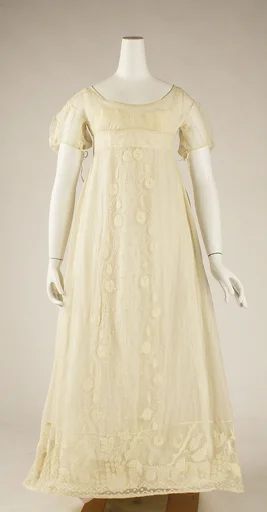
Evening dress
Unknown
1809–10 · cotton · Costume Institute
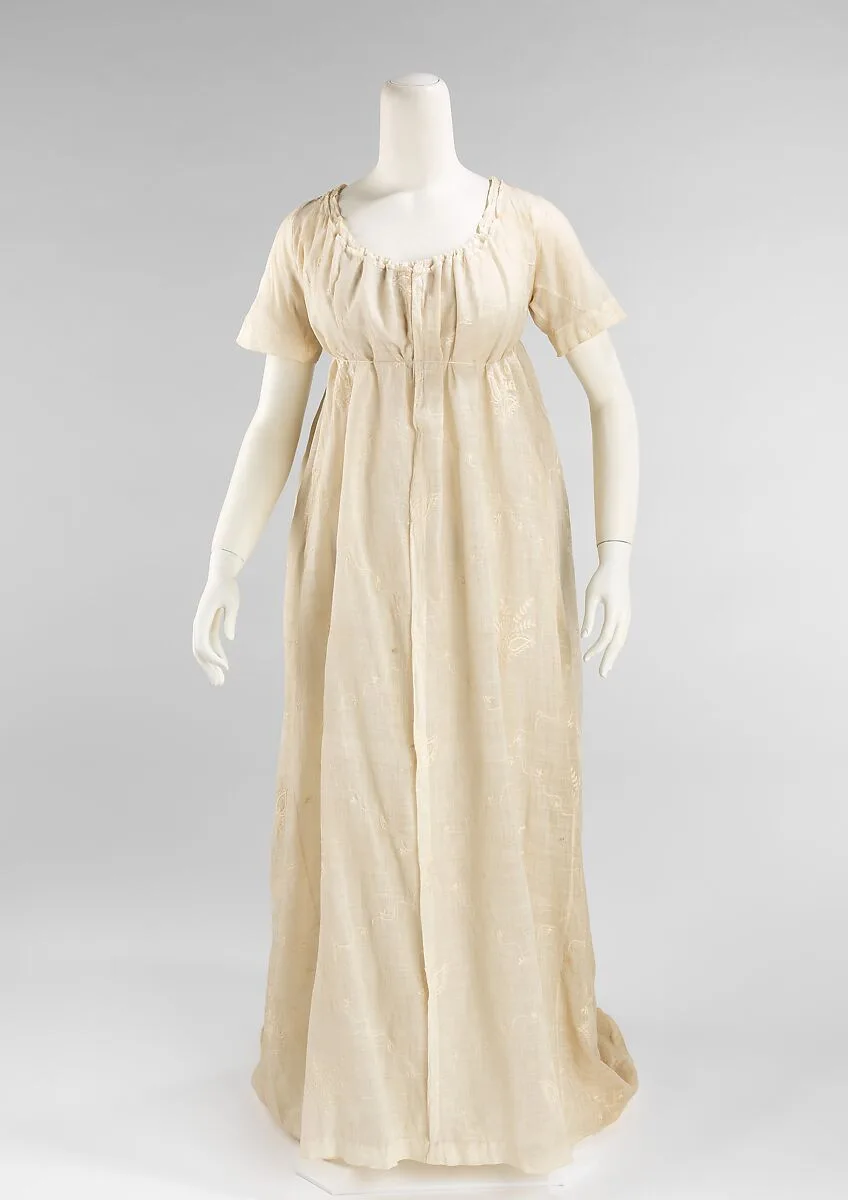
Fine Indian muslin used in the Empire period was manufactured and embroidered in India and exported to Europe and America. The finest and most sheer cottons were coveted because for these qualities. The embroidery on this dress is beautifully configured within the lines of the gown, most notably the way the lattice pattern is completed over the seam at front and the leaf pattern appears at intervals. The Empire silhouette is readily identified with its origins in the chiton of ancient Greco-Romans, which was a tubular garment draped from the shoulders and sometimes belted beneath the bust. Several re-interpretations have occurred throughout costume history but none have been as notable as the period bridging the rectangular panierred skirts of the 18th century and the conical hoop skirts of the 19th century. The neoclassic style was adopted in all forms of decoration after the French Revolution and was upheld during the Napoleonic Wars partly due to Napoleon Bonaparte's (1769-1821) alliance with Greco-Roman principles. In fashion, the style began as children's wear made from fine white cotton, but was adopted by women in the form of a tubular dress with skirts that were gathered under the bust with some fullness over a pad at the back. As the style progressed the skirts began to flatten at the front and solely gather from the bodice at the center back. The style persisted until the 1820s when the waist slowly lowered and the skirts became more bell shaped.
- Artist
- Unknown
- Date
- 1809–10
- Medium
- cotton
- Culture
- American
- Department
- Costume Institute
- Credit line
- Brooklyn Museum Costume Collection at The Metropolitan Museum of Art, Gift of the Brooklyn Museum, 2009; Gift of Mrs. M. Dow Brine, 1924