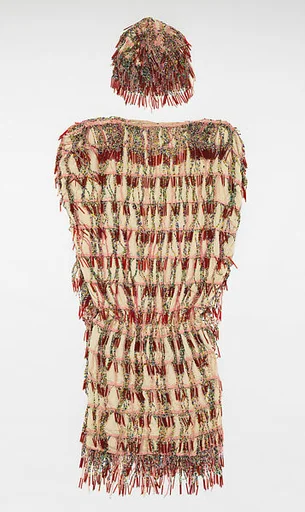
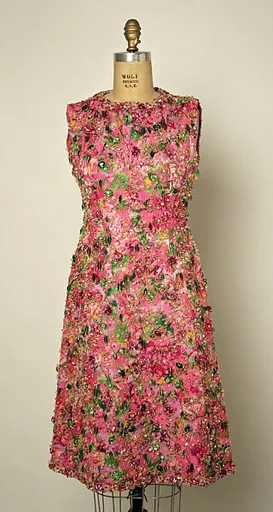
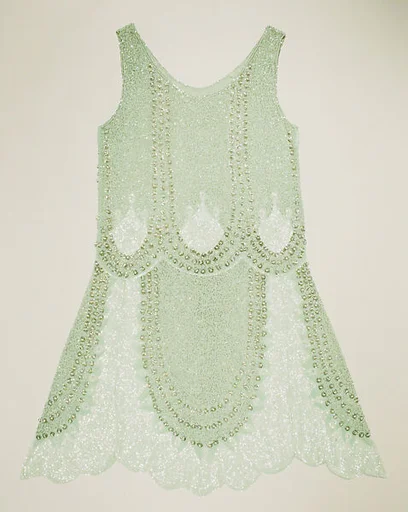
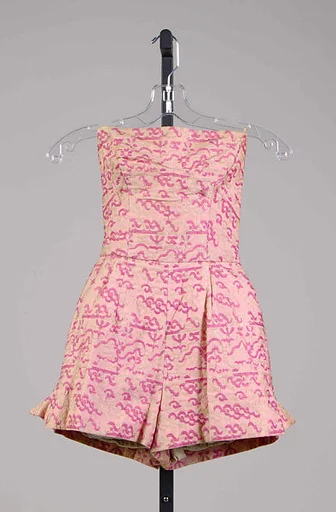
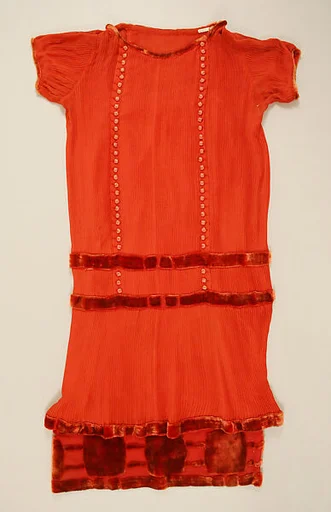
"Roseraie"
Jeanne Lanvin|House of Lanvin
spring/summer 1923 · silk · Costume Institute
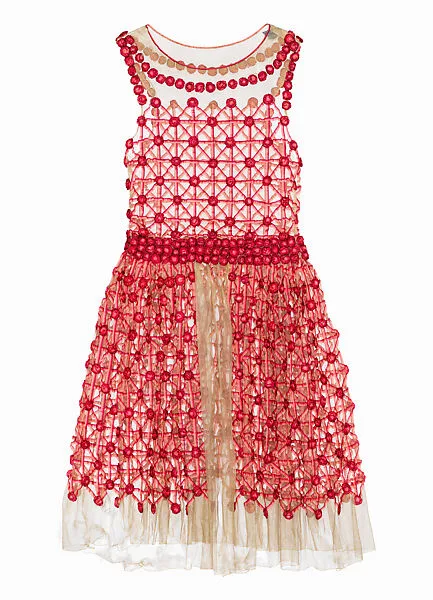
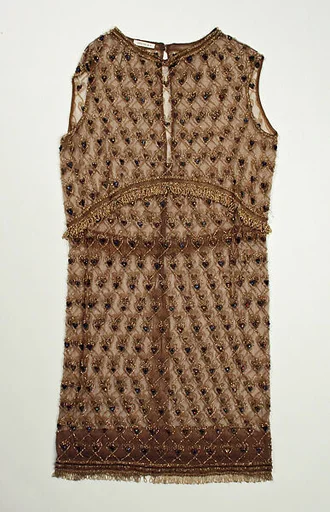
Jeanne Lanvin was apprenticed to a milliner and a dressmaker before opening her own millinery shop in 1889. She expanded into dressmaking when her clients began asking for the ensembles in which she adorned her daughter, Marguerite di Pietro (1897-1958). Her style embodied the femininity of youth in a most modern way with meticulous and relatively sparse surface embellishments and robe de style silhouettes, which could be worn by women of all ages. Lanvin's aptitude can be seen through her house's 1920s expansion into fur, lingerie, men's wear, household goods and perfume. She even had the forethought to open her own dye factory which produced the inimitable 'Lanvin blue.' The longevity of the House of Lanvin can be credited to her attentive management and design standards from its inception. The ribbon flower head designs of "Roseraie" are reminiscent of the floral designs of Art Nouveau architect Charles Rennie Mackintosh (1868-1928) and his wife Margaret MacDonald Mackintosh (1865-1933). Lanvin's version was originally created as a swatch at one of her embroidery studios in 1918-1919, according to Dean L. Merceron in his book "Lanvin." It was later used in this latticework to suggest a sense of youthful beauty evocative of designs at the 1925 Paris Exposition Internationale des Arts Décoratifs et Industriels Modernes. Lanvin's ability to manipulate applied ribbonwork, such as this, is one which she utilized continually to great success.
- Artist
- Jeanne Lanvin|House of Lanvin
- Date
- spring/summer 1923
- Medium
- silk
- Culture
- French
- Department
- Costume Institute
- Credit line
- Brooklyn Museum Costume Collection at The Metropolitan Museum of Art, Gift of the Brooklyn Museum, 2009; Anonymous gift, 1964