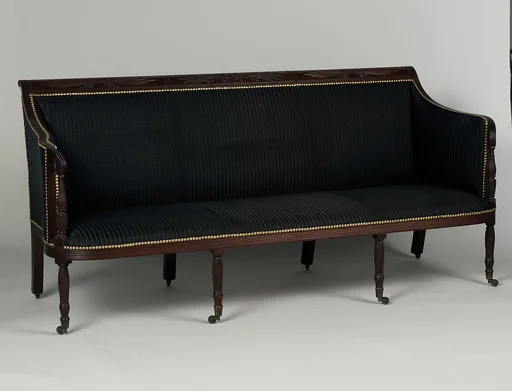
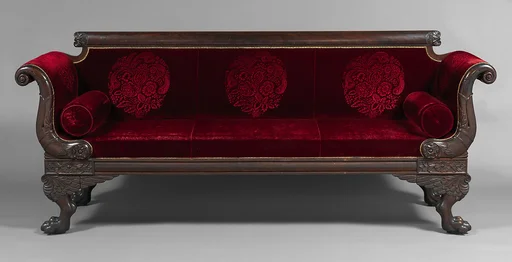
Couch
Duncan Phyfe & Sons|Duncan Phyfe
ca. 1837 · Mahogany, mahogany veneer, pine, ash, modern upholstery · The American Wing
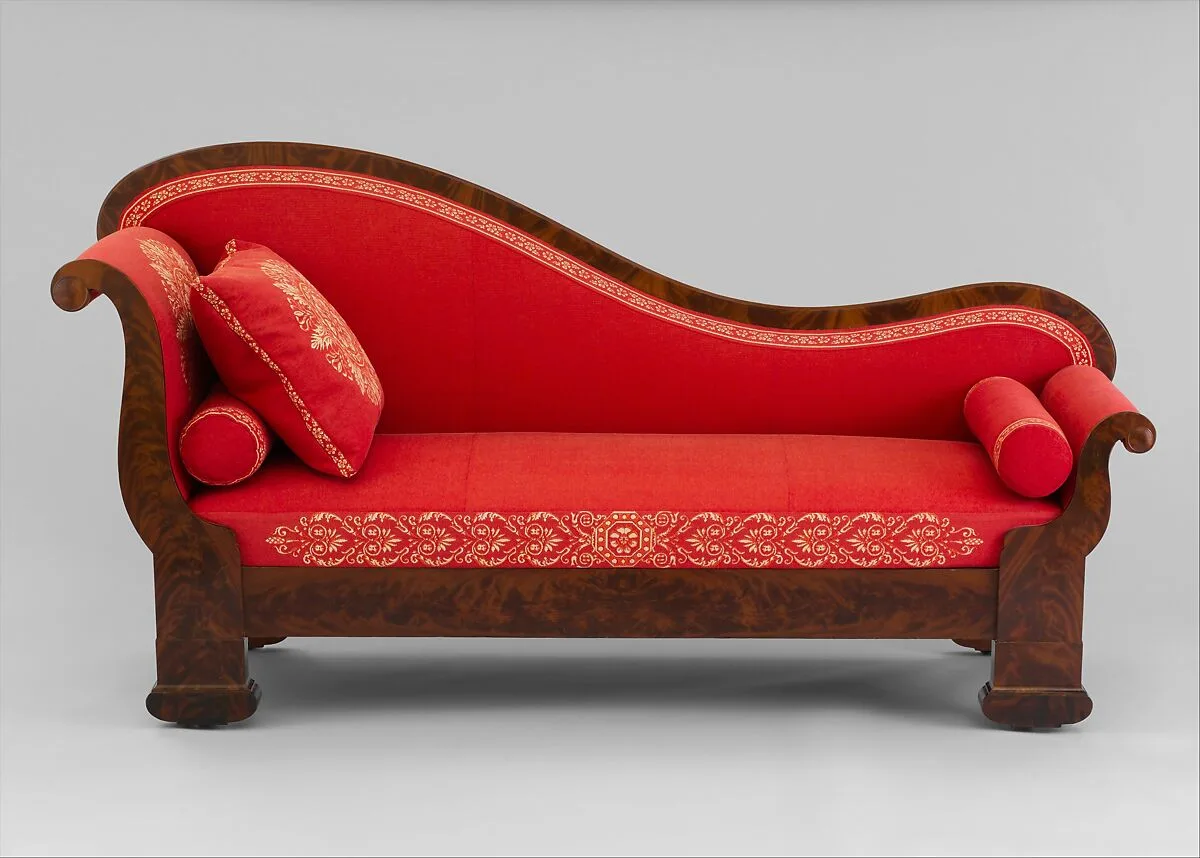
The scrolled armrests at opposite ends of this couch (and its pair 66.221.2) encouraged comfortable repose—or even a midday nap. In the early nineteenth century, designers and furniture makers embraced a revival of Classical prototypes from ancient Greek and Roman architecture and decorative arts. The sleek, curvaceous lines, and dramatic, figural mahogany veneers of this couch characterize the distinct Grecian Plain style that emerged in the 1820s to 1840s during the revival period. American cabinetmakers were highly influenced by French interpretations of Classical forms that circulated in design books and periodicals, such as Pierre de La Mésangère's Collection de Meubles et Objets de Goût (1820–1831). This couch and its pair are part of an expansive suite of seating furniture attributed to the workshop of cabinetmaker Duncan Phyfe (see 66.221.1–.10 and 1972.264.1–.2). It was made to furnish a New York City townhouse belonging to the lawyer Samuel A. Foot, located at 678 Broadway which had been completed in 1837. In 1847 the Foot family relocated to Geneva, New York, and sold the Broadway house to Foot's nephew, Thomas A. Davies. The Phyfe suite was likely moved to the family's new dwelling, a palatial Grecian-style villa named Mullrose (extant, though altered). The furniture came to the Museum through Foot’s descendants.
- Artist
- Duncan Phyfe & Sons|Duncan Phyfe
- Date
- ca. 1837
- Medium
- Mahogany, mahogany veneer, pine, ash, modern upholstery
- Culture
- American
- Department
- The American Wing
- Credit line
- Purchase, L. E. Katzenbach Fund Gift, 1966