Dress
Raymond Duncan
1920s · silk · Costume Institute
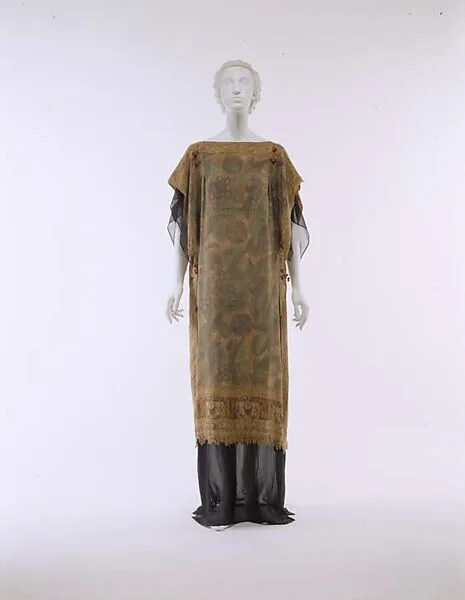
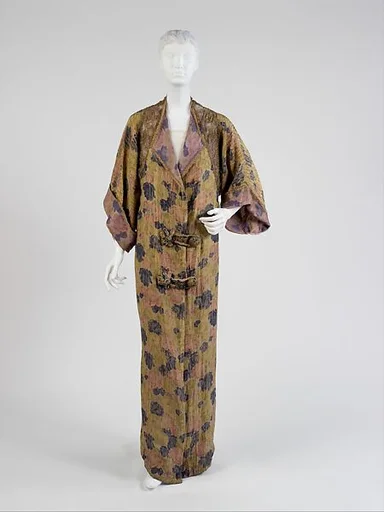
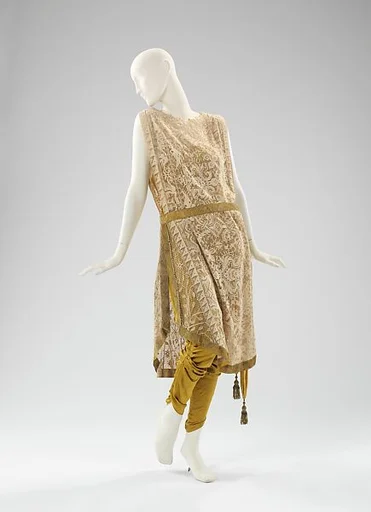
Raymond Duncan, the brother of Isadora, was always a fervent advocate of classical dress. So fanatical was his belief in the healthfulness of Grecian styles that Duncan had his son walk through Central Park in mid-winter clad only in a short chiton, chlamys, and sandals—an incident for which he was charged with the endangerment of a child. In ancient Greece, women were more substantially covered than men. A sleeveless woolen peplos or, as in the dress shown here, a tunic could be donned over a sleeved or sleeveless linen chiton. For this ensemble designed for his wife, Duncan hand-painted the overtunic. In place of a chiton, he substituted a similarly constructed but wider chiffon underdress. The pairing of an opaque tussah silk and a sheer chiffon is more evocative of nineteenth-century artistic conceits than it is of any antique Hellenic evidence. In addition, the pattern of the tunic is more closely aligned with the taste of the early twentieth-century Aesthetic Movement than it is with the patterns from classical Greece. The apples, grapes, and leaves, with their faint evocation of Dionysian pastoralism, are rendered in the Arts and Crafts style.
- Artist
- Raymond Duncan
- Date
- 1920s
- Medium
- silk
- Culture
- American
- Department
- Costume Institute
- Credit line
- Isabel Shults Fund, 1990