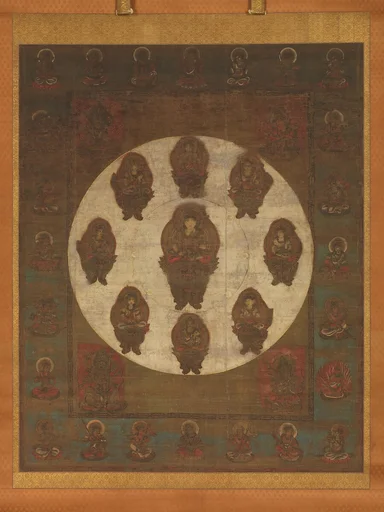
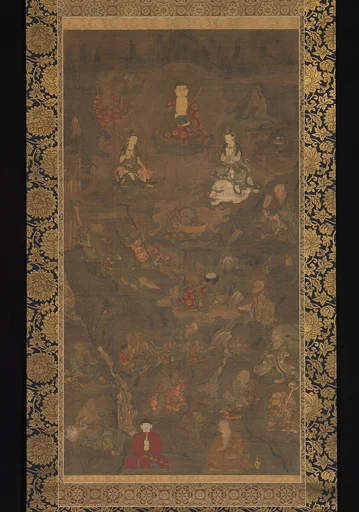
星曼荼羅図 (Hoshi mandara zu)|Star Mandala
Unknown
13th–14th century · Hanging scroll; ink, color, gold, and cut gold on silk · Asian Art
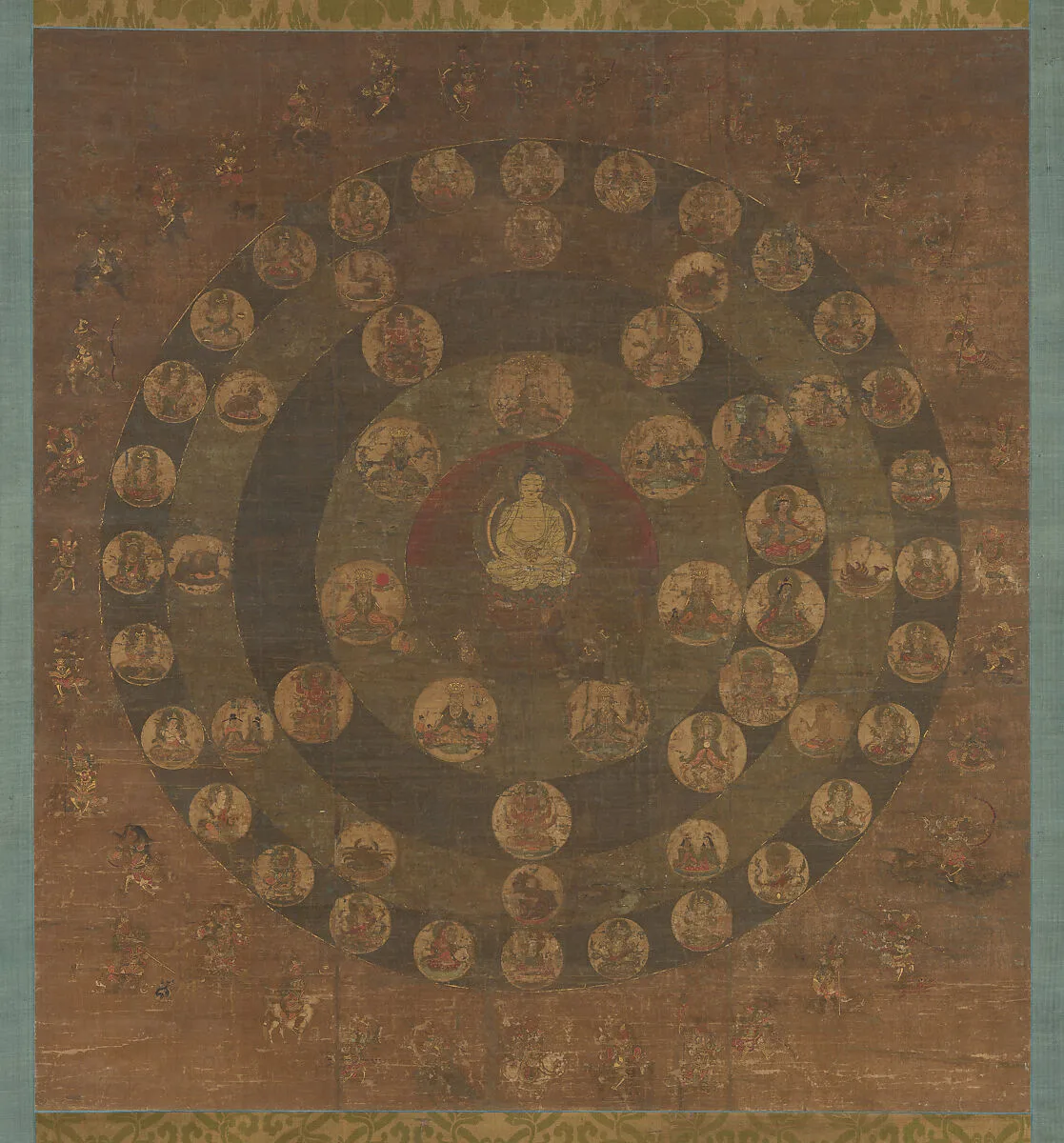
An understanding of the impact of celestial bodies on human activity was crucial to early East Asian Esoteric Buddhism; by the tenth century, complex star mandalas unique to Japan were being devised and used in rites for the prevention of natural calamities and epidemics as well as for the prolonging of life. Five concentric circles and an external ring of figures form this star mandala. The Buddha Shakyamuni of the Golden Wheel occupies the central circle, while the disks in the second circle represent the Big Dipper. The third and fourth circles contain the Nine Luminaries (including Jupiter, Mars, Saturn, Venus, Mercury, the sun, and the moon) as well as the lunar nodes (Ragō and Ketō) and the twelve zodiac symbols. In the fifth circle are the Twenty-Eight Lunar Mansions, the constellations through which the moon travels. Furthermore, the Thirty-Six Calendric Animals are paired with the Thirty-Six Celestial Guardians.
- Artist
- Unknown
- Date
- 13th–14th century
- Medium
- Hanging scroll; ink, color, gold, and cut gold on silk
- Culture
- Japan
- Department
- Asian Art
- Credit line
- Gift of Sue Cassidy Clark, in honor of Bernard Faure, 2020