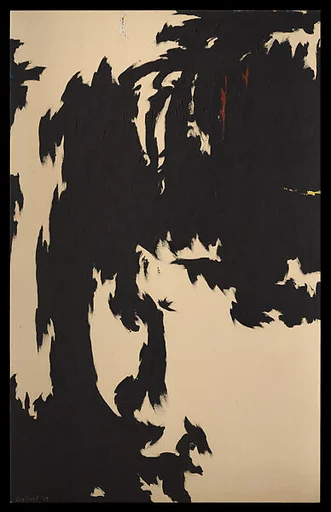
碧鱗|“Bluish-Green Fish Scales”
Kano Tan'yū
mid-17th century · Hanging scroll; ink on paper · Asian Art
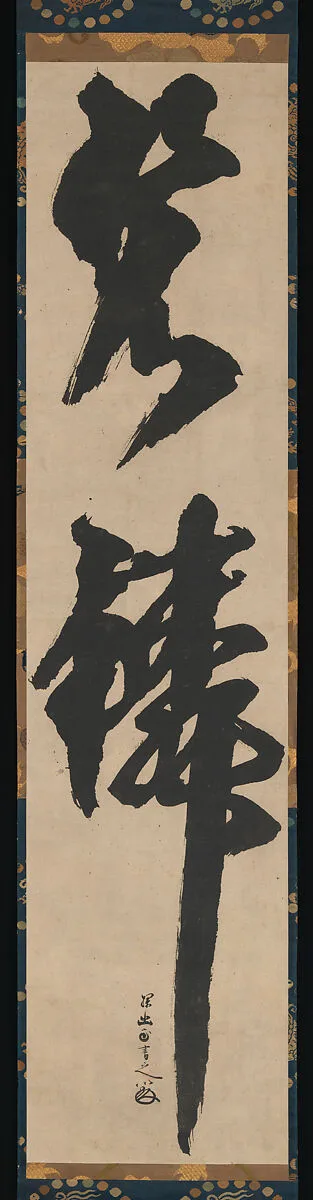
Tan’yū is best known as the heir to the mantle of the Kano school of painters in the early seventeenth to mid-seventeenth century, so it comes as a surprise to see a boldly inscribed pair of oversize Chinese characters signed with his art name. Yet several works by the famous artist survive written in the so-called Daishi-ryū style of calligraphy, named after the monk Kōbō Daishi, the founder of Shingon sect of Buddhism in Japan. Kōbō Daishi is said to have sometimes practiced a highly exuberant and expressive form of calligraphy, which became immensely popular among Zen monks and literati in the Edo period. Here the two characters read “Hekirin,” literally, the “bluish-green scales” of a fish such as bonito tuna. In this case, however, it may be drawn from a verse of the Song poet Su Shi who wrote a poem (Huái shàng zǎo fā淮上早發) likening the rippling of waves on West Lake to luminescent bluish-green fish scales.
- Artist
- Kano Tan'yū
- Date
- mid-17th century
- Medium
- Hanging scroll; ink on paper
- Culture
- Japan
- Department
- Asian Art
- Credit line
- Gift of Florence and Herbert Irving, 2015