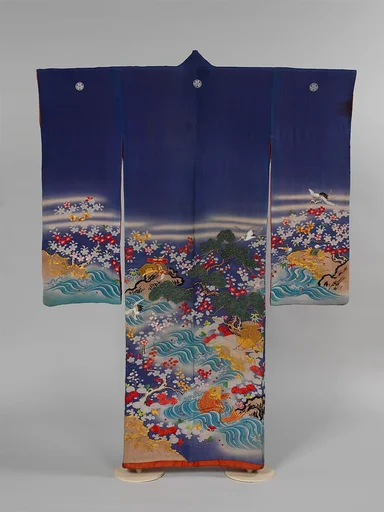
白地日露戦争講和図長襦袢|Man’s Under-Kimono (Nagajuban) with Scene of the Russo-Japanese War featuring General Nogi
Unknown
early 20th century · Resist-dyed, hand-painted plain-weave silk with traces of gold leaf · Asian Art
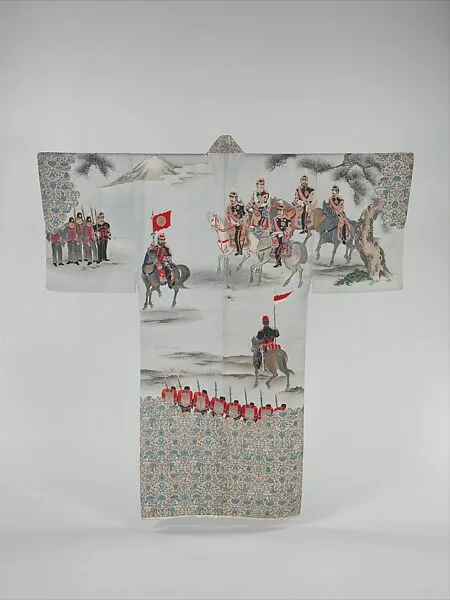
A nagajuban is an informal robe often decorated with eye-catching designs. This piece may be a one-of-a-kind commemorative garment related to Japan’s victory in the Russo-Japanese War of 1904–5. The scene refers to the lengthy Japanese siege of Port Arthur, an engagement lasting from August 1, 1904 to January 2, 1905, when the Russian general, Anatoly Stessel, surrendered to General Nogi Maresuke. After the war, General Nogi was celebrated as a national hero. Some scholars see such commemorative clothing as precursors of the more overtly propagandistic Japanese garments of the 1930s and World War II years.
- Artist
- Unknown
- Date
- early 20th century
- Medium
- Resist-dyed, hand-painted plain-weave silk with traces of gold leaf
- Culture
- Japan
- Department
- Asian Art
- Credit line
- Gift of Harumi Takanashi and Akemi Ota, in memory of their mother, Yoshiko Hiroumi Shima, 2007