伝近衛信尋書・伝長谷川宗也絵 葛下絵色紙貼付 『和漢朗詠集』 屏風|Anthology of Japanese and Chinese Poems (Wakan rōeishū) with Underpainting of Arrowroot Vines
Konoe Nobuhiro|Hasegawa Sōya
early 17th century · Six-panel folding screen; ink and color on gilt paper · Asian Art
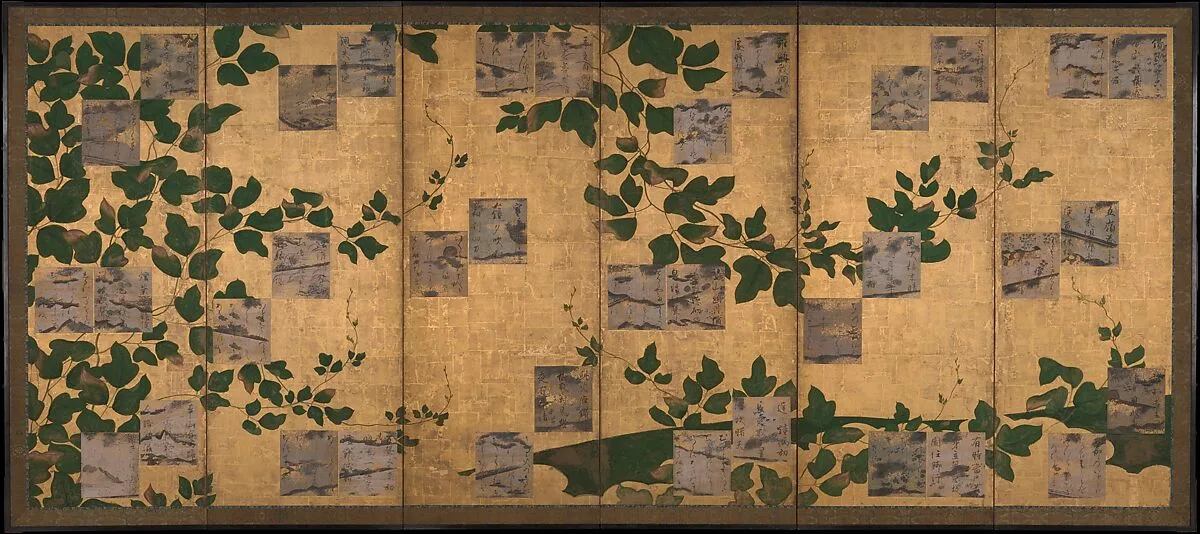
Thirty-six poem cards; ink, color, gold, and silver on paper Swaying arrowroot vines (kuzu) in autumnal decline serve as the background for an array of Japanese and Chinese poems inscribed on poem cards (shikishi). In East Asia the arts of poetry, calligraphy, and painting are considered the “three perfections,” and since the ninth century, the Japanese have decorated screens with paintings and poems inscribed in fine calligraphy. Three pairs of shikishi are pasted on each panel: each pair is inscribed with a couplet from a Chinese poem at the right and a waka (a thirty-one-syllable Japanese-style poem) at the left. The poems share common themes such as the four seasons, bamboo, pines, or clouds. The idiosyncratic style of calligraphy, with hooks at the ends of strokes and the tall, elongated profile of the characters, is attributable to the nobleman-calligrapher Konoe Nobuhiro (1599–1649).
- Artist
- Konoe Nobuhiro|Hasegawa Sōya
- Date
- early 17th century
- Medium
- Six-panel folding screen; ink and color on gilt paper
- Culture
- Japan
- Department
- Asian Art
- Credit line
- Purchase, several members of The Chairman's Council Gifts, 2001