Apple Blossoms
Charles Caryl Coleman
1889 · Oil on canvas · The American Wing
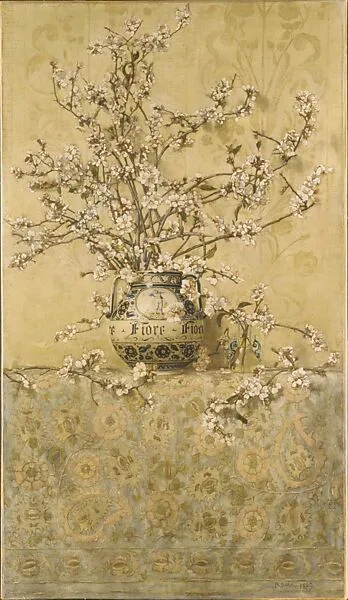
While living in Italy, expatriate Coleman devised a type of large-scale still-life painting that is synonymous with his name. Of the six known examples, "Apple Blossoms" is the most subtle and demonstrates the spirit of the international Aesthetic Movement, in which Coleman participated. Artists involved in the Aesthetic Movement aimed to create harmonious ensembles based on inventive borrowing and recombination of elements from many traditions. Thus in "Apple Blossoms" Coleman arranged a Near Eastern-style textile and Renaissance-inspired ceramic and glass vases in very shallow relief against a damask background in a composition that suggests his appreciation of Japanese paintings. The flowers, the tactile petals of which recall Coleman's study under Thomas Couture, engage in a delightful visual dialogue with their stylized counterparts ornamenting the man-made forms. The objects and textiles portrayed were probably part of Coleman's large collection (some of which he sold to Henry G. Marquand, who purchased them on behalf of the Metropolitan in the early 1890s). Thus both "Apple Blossoms" and its creator reflect the keen enthusiasm for collecting that was at the heart of the founding and early history of the Museum.
- Artist
- Charles Caryl Coleman
- Date
- 1889
- Medium
- Oil on canvas
- Culture
- American
- Department
- The American Wing
- Credit line
- Barbara and John Robinson Fund and Marguerite and Frank A. Cosgrove Jr. Fund, 1996