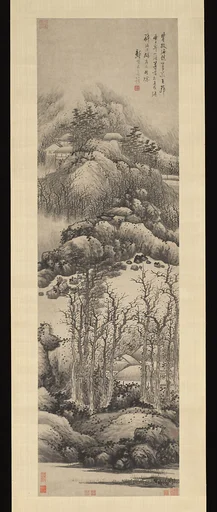
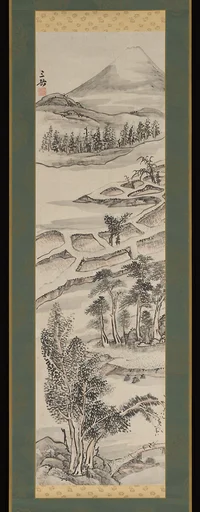
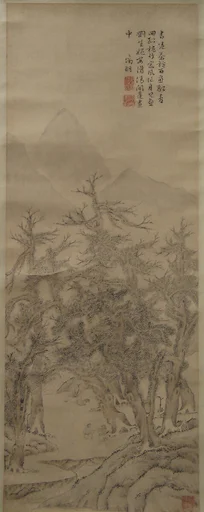
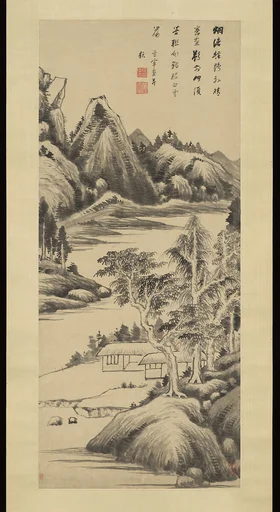
清 祁豸佳 倣倪瓚冬林亭子圖 軸|Pavilion amongst Wintry Trees after Ni Zan
Qi Zhijia
dated 1661 · Hanging scroll; ink on paper · Asian Art
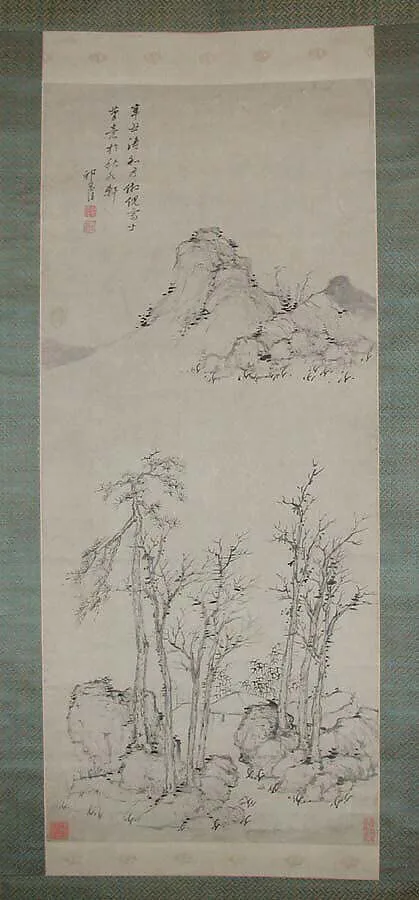
Qi Zhijia, whom a contemporary described as being "addicted to calligraphy, painting, kickball, cymbal music, and opera," was a native of Shanyin, Zhejiang Province. He served briefly as an official under the Ming dynasty, but retired after the Manchu conquest of 1644, adopting the lifestyle of a scholar-recluse. Renown as a poet and calligrapher, he also excelled in landscape painting in the styles of the tenthcentury masters Dong Yuan and Juran. In this painting Qi has adopted the spare landscape idiom of the scholar-artist Ni Zan (1306–1374). Typified by an isolated grove of trees or empty pavilion set within an austere river landscape, Ni's images have long been understood as emblematic of the displacement and isolation experienced by many members of the educated elite during the disintegration of the Mongol Yuan dynasty. After the fall of the Ming, many loyalists consciously evoked Ni's pictorial imagery as a way of expressing their response to dynastic collapse.
- Artist
- Qi Zhijia
- Date
- dated 1661
- Medium
- Hanging scroll; ink on paper
- Culture
- China
- Department
- Asian Art
- Credit line
- Gift of Marie-Hélène and Guy A. Weill, 2000