中村大三郎筆 「つゝみ」|Tsuzumi (Hand Drum) つゝみ
Nakamura Daizaburō 中村大三郎
early 1920s · Hanging scroll; ink and color on silk · Asian Art
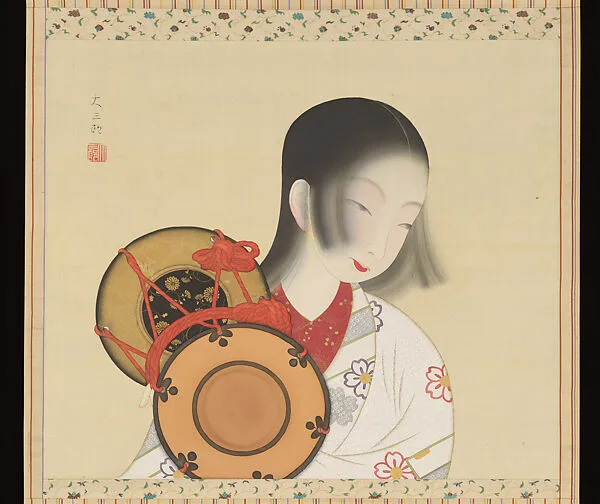
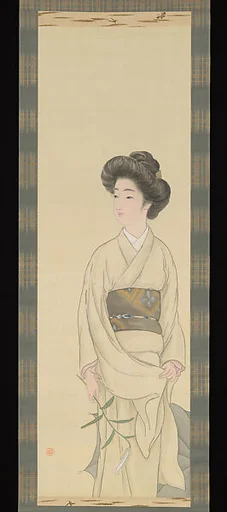
The artist titled this work Tsuzumi (Hand Drum)—inscribed in kana calligraphy on the storage box. In doing so, he followed a convention established by Japanese modern artists of titling a work after a distinctive object in a painting rather than by referring to its human subject—in this case, a young apprentice geisha (maiko). The small tsuzumi (or kotsuzumi) she has placed on her right shoulder consists of a lacquered wooden body shaped like an hourglass and features two drumheads with cords that can be squeezed or released to allow the player to raise or lower the pitch while playing (see an example on display in the Musical Instruments Galleries, 1986.117). Such hand drums are used in Noh, dance music (nagauta), off-stage Kabuki theater music (geza), and in traditional folk music performed by maiko and geisha. Nakamura Daizaburō, oldest son of a kimono dyer, established his fame in the early 1920s, creating numerous paintings of idealized young women. His training in the family textile dyeing business allowed his works to accurately capture the latest fashions of the day. Later in the 1920s he would expand his repertory to create larger format genre scenes, including masterworks such as At the Piano that was well received in the government sponsored Teiten exhibition of 1926, Kyoto City Kyocera Museum of Art) and Woman (Fujo) of 1930, showing its subject reclining on a Western-style chaise lounge, Honolulu Museum of Art). Such works demonstrate how Daizaburō started to depict more modern or Westernized beauties. In his later years, he also created a number of works based on traditional Japanese literature.
- Artist
- Nakamura Daizaburō 中村大三郎
- Date
- early 1920s
- Medium
- Hanging scroll; ink and color on silk
- Culture
- Japan
- Department
- Asian Art
- Credit line
- Purchase, Sachiko and Lawrence Goodman Gift, 2023