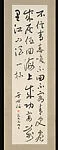
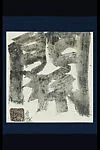
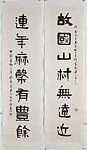
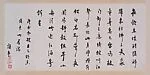
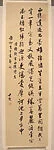
清水比庵書 良寛詩|Chinese Poem by Ryōkan
Shimizu Hian 清水比庵
1966 · Hanging scroll; ink on paper · Asian Art
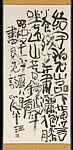
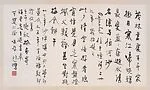
Purposely and radically departing from traditional Chinese orthodox calligraphic styles and inspired by the idiosyncratic brushwork of the renowned Zen monk-poet-calligrapher Ryōkan Taigu (1758–1831), a quatrain of Chinese verse in four five-syllable lines was brushed with thick, coarse brushstrokes that are crowded together, giving the impression of a chaotic and unbalanced composition. The effect is at once disconcerting and compelling. Though many of the characters are distorted, the poem is a known one by Ryōkan, and can be transcribed and translated as follows: 結宇碧嵓下 薄言養残生 蕭灑抱膝坐 遠山暮鐘声 Japanese pronunciation: 宇(庵)を結ぶ碧嵓(へきがん)の下(もと) 薄(いささか)言(ここ)に残生を養う 蕭灑(しょうしゃ)、膝を抱いて座す 遠山、暮鐘の声 Building a hut beneath the Blue Cliff, Hastily, I choose to spend the rest of my life here. Unencumbered, I sit and hold my knees, Listening to the bell at dusk from the distant mountain. (Translated by Tim Zhang) Ryōkan earned esteem as one of the great eccentrics of Japanese calligraphy. His verse reflects his advocacy for living a reclusive life and practicing Zen. The reference to “Blue Cliff” alludes to the Blue Cliff Record (碧巌録 Hekigan roku in Japanese; Biyan lu in Chinese), a Song dynasty collection of kōan that became a foundational text of Zen Buddhist practice in Japan. The calligrapher Shimizu Hian was a noted poet, painter, and calligrapher in his own right, known for his own variety of idiosyncratic literary and calligraphic output. He was indeed often referred to as the “contemporary Ryōkan.” Hian’s brushwork serves as a tribute to Ryōkan's poetic and spiritual legacy.
- Artist
- Shimizu Hian 清水比庵
- Date
- 1966
- Medium
- Hanging scroll; ink on paper
- Culture
- Japan
- Department
- Asian Art
- Credit line
- Mary and Cheney Cowles Collection, Gift of Mary and Cheney Cowles, 2022