比翼塚 (Hiyokuzuka)|Lovers’ Double Grave
Kobayakawa Shūsei 小早川秋聲
1920s · Hanging scroll; ink on paper · Asian Art
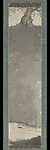
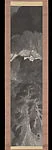
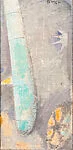
This unexpected early work by Kobayakawa Shūsei, painted entirely in monochrome ink, shows a lone duck swimming along the bank of a pond or river, the grassy, moonlit embankment of which occupies most of the composition and is painted with overlapping ink washes and small crescent-shaped brushstrokes in two tones of ink. At the very top of the embankment, in the shadows of an old tree, can be seen the silhouette of a five-story stone pagoda, marking the grave hinted at in the artist’s title, Hiyokuzuka, or literally, “Paired Wings Tomb,” a figurative description for a gravesite shared by lovers. Kobayakawa is better known as a painter of wartime scenes, which he created during the early years of the Pacific War while traveling with the Japanese Army on campaigns in China and Southeast Asia. His works during this period are associated with the modern traditionalist mode known as Nihonga, which use media and formats familiar to traditional Japanese painting.
- Artist
- Kobayakawa Shūsei 小早川秋聲
- Date
- 1920s
- Medium
- Hanging scroll; ink on paper
- Culture
- Japan
- Department
- Asian Art
- Credit line
- Mary and Cheney Cowles Collection, Gift of Mary and Cheney Cowles, 2021