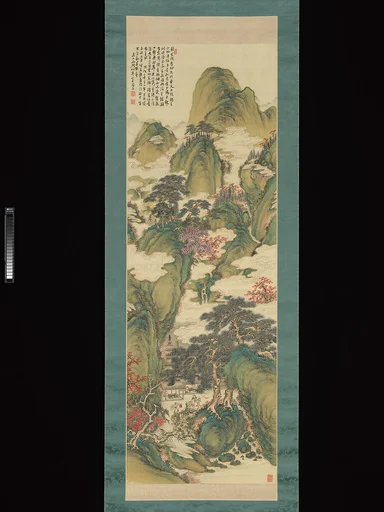
桃源境図 (Tōgenkyō zu)|Peach Blossom Spring Utopia
Tomita Yoshiko 冨田芳子|Tomita Keisen 冨田溪仙
early 20th century · Hanging scroll; ink and color on silk · Asian Art
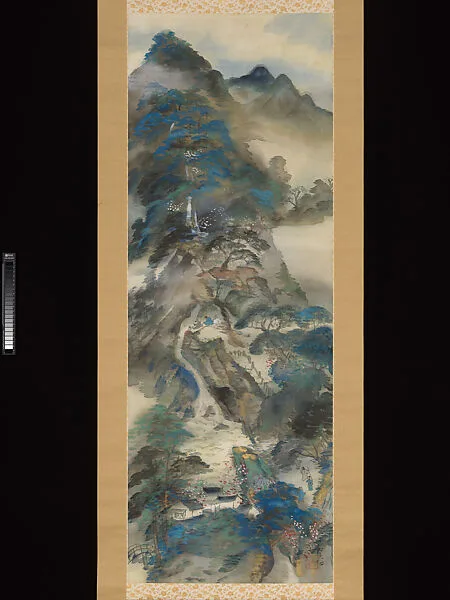
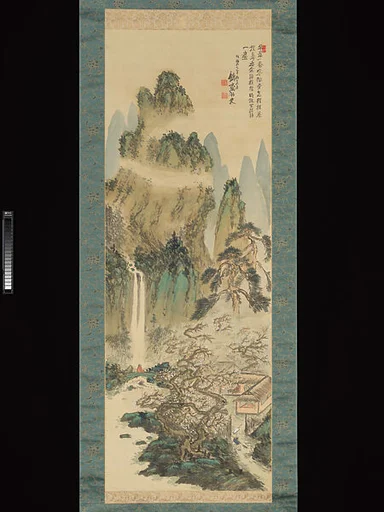
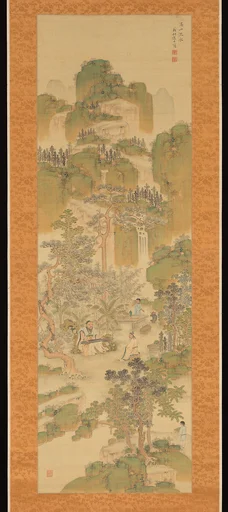
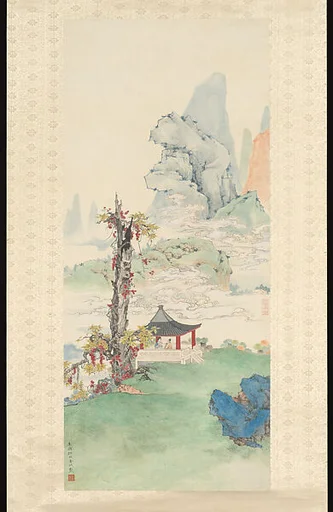
We enter this otherworldly landscape of steep mountain peaks garlanded by green and blue foliage in the lower left corner, where a bridge gives us access to a remote village. A person peers out from an open window to inspect the new visitor. Other figures roam the mountain paths, dotted with the delicate pink blossoms of peach trees. On a high cliff, a trio of men relax and read. Throughout, the artist employs an age-old pictorial vocabulary to suggest the paradisiacal nature of the locale, the legendary Peach Blossom Spring of ancient Chinese lore. This utopian setting was first imagined by the great fifth-century poet Tao Qian (also TaoYuanming; 365–427), who wrote in his famous prose-poem of the same title of a fisherman who stumbles across and spends time in an idyllic community whose residents urge him not to report back to anyone on his time there. He ignores their plea and marks his path home so he can find his way back, but, in the end, he is never able to return to the Peach Blossom Spring. Born Tomita Shigegorō in Hakata on the western Japanese island of Kyūshu, Keisen began studying painting as a child with Kinugasa Tankoku, a former painter-in-attendance to leaders of the local Fukuoka Domain, in what is today Fukuoka Prefecture. Kinugasa taught Tomita painting methods associated with the Kano school of painters, which by the late nineteenth century had dominated mainstream Japanese painting for four centuries, before sending him off to Kyoto, where he studied with Tsuji Kakō, one of the leading figures of the modern Shijō school. He also became enamored with literati painting modes and in particular admired the work of one of the movement’s leading figures, Tomioka Tessai.
- Artist
- Tomita Yoshiko 冨田芳子|Tomita Keisen 冨田溪仙
- Date
- early 20th century
- Medium
- Hanging scroll; ink and color on silk
- Culture
- Japan
- Department
- Asian Art
- Credit line
- Mary and Cheney Cowles Collection, Gift of Mary and Cheney Cowles, 2021