埴輪図 (Haniwa zu)|Haniwa
Tsuji Kakō 都路華香
ca. 1920 · Hanging scroll; ink and color on paper · Asian Art
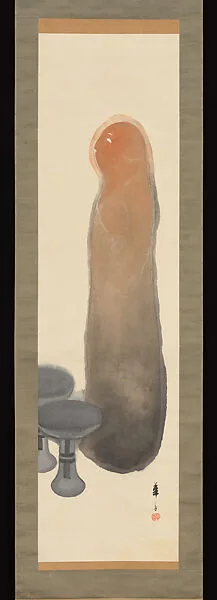
Haniwa are low-fired earthenware figures associated with Japan’s prehistoric Kofun period (ca. 300–710). They were made to line the perimeter of the keyhole shaped tombs, kofun, from which the historical period takes its name. Although some took simple cylindrical forms, many represented humans, animals, buildings, and tools. Haniwa are immensely popular today in Japan, where they are regularly displayed at museums and recreated in animation or even as plush dolls. In this work by the immensely versatile modern painter Tsuji Kakō, a tall haniwa, rendered in overlapping washes of ink and cinnabar, is accompanied by two additional tomb objects, namely two stoneware stands. Such objects, which are characteristically gray and fired at a higher temperature that haniwa, were earlier made in the Korean peninsula and the technology transmitted to Japan. Although haniwa have rarely become the subject of Japanese paintings, Tsuji created multiple works depicting these recognizable prehistoric figures, including an award-winning pair of screens painted in 1917 and now owned by the National Museum of Modern Art, Kyoto.
- Artist
- Tsuji Kakō 都路華香
- Date
- ca. 1920
- Medium
- Hanging scroll; ink and color on paper
- Culture
- Japan
- Department
- Asian Art
- Credit line
- Mary and Cheney Cowles Collection, Gift of Mary and Cheney Cowles, 2021