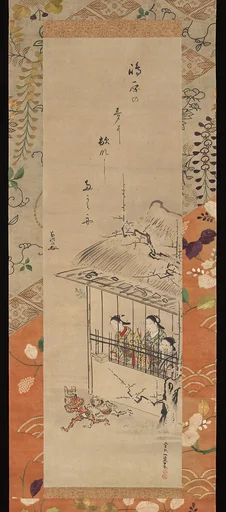
萬歳楽圖 (Manzairaku zu)|Manzai Performers
Tomioka Tessai 富岡鉄斎|Ōtagaki Rengetsu 太田垣蓮月
1869 · Hanging scroll; ink and light color on paper · Asian Art
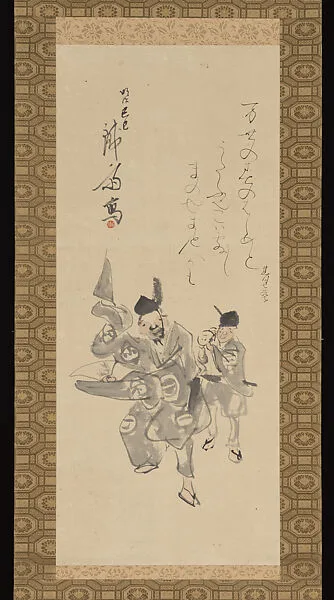
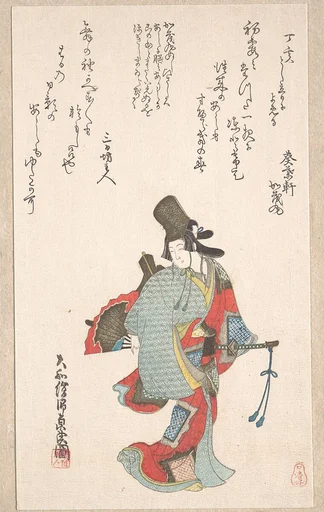
A pair of ebullient Manzai performers in courtier robes and caps help ring in the New Year. The lead figure carries an offering tray while the second performer accompanies their dance with a hand drum. This type of performance can be traced back to ancient times in Japan when the two Manzai (literally “ten thousand years!”) performers pretend to serve as oracles from the Shinto gods. But their ostensibly divine message is communicated through a kind of humorous standup comedy routine, with one performer offering some sort of argument or challenge to whatever the other says. The performance of these joyful dances, especially at the New Year, continued into Meiji times. Tessai’s spontaneous rendering in ink and washes, with a touch of light color, captures the vitality of the performance. The famous poet-calligrapher Nun Rengetsu, who early on supported Tessai’s career as an artist, has added one of her poems, transcribed in her distinctive delicate kana script, with an admixture of kanji rendered so cursively that they blend in harmoniously. Her poem uses two ancient poetic terms: Yamatobito (people of the Yamato, an ancient name for Japan) and Shikishima, literally the string of islands, an old name for Japan. It can be deciphered and translated as follows: 万世の春のはしめとうたふ也 こは敷しまのやまと人かも Bansei no haru no hajime to utau nari kowa Shikishima no Yamatobito kamo From time immemorial they have heralded the beginning of spring — these true Japanese souls of the islands of Shikishima. Trans. by John T. Carpenter
- Artist
- Tomioka Tessai 富岡鉄斎|Ōtagaki Rengetsu 太田垣蓮月
- Date
- 1869
- Medium
- Hanging scroll; ink and light color on paper
- Culture
- Japan
- Department
- Asian Art
- Credit line
- Mary and Cheney Cowles Collection, Gift of Mary and Cheney Cowles, 2021