Untitled
Unidentified artist|G. C. Dass
ca. 1880–85 (recto); ca. 1875–85 (verso) · Recto: lithograph, printed in black and hand-colored in red, crimson, and yellow watercolor, selectively applied glaze. Verso: lithograph, printed in black · Asian Art
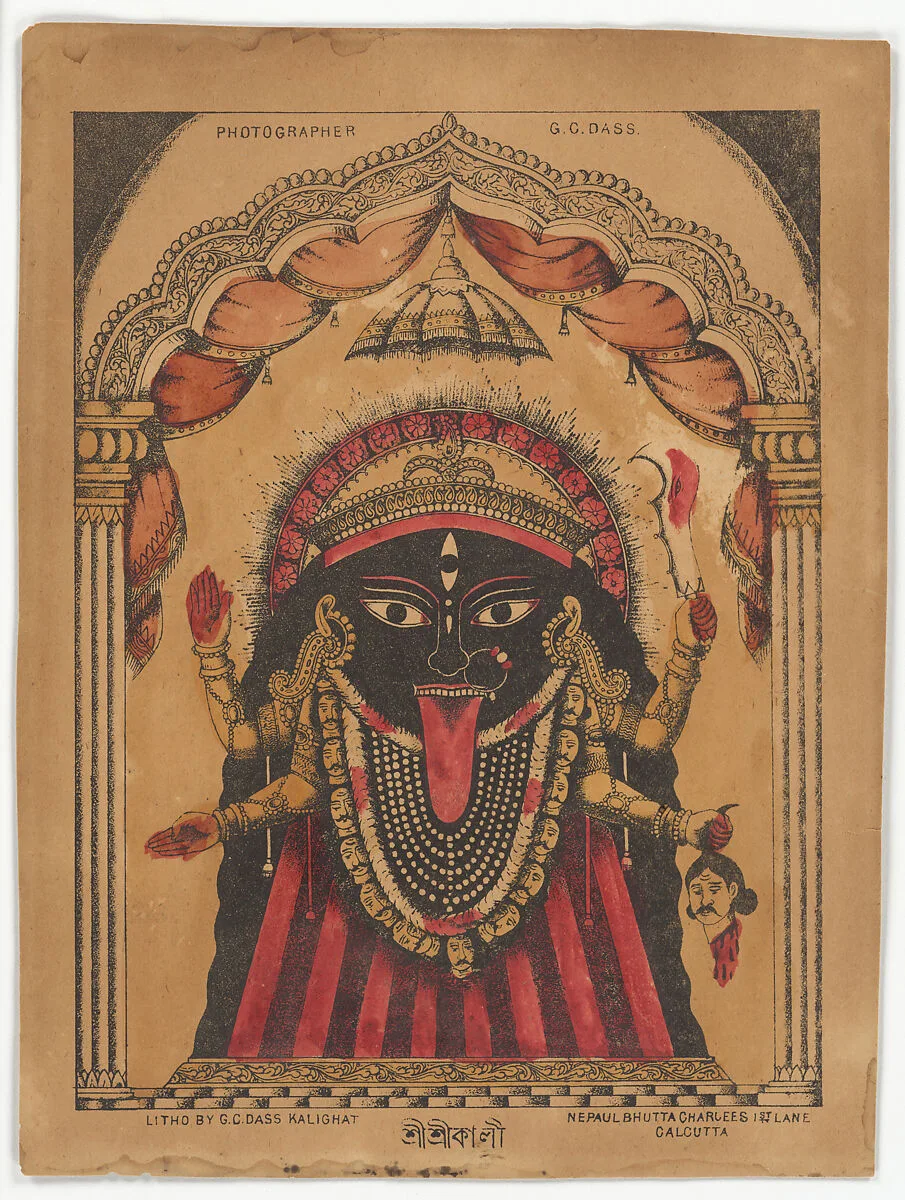
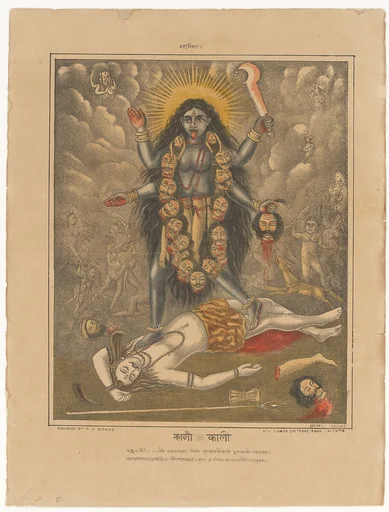
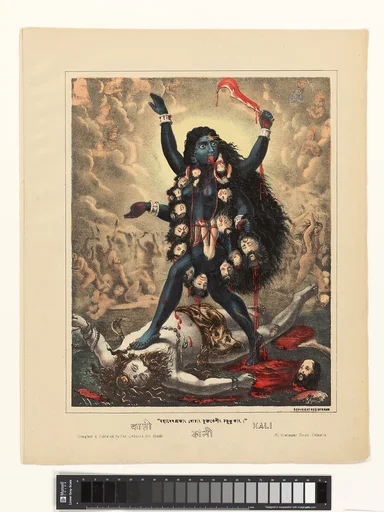
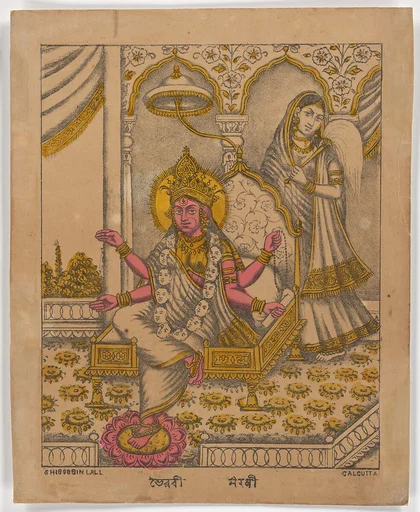
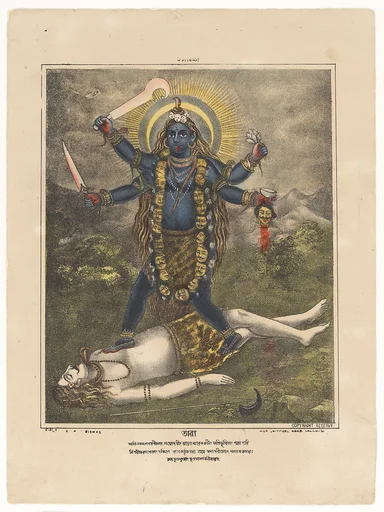
The goddess Kali (the “Black One”), the destroyer of time itself and the embodiment of supreme power, lies at the heart of Bengal Hindu devotionalism. When the printing workshops of Calcutta began producing multiple images of the Hindu gods to be sold to pilgrims, Kali was amongst the first. In this small but powerful image, Kali appears doll-like, with a large head, forehead third eye, wide glaring eyes and a long red lolling tongue. Four arms project from her upper body, those on her left wield the sacrificial chopper (marked with the all-seeing eye) and severed male head. This head, and a garland of severed heads that she wears along with garlands of white jasmine, all have the twin horizonal forehead mark (tilaka) of Shaiva devotees. On the verso is another, incomplete, image, indicating that the lithograph was printed on the recycled paper of another lithographed image of Kali. This is the only known version of this highly realistic rendering of Kali, making this double-sided image of singular importance in the early history of Kali print-making.
- Artist
- Unidentified artist|G. C. Dass
- Date
- ca. 1880–85 (recto); ca. 1875–85 (verso)
- Medium
- Recto: lithograph, printed in black and hand-colored in red, crimson, and yellow watercolor, selectively applied glaze. Verso: lithograph, printed in black
- Culture
- West Bengal, Calcutta
- Department
- Asian Art
- Credit line
- Gift of Mark Baron and Elise Boisanté, 2021