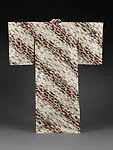
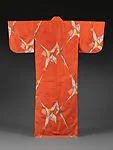
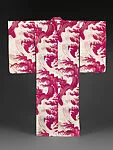
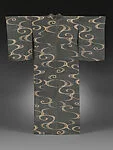
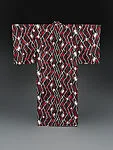
紺青市松格子地巴模様御召銘仙単衣|Meisen Summer Kimono with Comma (Tomoe) Patterns
Unknown
ca. 1930s · Plain-weave machine-spun silk warps with twisted silk and rayon wefts in double ikat (heiyō-gasuri) · Asian Art

This kimono exemplifies the heiyō-gasuri technique, in which stencil-printed warp and weft threads are woven into complex double-ikat patterns with curves and flowing lines. It was made in Isesaki, one of the meisen production centers where this technique was developed and refined. The pattern on this summer garment is a modern rendering of a traditional comma (tomoe) pattern that was associated with samurai culture and widely used in crests in the Edo period (1615–1868). Here, large commas boldly punctuate a background of rectangles. The fabric, which was promoted as Chiyoda omeshi, has a slightly ribbed texture similar to crepe, the result of strongly twisted silk and rayon wefts. The use of inexpensive rayon was common in Isesaki in the 1930s, when the demand for meisen was at its peak.
- Artist
- Unknown
- Date
- ca. 1930s
- Medium
- Plain-weave machine-spun silk warps with twisted silk and rayon wefts in double ikat (heiyō-gasuri)
- Culture
- Japan
- Department
- Asian Art
- Credit line
- Gift of John C. Weber, 2023